
About
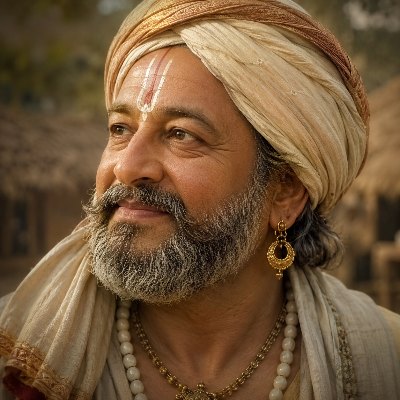
Nanda Baba — Chieftain of Gokula, Foster-Father of Krishna
Nanda · Nanda Baba · Nanda Maharaja · Mandaladhish Nanda Rai
Nanda, commonly called Nanda Baba or Nanda Maharaja, was the chief of the cowherd settlement of Gokula, later relocated to Vrindavana, within the pastoral branch of the Yadava clan. He was the son of Parjanya and Variyasi, and husband of Yashoda. He is revered as the foster-father of Krishna, into whose household the infant Krishna was secretly placed by his biological father Vasudeva to protect him from King Kamsa of Mathura. Nanda's home forms the setting for the celebrated childhood narratives of Krishna and Balarama recounted principally in the Bhagavata Purana and the Harivamsha.
✦ The Name
Nanda derives from the Sanskrit root "nand," meaning to rejoice or delight. Parjanya named all five of his sons from this same root — Upananda, Abhinanda, Nanda, Sannanda, and Nandana — so that Nanda's name reflects both his father's naming pattern and the joy later associated with his household through Krishna's presence.
✦ Lineage
- Father: Parjanya, Yadava cowherd chieftain, son of Devamidha of Mathura.
- Mother: Variyasi.
- Siblings: Upananda (eldest, initial holder of the chieftainship before transferring it to Nanda), Abhinanda, Sannanda, and Nandana.
- Spouse: Yashoda.
- Children: Krishna and Balarama, raised as foster-sons; a daughter born to Yashoda around the time of Krishna's birth, identified in the Bhagavata Purana with the goddess Yogamaya.
✦ Previous Birth
The Bhagavata Purana relates that Nanda, in a former existence, was Drona, one of the eight celestial Vasus. Together with his wife Dhara, he performed prolonged penance directed toward Brahma. When Brahma offered them a boon, the couple asked not for heavenly reward but for the opportunity to experience the parental love of holding, feeding, and raising the Supreme Lord as their own child when he descended to earth. Brahma granted the request, and in consequence Drona was born as Nanda in the cowherd settlement of Vraja, with Dhara born as Yashoda, so that Krishna could be raised in their household as foretold.
✦ Succession to the Chieftainship
On Parjanya's passing of leadership to his eldest son Upananda, Upananda in his first act as chief crowned Nanda in his stead, deferring to his younger brother's recognized greatness and calling himself merely "a little Nanda." This act, accepted by the whole community, made Nanda head of the cowherd settlement.
✦ The Exchange of Infants
On the night of Krishna's birth in the Mathura prison, Vasudeva carried the newborn across the river Yamuna to Nanda's house in Gokula and exchanged him for the daughter just born to Yashoda, then returned to the prison with the girl before the guards awoke. When Kamsa attempted to kill this substituted infant, believing her to be the child prophesied to cause his death, she rose into the sky in the form of a goddess and warned him that his true destroyer was already safe elsewhere.
✦ Life in Gokula and Vrindavana
As chief, Nanda presided over the community's later relocation from Gokula to Vrindavana, undertaken on the advice of the cowherds after repeated attacks on the settlement by demons sent by Kamsa, including Putana and Trinavarta. Nanda oversaw Krishna and Balarama's upbringing there, and later led the Vrajavasis to Mathura to pay tribute to Kamsa, during which visit the grown Krishna and Balarama killed the tyrant king.
✦ Theological Significance
In Vaishnava tradition, particularly Gaudiya Vaishnavism, Nanda is regarded as an eternal companion of Krishna in his transcendent pastoral realm of Vraja, embodying parental devotion (vatsalya-bhava) as the archetype of the doting earthly father, complementing rather than competing with Vasudeva's role as Krishna's biological father.
✦ Connection to the Wider Genealogy
Nanda's father Parjanya was the half-brother of Shurasena, father of Vasudeva, making Nanda first cousin to Vasudeva. Krishna's foster-father was thus also his biological father's first cousin, placing the cowherd settlement of Gokula and Vrindavana as a collateral branch of the same Yadava house, descended from Devamidha, that produced the ruling line of Mathura.
✦ References
- Bhagavata Purana (Canto 10): the principal narrative source for Nanda's role as foster-father, the infant exchange, the move to Vrindavana, and the death of Kamsa.
- Harivamsha: parallel account of the Gokula settlement and the Yadava genealogy connecting Nanda to Devamidha's line.
- Wikipedia, "Nanda Baba": secondary summary of Nanda's titles and genealogical relationships.
- The Harmonist, "The Glory of Krishna's Birth": secondary Gaudiya Vaishnava commentarial account of the succession from Parjanya through Upananda to Nanda.