
About
Sharabhanga — Sage Who Awaited Rama Before Ascending to Brahmaloka
Sharabhanga · Sarabhanga
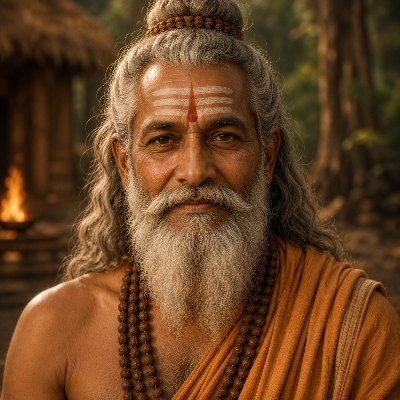
Sharabhanga was a sage of great ascetic accomplishment who dwelt in a hermitage in the Dandaka forest, visited by Rama, Sita, and Lakshmana during their forest exile in the Aranya Kanda of the Valmiki Ramayana. Having earned passage to Brahmaloka through his penances, Sharabhanga postponed his ascent, refusing Indra's invitation to depart until he had beheld Rama with his own mortal eyes. After Rama's arrival, Sharabhanga entered a sacrificial fire he had prepared and ascended in a youthful, transfigured form to the abode of Brahma. His episode is recounted solely within the Ramayana and forms one of the sequence of hermitage visits marking Rama's passage through the Dandaka forest.
✦ Lineage
No parentage is recorded for Sharabhanga in the Valmiki Ramayana or in any other primary source consulted for this profile; he appears in the narrative solely as an established forest ascetic, with no father, mother, or family origin named. Within this genealogical reference work, in the absence of any recorded parentage, Sharabhanga is placed as a descendant within the lineage of the sage Gautama rather than as his biological son, reflecting an inferred rather than textually attested line of descent.
✦ The Advice of the Dying Viradha
Rama, Sita, and Lakshmana were directed to Sharabhanga's hermitage by the demon Viradha, whom Rama had slain in the forest shortly before. As he lay dying, Viradha counselled Rama that the Dandaka forest was perilous and unfamiliar territory, and advised him to seek out the sage Sharabhanga without delay. Following this counsel, Rama turned his party's steps toward Sharabhanga's hermitage.
✦ Indra's Visit and Sharabhanga's Refusal
As Rama approached the hermitage, he beheld a marvel in the sky: Indra, radiant and richly attired, mounted on a splendid chariot drawn by green horses, attended by gandharvas, siddhas, and a host of great sages, all extolling him. Indra had come in person to conduct Sharabhanga to Brahmaloka, the celestial region the sage had earned through the merit of his penances and which was inaccessible to those lacking full mastery of themselves. Sharabhanga, however, declined to depart with Indra, explaining, once Rama arrived and questioned him about the vision, that he had refused because he wished first to behold Rama in the flesh before ascending. Having now had that meeting, Sharabhanga told Rama he would proceed first to the three lower heavens and only thereafter to the highest.
✦ The Ascent to Brahmaloka
After Indra departed and Sharabhanga had spoken with Rama, indicating the course of his onward journey through the forest, the sage prepared a sacrificial fire and poured clarified butter into it, reciting sacred formulas. He then entered the flames, and, assuming a youthful and transfigured form, ascended bodily to the abode of Brahma, having chosen to relinquish his mortal body through fire rather than depart in ordinary form, since an embodied ascent to the higher heavens was held to be impossible for a mortal frame.
✦ Theological Significance
Sharabhanga's episode is read within the Ramayana as an early affirmation, during Rama's forest exile, of Rama's divine stature: a sage of sufficient merit to be personally escorted to Brahmaloka by Indra nonetheless regards a direct sight of Rama as a higher priority than his own ascent, and Sharabhanga's willing self-immolation to attain his final release is presented as the fitting culmination of a life of accomplished asceticism, achieved only once this final wish had been fulfilled.
✦ References
- Valmiki Ramayana, Aranya Kanda (Sarga 5): the sole primary source for Sharabhanga's episode, narrating Viradha's counsel, Indra's visit, Sharabhanga's refusal, his meeting with Rama, and his ascent through fire to Brahmaloka.
- Wikipedia, "Sharabhanga": secondary summary confirming the episode's placement in the Aranya Kanda and Sharabhanga's wish to see Rama before departing.
- Wisdomlib, translation of Aranya Kanda Chapter 5: secondary translation consulted for the narrative details of Indra's chariot and Sharabhanga's dialogue with Rama.