
About
Shravana Kumara — Devoted Son Slain by Dasharatha
Shravana Kumara · Shravan Kumar · Yagnyadatta
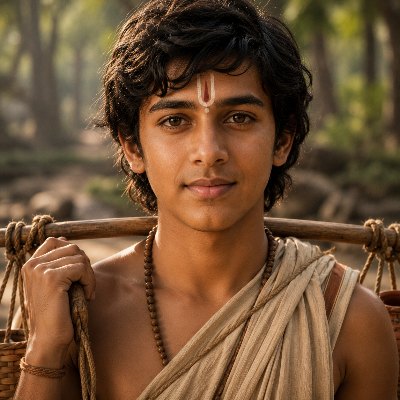
Shravana Kumara was a young hermit renowned for his devotion to his aged, blind parents, whom he was carrying on a pilgrimage to sacred sites when he was accidentally killed by an arrow shot by King Dasharatha of Ayodhya, father of Rama. His death, recounted in the Ayodhya Kanda of the Valmiki Ramayana, and the curse subsequently laid on Dasharatha by Shravana's grieving parents, form a pivotal piece of backstory recalled by Dasharatha himself near the end of his life: the curse, that he too would die grieving the loss of a son, comes to pass when Dasharatha dies of sorrow after being compelled to exile his own son Rama. Shravana Kumara is remembered in Indian tradition as the foremost exemplar of filial devotion (matru-pitru bhakti).
✦ The Name
Shravana is a Sanskrit name associated with hearing, fittingly recalled in a story turning on Dasharatha's fatal reliance on sound alone to guide his arrow. The Agni Purana refers to him by the alternate name Yagnyadatta ("given by sacrifice" or "given in a yajna").
✦ Lineage
- Father: Shantanu, a hermit, blind in his old age.
- Mother: Jnanavanti, also called Malaya, a hermit, likewise blind in her old age.
✦ Care for His Blind Parents
Shravana's parents, hermits both blind in old age, expressed a wish to undertake a pilgrimage (tirtha-yatra) to sacred sites to purify their souls before death. Unable to afford any conveyance for them, Shravana devised a means of carrying both parents himself: he placed each of them in a basket, slung the baskets from the two ends of a bamboo pole, and bore the pole across his shoulders throughout the journey, tending to their every need along the way.
✦ The Fatal Arrow
While the family were resting near Ayodhya, on the banks of the river, Shravana went at night to fetch water for his thirsty parents. King Dasharatha, out hunting nearby and skilled in shabda-bhedi, the technique of shooting by sound alone, heard the sound of water being disturbed and, believing it to be an animal come to drink, loosed an arrow toward the sound. The arrow struck Shravana, mortally wounding him. Rushing to the spot, Dasharatha discovered he had killed not a beast but a young man. With his dying breath, Shravana asked the king to carry water to his blind parents waiting nearby and to tell them what had befallen him, then died of his wound.
✦ The Parents' Curse
Dasharatha carried out Shravana's last request, bringing water to the old couple and confessing what he had done. Overcome with grief at the loss of their only son and support, the parents, though acknowledging the death was accidental, pronounced a curse upon Dasharatha: that he too would one day die in the grip of putra-shoka, the sorrow of separation from a son. Unable to bear their grief, Shravana's parents themselves died soon after, without having drunk the water Dasharatha had brought.
✦ Fulfillment of the Curse
Dasharatha recounts this episode from his youth to his wife Kaikeyi in the Ayodhya Kanda, recognizing in it the origin of the sorrow now overtaking him. Bound by his own promise to Kaikeyi to grant her two boons, Dasharatha is compelled to exile his beloved son Rama to the forest for fourteen years and to install Kaikeyi's son Bharata as heir instead. Unable to bear separation from Rama, Dasharatha dies of grief shortly after Rama's departure into exile, fulfilling the curse laid upon him decades earlier by Shravana's parents.
✦ Theological and Moral Significance
Shravana Kumara's story is held up across Indian tradition as the ideal of matru-pitru bhakti, unwavering devotion to one's parents, and his willingness to sacrifice his own comfort for their care is frequently invoked as a moral exemplar, particularly in the context of caring for the elderly. Within the structure of the Ramayana itself, the episode functions as a carefully placed ethical foreshadowing: an act of unintentional violence in youth returns, years later, as the mechanism by which fate compels Dasharatha's own tragic end, binding the themes of filial devotion, parental grief, and dharmic consequence tightly together.
✦ References
- Valmiki Ramayana, Ayodhya Kanda (chapters 63–64): primary source for Dasharatha's own recounting of Shravana's death and the parents' curse.
- Agni Purana (chapters 6, 37–38): primary source giving the alternate name Yagnyadatta for Shravana.
- Wikipedia, "Shravana Kumara": secondary summary of the parents' names, the pilgrimage, and the site traditions associated with the episode.
- DharmaRenaissance Blog, "Shravana Kumara in the Ramayana": secondary devotional and thematic account of the episode's placement within the Ayodhya Kanda.