
About
Sandipani — Guru of Krishna and Balarama
Sandipani · Sandipana
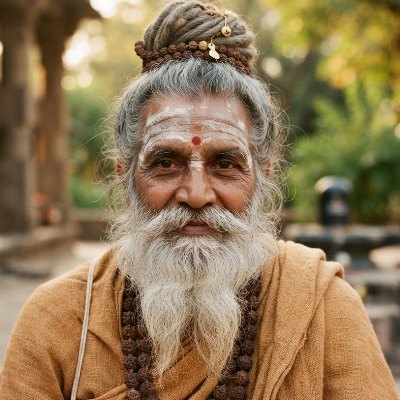
Sandipani was a Brahmin sage who served as the preceptor (guru) of Krishna and Balarama, instructing them at his ashram in Avanti, the ancient city now known as Ujjain, following their sacred thread ceremony after the killing of Kamsa in Mathura. He is remembered for the extraordinary speed with which his two divine pupils, together with their fellow student Sudama, mastered the full range of Vedic learning and the traditional arts, and for the miraculous guru dakshina his students performed on his behalf: the restoration of his deceased or lost son from the realm of Yama, the god of death. His story is recorded in the Bhagavata Purana and, with variation, in the Harivamsha.
✦ Lineage
- Spouse: unnamed in the sources consulted, referenced only as joining Sandipani in seeking the return of their son.
- Son: Punardatta, lost in the ocean at Prabhasa and later restored to life by Krishna and Balarama.
- Students: Krishna and Balarama, sons of Vasudeva and foster-sons of Nanda and Yashoda, sent to his ashram for their education; Sudama, a fellow disciple who studied alongside them.
✦ The Ashram and Course of Study
Sandipani maintained his ashram at Avanti, renowned for his mastery of the Vedas as well as Dhanurveda, the auxiliary Vedic discipline concerned with archery and the art of warfare, alongside instruction in drawing, astronomy, gandharva-veda (music), medicine, and the training of elephants and horses. Krishna and Balarama, together with their companion Sudama, are described as having mastered every lesson given to them after being taught it only once. Later tradition holds that within a span of sixty-four days, the two brothers acquired fourteen traditional sciences (vidyas) and sixty-four arts (kalas), a course of study said to ordinarily require several years to complete.
✦ The Request for Guru Dakshina
Upon completing their studies, Krishna and Balarama pressed their teacher to name any guru dakshina (a preceptor's honorarium) of his choosing. Sandipani, together with his wife, asked for the restoration of their son, who had been lost years earlier while bathing in the ocean at the sacred site of Prabhasa.
✦ The Battle with the Conch Demon
Krishna and Balarama travelled to Prabhasa and learned that the boy had been seized by a being dwelling in the ocean in the form of a conch shell. Krishna plunged into the water, confronted and slew the demon, and took possession of its conch-shaped body, which became his own divine conch, the Panchajanya. The boy, however, was not found within the demon's body.
✦ The Journey to Yamaloka
Realizing that Sandipani's son had in fact died and passed to Yamaloka, the abode of Yama, Krishna and Balarama travelled there and sought the boy's return. Krishna blew his newly won conch and addressed Yama directly, commanding the return of his guru's son, who had been brought to that realm as a consequence of his own karma. Yama, recognizing Krishna's supreme nature, complied, and the boy was restored to life. Krishna and Balarama returned him, along with rare jewels received in Yamaloka and the conch Panchajanya, to Sandipani's ashram.
✦ Textual Variants and Inconsistencies
The Bhagavata Purana names the demon encountered in the ocean Shankhasura ("conch demon"), while the Harivamsha instead calls him Panchajana, the name by which Krishna's conch, Panchajanya, is generally explained. The two texts also differ slightly in framing the boy's fate: the Bhagavata Purana's account emphasizes the demon's role throughout, while the Harivamsha makes explicit that the boy had died and been taken to Yamaloka, requiring Krishna and Balarama's direct journey there and negotiation with Yama to secure his return.
✦ Theological Significance
Sandipani's ashram is upheld in Vaishnava tradition as the ideal expression of the ancient gurukula system, in which even Krishna, understood as the source of all knowledge, submitted himself to the discipline of studenthood to model the value of humility and structured learning for humanity. The restoration of Punardatta, achieved through Krishna's mastery over both the depths of the ocean and the realm of death itself, is read as a demonstration of his sovereignty over every domain of creation, offered in the specific, humble form of a guru dakshina rather than a public display of power.
✦ Cultural and Geographic Legacy
The site of Sandipani's ashram is preserved today near Ujjain in Madhya Pradesh, as an active pilgrimage destination housing a temple dedicated to the sage. Nearby lies Ankapata, traditionally identified as the spot where Krishna washed his writing tablets, where a stone said to bear numerals inscribed by Sandipani himself can still be seen. Separately, the Gomti Kund, a stepped water tank near the ashram, is associated with a local tradition holding that Krishna summoned the waters of all the major pilgrimage sites there, so that his aged guru would not need to travel to visit them himself.
✦ References
- Bhagavata Purana (Canto 10, chapters 45–46): primary source for Sandipani's role as guru, the course of study at his ashram, and the naming of the ocean-demon as Shankhasura.
- Harivamsha (Vishnu Parva): primary source naming the demon Panchajana and detailing the journey to Yamaloka to recover Sandipani's son.
- Wikipedia, "Sandipani": secondary summary comparing the Bhagavata Purana and Harivamsha versions of the guru dakshina episode.
- Religion Wiki (Fandom), "Sandipani": secondary account of the Sandipani Muni ashram site, the Ankapata stone, and the Gomti Kund tradition.
- Sanskriti Magazine, "64 Kalas and 14 Vidyas of Ancient India": secondary source for the tradition of the sixty-four-day course of study.