
About
Gautama Buddha — Founder of Buddhism, Ninth Avatar of Vishnu in Puranic Tradition
Siddhartha Gautama · Shakyamuni · Tathagata · Buddha
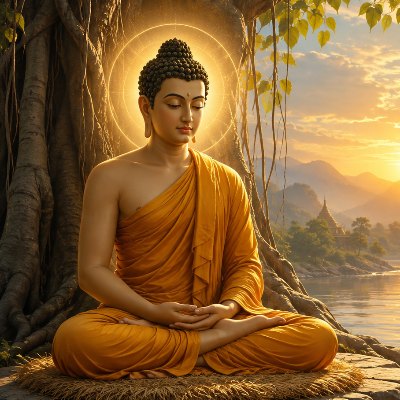
Gautama Buddha, born Siddhartha Gautama, was a prince of the Shakya clan who renounced his royal life to become a wandering ascetic, attained enlightenment beneath the Bodhi tree at Bodh Gaya, and thereafter taught the path to liberation from suffering that became the foundation of Buddhism. He lived and taught across the region of ancient Magadha and Kosala in northeastern India, traditionally dated to the sixth and fifth centuries BCE, and is remembered as the founder of one of the world's major religious and philosophical traditions. Within later Hindu Puranic literature, including the Vishnu Purana, Bhagavata Purana, Garuda Purana, and Harivamsha, he is also counted among the avatars of Vishnu, most commonly listed as the ninth.
✦ Lineage
- Father: Shuddhodana, chief or elected ruler of the Shakya clan, whose capital was Kapilavastu.
- Mother: Maya (Mahamaya), a princess connected to the Koliya clan, who died seven days after giving birth to Siddhartha.
- Stepmother and foster mother: Mahaprajapati Gautami, younger sister of Maya, who raised Siddhartha after his mother's death and later became the first woman ordained as a Buddhist nun (bhikkhuni).
- Half-siblings: Nanda and Sundari Nanda, children of Shuddhodana and Mahaprajapati Gautami, both of whom later became Buddhist monastics.
- Spouse: Yashodhara, whom Siddhartha married at the age of sixteen and who later became his disciple.
- Son: Rahula, the couple's only child, whose name is traditionally understood to mean "fetter" or "shackle," reflecting Siddhartha's view of worldly attachment; Rahula later became a disciple of his father.
✦ Sheltered Youth and the Four Sights
At Siddhartha's birth, sages foretold that he would become either a great universal monarch (Chakravartin) or a fully enlightened renouncer of the world, depending on what he encountered in life. Determined to secure a royal heir, Shuddhodana kept his son within the palace, surrounded by comfort and shielded from suffering. At the age of twenty-nine, Siddhartha ventured beyond the palace walls and encountered, in succession, an old man, a sick person, a corpse, and a wandering ascetic. These Four Sights revealed to him the universal realities of aging, illness, death, and the possibility of a path beyond suffering, and shattered the sheltered worldview in which he had been raised.
✦ The Great Renunciation and the Middle Way
Moved by what he had witnessed, Siddhartha left his palace, his wife, and his infant son by night, renouncing his inheritance to seek an end to suffering. For six years he studied under meditation teachers, including Alara Kalama and Uddaka Ramaputta, and practiced severe ascetic self-denial, including prolonged fasting. Finding that extreme austerity weakened the body and mind without yielding the answers he sought, he abandoned this path and instead formulated the Middle Way, a course of practice avoiding both indulgence in sensual pleasure and harsh self-mortification.
✦ Enlightenment at Bodh Gaya
At the age of thirty-five, Siddhartha seated himself beneath a pipal tree, later known as the Bodhi tree, at Bodh Gaya, resolving not to rise until he had attained ultimate understanding. Overcoming the temptations and illusions presented by the demon Mara, he entered deep meditation and attained complete awakening, thereafter becoming known as the Buddha, "the Awakened One."
✦ The First Teaching and Core Doctrine
The Buddha delivered his first sermon, the Dhammacakkappavattana Sutta ("Setting the Wheel of Dhamma in Motion"), to five former companions at the Deer Park in Sarnath, near Varanasi. His teaching centers on the Four Noble Truths: that existence is characterized by suffering (dukkha); that suffering arises from craving and ignorance (samudaya); that suffering can cease (nirodha); and that the way to its cessation is the Noble Eightfold Path (magga). This path comprises right view, right intention, right speech, right action, right livelihood, right effort, right mindfulness, and right concentration, organized under the three divisions of wisdom, ethical conduct, and mental discipline, and leads ultimately to Nirvana, the extinguishing of craving, hatred, and delusion, and liberation from the cycle of rebirth (samsara).
✦ Ministry and the Sangha
Over the following forty-five years, the Buddha travelled throughout northeastern India, teaching and establishing a monastic community, the Sangha, of monks and, eventually, nuns. Among his principal disciples were his cousin and longtime attendant Ananda, along with Sariputta, Moggallana, and Mahakasyapa, each remembered for particular excellences in wisdom, spiritual power, or discipline.
✦ Mahaparinirvana
At the age of eighty, in the town of Kushinagar, the Buddha fell gravely ill after eating a final meal offered by a blacksmith named Cunda. He lay down on his right side between a pair of Shala trees and passed into Mahaparinirvana, the final release from the cycle of rebirth. His last recorded words to his grieving disciples urged them that all conditioned things are subject to decay, and exhorted them to strive diligently for their own liberation.
✦ Textual Variants and Inconsistencies
Buddhist tradition itself dates the Buddha's birth and death variously to around 563 to 483 BCE or around 480 to 400 BCE, with scholarly opinion divided between these ranges. The Hindu Puranic tradition's account of the Buddha differs sharply in purpose and framing from the Buddhist tradition's own understanding of him: several Puranas, including the Bhagavata Purana and Vishnu Purana, describe Vishnu taking birth as Buddha specifically in order to delude asuras and other beings away from Vedic ritual observance, thereby weakening their strength, rather than presenting his teaching as an independent path to liberation in its own right. This Puranic framing stands in direct contrast to the self-understanding recorded in Buddhist scripture, where the Buddha's awakening and teaching are presented as a complete and independently discovered path to the cessation of suffering.
✦ Connection to the Wider Genealogy
Later Hindu tradition situates Gautama Buddha's clan, the Shakyas, within the wider genealogical framework of the Ikshvaku dynasty, the Suryavamsha or solar line of kings from which Rama himself is also descended. In the standard Puranic listing of Vishnu's ten principal avatars (Dashavatara), Buddha is most commonly named as the ninth, appearing between Krishna, the eighth avatar, and Kalki, the tenth avatar yet to come, thereby linking Buddha's earthly life into the same sequence of Vishnu's incarnations that includes Rama and Krishna.
✦ References
- Dhammacakkappavattana Sutta (Samyutta Nikaya): primary Buddhist source for the first sermon and the exposition of the Four Noble Truths and Eightfold Path.
- Mahaparinibbana Sutta (Digha Nikaya): primary Buddhist source for the account of the Buddha's final illness, death at Kushinagar, and last words.
- Vishnu Purana and Bhagavata Purana: primary Puranic sources listing Buddha among the avatars of Vishnu and framing the purpose of this incarnation as delusion of the asuras away from Vedic observance.
- Harivamsha and Garuda Purana: further primary Puranic sources including Buddha within the Dashavatara listing of Vishnu's incarnations.
- Wikipedia, "The Buddha," "Family of Gautama Buddha," and "The Buddha in Hinduism": secondary summaries of the standard biographical narrative, family relationships, and the Puranic avatar tradition.
- Britannica, "Shuddhodana": secondary reference confirming Shuddhodana's role as king of the Shakya clan and father of the Buddha.