
About
Kalki — Prophesied Tenth Avatar of Vishnu
Kalki · Kalkin
Kalki is the prophesied final avatar of Vishnu, foretold to appear at the close of the current Kali Yuga to destroy the wicked and corrupt rulers of the age and to inaugurate the following Satya Yuga, the age of truth. Unlike the other avatars of Vishnu, whose deeds belong to the past, Kalki's incarnation is described in Hindu scripture as an event yet to occur. References to Kalki appear across the Mahabharata, the Vishnu Purana, the Bhagavata Purana, the Agni Purana, the Linga Purana, the Vayu Purana, the Brahmanda Purana, and, in its fullest and latest elaboration, in the dedicated Kalki Purana.
✦ The Name
The name Kalki is commonly understood to derive from a root meaning "destroyer of darkness or ignorance," reflecting his prophesied role in ending the moral degradation of the Kali Yuga and restoring dharma at the dawn of the following age.
✦ Lineage
- Father: Vishnuyasha, described across the Vishnu Purana, Bhagavata Purana, and Agni Purana as the most eminent Brahmin of Shambhala village.
- Mother: named in the Kalki Purana as Sumati.
- Spouse: named in the Kalki Purana as Padma, daughter of King Brihadratha of the island of Simhala and Queen Kaumudi.
✦ The Prophesied Birth
The earliest surviving reference to Kalki occurs in the Mahabharata, where the sage Markandeya instructs Yudhishthira that at the end of the Kali Yuga, Vishnu will take birth in the village of Shambhala. The Vishnu Purana and Bhagavata Purana both confirm this location and identify Kalki's father as Vishnuyasha, describing his coming birth as the point at which Vedic practice and law will have nearly ceased across the earth. The Kalki Purana specifies that his birth will occur in the bright fortnight of the lunar month of Vaishakha, on the twelfth lunar day (Dvadashi).
✦ Training and Divine Gifts
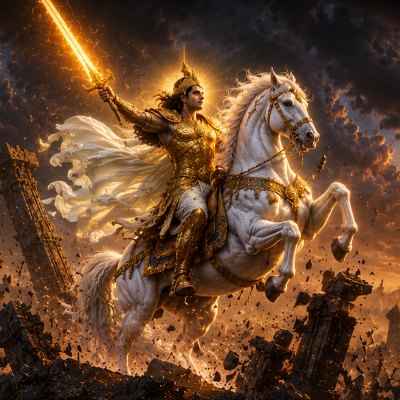
According to the Kalki Purana, Kalki will undergo training in spiritual knowledge and warfare under Parashurama, the sixth avatar of Vishnu, who by tradition continues to live as an immortal (chiranjivi) ascetic. Having completed this training and mastered the sixty-four traditional arts along with Vedic learning, Kalki will worship Shiva, who, pleased by his devotion, will grant him a horse named Devadatta, said to be a manifestation of Garuda capable of travelling anywhere and assuming many forms, together with a divine sword and a parrot possessing knowledge of past, present, and future.
✦ The Destruction of the Wicked
The Bhagavata Purana describes Kalki mounting his swift horse Devadatta and travelling across the earth with sword in hand, displaying eight mystic opulences and special qualities of divinity, to kill by the millions those thieves and plunderers who will have usurped the thrones of kings during the depths of the Kali Yuga. The Agni Purana adds that Kalki will be accompanied by Yajnavalkya as his priest in this campaign against the wicked rulers who prey upon the righteous. Through this act of destruction, the Puranas describe Kalki as bringing the Kali Yuga to its close and establishing the conditions for the following Satya Yuga to begin.
✦ Textual Variants and Inconsistencies
The core Puranic sources, including the Vishnu Purana and the principal verses of the Bhagavata Purana, give only a brief description of Kalki: his father's name, his birthplace, his horse, and his sword, without naming his mother, wife, or teacher. These further details, including his mother Sumati, his wife Padma, and his training under Parashurama, appear only in the later Kalki Purana, a minor Purana of considerably later composition than the principal Mahapuranas, and are not corroborated in the earlier texts. Sources also differ on Kalki's teacher in the destruction of the wicked: the Kalki Purana names Parashurama as his instructor in warfare and spiritual knowledge, while the Agni Purana instead names Yajnavalkya as his priest and companion in battle, without describing him as a teacher of arms. The Bhagavata Purana itself contains an internal variation in enumeration: while Kalki is most commonly listed as the tenth of ten principal avatars (Dashavatara), the same text elsewhere lists him as the twenty-second in an extended list of twenty-five avatars of Vishnu.
✦ Theological Significance
Kalki occupies a distinctive place among the avatars of Vishnu as the only one whose incarnation is understood as a future rather than a past or present event, functioning within Hindu cosmology as the guarantor that the cyclical descent of dharma into the corruption of the Kali Yuga is not final, but will be reversed through direct divine intervention, restoring righteousness and inaugurating the renewed Satya Yuga.
✦ Connection to the Wider Genealogy
Kalki stands as the final incarnation in the standard sequence of Vishnu's ten avatars (Dashavatara), following Buddha as the ninth avatar and preceded in turn by Rama and Krishna, situating his prophesied birth to Vishnuyasha and Sumati as the concluding episode in the same continuous cycle of Vishnu's descents that runs through the entire span of Hindu cosmological time.
✦ References
- Mahabharata, Vana Parva (Markandeya-Samasya Parva): earliest primary reference to Kalki's future birth in Shambhala village, related by the sage Markandeya to Yudhishthira.
- Vishnu Purana (Book IV, chapter 24): primary source naming Vishnuyasha as Kalki's father and describing the conditions preceding his birth.
- Bhagavata Purana (Canto 1, verse 3.25; Canto 12, chapter 2, verses 18–24): primary source giving Kalki's birthplace, father, horse, sword, and mission, and his place in the sequence of Vishnu's avatars.
- Agni Purana (chapter 16, verses 7–9): primary source naming Yajnavalkya as Kalki's priest and companion in the destruction of corrupt rulers.
- Linga Purana, Brahmanda Purana, Vayu Purana: further primary sources corroborating the core Kalki prophecy.
- Kalki Purana: primary but later source elaborating Kalki's mother Sumati, wife Padma, training under Parashurama, and the divine gifts received from Shiva.
- Vishnudharmottara Purana: primary source for the iconographic description of Kalki as a warrior on a white horse with a raised sword.
- Svastika, "Kalki Avatar: What the Texts Actually Say": secondary source distinguishing the brief core Puranic references to Kalki from the far more elaborate details found only in the later Kalki Purana.