
About
Aghasura — Python-Demon Slain by the Child Krishna
Aghasura
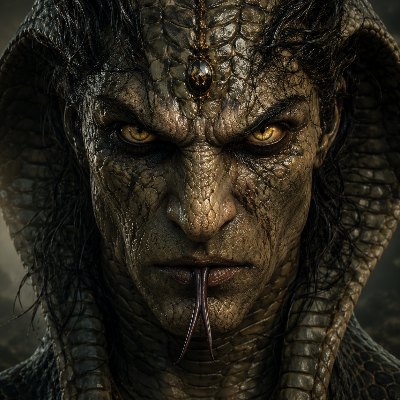
Aghasura was a formidable asura, one of King Kamsa's generals, sent to kill the child Krishna and his cowherd companions in Vrindavana. Assuming the form of a colossal python eight miles in length, he lay across a forest path with his mouth open wide, luring Krishna's friends and their calves inside as though into a mountain cavern. Krishna entered after them to save them, expanded his body within the demon's throat until Aghasura suffocated, and thereby not only rescued his companions but granted the demon liberation. His story is recounted in the Tenth Canto of the Bhagavata Purana, narrated by the sage Shuka to King Parikshit.
✦ The Name
The name Aghasura combines the Sanskrit "agha" (sin) with "asura" (demon), yielding "the sinful demon," a name fitting both his malicious intent toward Krishna's companions and, by the story's end, the sin that his contact with Krishna ultimately dissolves.
✦ Lineage
- Siblings: the Bhagavata Purana identifies Aghasura as the younger brother of the demoness Putana, killed by the infant Krishna through her own poisoned breast milk, and of Bakasura, the crane-demon killed by Krishna in his beak.
✦ Motive of Vengeance
Sent by Kamsa after his earlier attempts on Krishna's life had failed, Aghasura, upon seeing Krishna at the head of the cowherd boys, resolved to avenge his siblings, reasoning that Krishna's death, together with that of his young companions, would in turn devastate all the inhabitants of Vraja, for whom the boys were their very life and joy.
✦ The Serpent's Mouth
During a forest picnic, Aghasura transformed himself into an immense python, his body stretching eight miles and rising to the height of a mountain, his gaping mouth appearing to span from the earth to the sky. Mistaking this form for a natural cavern, the cowherd boys, laughing and unafraid because Krishna was among them, entered its mouth along with their calves. The demon, awaiting Krishna's own entry before closing his jaws, did not swallow them at once.
✦ Krishna's Entry and the Demon's Death
Recognizing the danger to his friends, Krishna entered the python's mouth as well, and once inside began expanding his own body. As Krishna grew, he filled and then blocked the demon's throat, cutting off his breath; Aghasura, in turn, tried to expand himself to match, but could not keep pace, and began to suffocate, his eyes bulging under the strain. Unable to sustain the struggle, the demon died, his trapped life-breath finally bursting forth through an aperture at the crown of his skull, the brahmarandhra, in the form of a brilliant, radiant light that rose into the sky and waited there. Krishna then revived his companions and their calves, who had died from suffocation within the demon's body, with a single merciful glance, and led them safely out of the serpent's carcass. As Krishna emerged, the shining light that had been Aghasura's departing life merged directly into him.
✦ The Delayed Revelation
The Bhagavata Purana notes that this event took place when Krishna was five years old, yet it was not disclosed to the people of Vraja until a full year later, when Krishna had entered his sixth year. King Parikshit, hearing the account from Shuka, expresses astonishment at this delay and asks why the inhabitants of Vraja, upon finally learning of it, believed the episode had occurred only that very day, a question with which the chapter closes without further elaboration in the base text.
✦ Textual Variants and Inconsistencies
The Sanskrit text of the Bhagavata Purana (10.12.14) explicitly describes Aghasura as the younger brother ("anuja") of Putana and Bakasura, a reading followed consistently across direct translations of the verse. Some later secondary summaries, including certain modern encyclopedic accounts, instead describe him as their elder brother, a reversal not supported by the primary Sanskrit verse itself.
✦ Theological Significance
The Bhagavata Purana states explicitly that sayujya mukti, liberation through merging into the Brahman effulgence, is ordinarily unavailable to a being as sinful and crooked as Aghasura; it was granted to him solely because the Supreme Being, Krishna, had physically entered his body, and by that contact alone the demon attained this rare form of liberation. The episode is thus read as a demonstration that Krishna's mercy extends even to his most hostile enemies, provided they come into direct contact with him, however malicious their original intent.
✦ Connection to the Wider Genealogy
As the youngest of three siblings dispatched or associated with Kamsa's campaign against Krishna, alongside Putana and Bakasura, Aghasura's episode forms part of the extended sequence of demonic attacks that mark Krishna's childhood in Gokula and Vrindavana, all instigated by Kamsa, ruler of Mathura and Krishna's maternal uncle, in his ongoing effort to eliminate the child prophesied to bring about his death.
✦ References
- Bhagavata Purana (Canto 10, Chapter 12): the sole primary source for the full episode, including Aghasura's motive, his serpent form, his death, and the delayed revelation of the pastime.
- Vedabase / Vanisource, translation of Srimad-Bhagavatam 10.12: primary-text translation consulted for the precise Sanskrit designation of Aghasura as the younger brother of Putana and Bakasura, and for the sayujya-mukti explanation.
- Wisdomlib, "Agha" entry: secondary compilation of the episode, including the detail of the demon's breath escaping through the brahmarandhra.
- Wikipedia, "Aghasura": secondary summary of the episode, noted here as the source of the divergent "elder brother" claim inconsistent with the primary Sanskrit verse.