
About
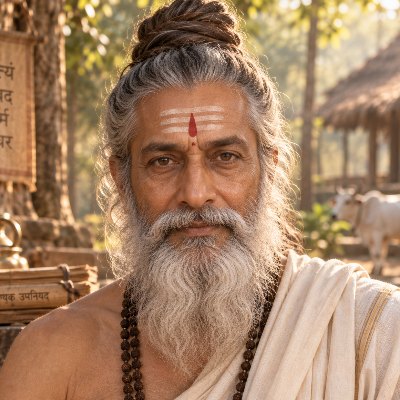
Yajnavalkya — Upanishadic Philosopher, Seer of the Shukla Yajurveda, Author of the Brihadaranyaka Upanishad
Yajnavalkya · Yagyavalkya · Vajasaneya · Devaratasuta (patronymic) · Yogesvara (epithet from Yajnavalkya Smriti 1.1)
Yajnavalkya is one of the most eminent sages and philosophers in the Vedic and Upanishadic tradition, estimated to have lived in the eighth to seventh century BCE in the Mithila region of the Videha kingdom. He is the central voice of the Brihadaranyaka Upanishad — one of the oldest and most extensive of the principal Upanishads, attached to the Shatapatha Brahmana of the Shukla Yajurveda — and the attributed compiler of the Shukla Yajurveda Samhita, also known as the Vajasaneyi Samhita. He is further associated with the composition of the Shatapatha Brahmana, the Ishopanishad, the Yoga Yajnavalkya, and the Yajnavalkya Smriti, one of the three great Dharmashastra texts. He belongs to the Vishvamitra gotra and carries the Tryarsheya Pravara of Vishvamitra, Devarata, and Audala. He is the son of Devarata — also named Brahmaratha in the Vishnu Purana — and of Sunanda Devi, the sister of Vaishampayana, making Vaishampayana his maternal uncle and first teacher. He married two wives: Katyayani, the daughter of Bharadvaja, by whom he had three sons, and Maitreyi, a Brahmavadini philosopher. The Brihadaranyaka Upanishad's dialogues — with Maitreyi, with Gargi, with King Janaka, and with assembled sages — constitute the primary textual record of his teaching. He is credited by the scholar Michael Witzel as the coiner of the term Advaita, meaning non-duality of Atman and Brahman.
✦ The Name
The name Yajnavalkya is derived from yajna, meaning sacrifice or ritual, indicating a deep ancestral and personal connection to the sacrificial tradition. The epithet Yogesvara, meaning "lord of yogis" or "king of yogis," appears in the opening verse of the Yajnavalkya Smriti and reflects the tradition's assessment of his mastery of both the ritual and the contemplative dimensions of Vedic knowledge. The name Vajasaneya, meaning "son of Vajasani" or "son of the provider of food" — understood as a reference to Surya — is the designation under which the Shukla Yajurveda Samhita is known as the Vajasaneyi Samhita, encoding his identity as the direct disciple of the Sun God in the very name of the Vedic corpus he transmitted. The patronymic Devaratasuta means "son of Devarata" and is the form used in the Bhagavata Purana.
✦ Lineage
- Gotra: Vishvamitra — the Tryarsheya Pravara of Vishvamitra, Devarata, Audala, confirmed in the Matsya Purana's Gotra Pravara Nirnaya which lists Yajnavalkya among the Vishvamitra-lineage descendants who carry this three-rishi formula.
- Father: Devarata, also named Brahmaratha — a Brahmin sage of the Vishvamitra gotra deeply devoted to Vedic ritual and the worship of Yajneshvara; the Bhagavata Purana identifies Yajnavalkya as his son under the patronymic Devaratasuta; the Vishnu Purana names the father Brahmaratha.
- Mother: Sunanda Devi — a pious woman who performed austerities alongside her husband; identified across the hagiographic tradition as the sister of the Vedacharya Vaishampayana.
- Maternal uncle and first teacher: Vaishampayana — the sage appointed by Veda Vyasa to transmit the Yajurveda; teacher of the Krishna Yajurveda or Taittiriya Shakha; Yajnavalkya's mother Sunanda was his sister, making him Yajnavalkya's maternal uncle as well as his Guru.
- First wife: Katyayani — daughter of Bharadvaja; the householder wife who managed domestic duties and bore his sons.
- Second wife: Maitreyi — daughter of the sage Maitri; a Brahmavadini philosopher who engaged in metaphysical dialogue with Yajnavalkya; the Brihadaranyaka Upanishad (2.4 and 4.5) records their celebrated dialogue on the nature of the Self.
- Sons (by Katyayani): Chandrakanta, Mahamegha (also rendered Mahamedha), and Vijaya — named in the hagiographic tradition as sons who became Vedic scholars; confirmed across DLSHQ, Sanskriti, and Hindupedia.
- Principal disciple: King Janaka of Videha — the philosopher-king who received Brahma Vidya from Yajnavalkya and at whose court Yajnavalkya won the celebrated Bahudakshina Yajna debate against all assembled Brahmin scholars.
✦ The Dispute with Vaishampayana and the Origin of the Shukla Yajurveda
The primary narrative explaining the origin of the Shukla Yajurveda is preserved across several textual sources with minor variations. Yajnavalkya studied the Taittiriya Samhita of the Krishna Yajurveda under his maternal uncle and teacher Vaishampayana. On one occasion, the assembled rishis near Mount Meru passed a resolution that any sage who absented himself from the association at the appointed time would incur the sin of Brahmahatya for seven days. Vaishampayana failed to attend and sought to discharge his penance through his disciples. Yajnavalkya volunteered to undertake the entire penance alone on his teacher's behalf, declaring that his fellow disciples were insufficiently qualified for such rigour. Vaishampayana was offended by what he perceived as arrogance toward his other disciples and commanded Yajnavalkya to return all the Vedic knowledge he had transmitted. Yajnavalkya, through the power of yoga, vomited forth the Vedic knowledge he had absorbed. The other disciples of Vaishampayana, on their teacher's instruction, took the form of tittiri birds — partridges — and consumed what was regurgitated. Because these birds consumed the knowledge, the Yajurveda transmitted through this episode came to be called the Taittiriya — the partridge — Yajurveda, which is the Krishna Yajurveda.
Now bereft of his acquired Vedic knowledge and resolved never again to take a human teacher, Yajnavalkya turned in prayer to Surya, the Sun God. Surya appeared before him in the form of a horse. This form is the origin of the name Vajasaneya — from vaja, meaning food or strength, and the association with Surya as its provider — under which the Vedic corpus Yajnavalkya received is known. Surya revealed to him entirely new Vedic portions — mantras and Brahmana passages that his human teacher Vaishampayana had not known. This direct revelation from Surya became the Shukla Yajurveda or White Yajurveda, so called because it was received in pure, luminous form without the admixture of Brahmana commentary that characterises the Krishna Yajurveda. The Vedic Heritage Portal summary of the Yajurveda confirms this account of the twofold division, stating that Surya came to Yajnavalkya in the form of a horse to transmit this knowledge.
A variant account appears in the Vishnu Purana, which names Paila rather than Vaishampayana as the teacher from whom Yajnavalkya received his initial Vedic training, and places the episode within a slightly different contextual framework. This represents a genuine textual difference between the two Puranic accounts and must be noted alongside the main tradition.
✦ The Brihadaranyaka Upanishad and the Teaching of Brahma Vidya
The Brihadaranyaka Upanishad, attached to the Shatapatha Brahmana and estimated to date from approximately the seventh to sixth century BCE, is the principal textual record of Yajnavalkya's philosophical teaching. Chapters three and four contain his most sustained philosophical expositions. Chapter three records his debates at the court of King Janaka during the Bahudakshina Yajna, in which Janaka offered one thousand gold-decked cows to whichever sage among the assembled could demonstrate himself as the finest Brahmin. Yajnavalkya alone claimed the prize and successfully defended his claim against all questioners, including the celebrated woman philosopher Gargi Vachaknavi, who pressed him with a sustained series of cosmological questions. Chapter four records his private teaching of Brahma Vidya to Janaka and the two celebrated dialogues with Maitreyi — at Brihadaranyaka Upanishad 2.4 and 4.5 — in which he expounds the nature of the Atman, the ground of all love and all knowledge. It is in these passages that the formulation most closely associated with Advaita — the non-dual identity of Atman and Brahman — finds its earliest and most developed expression in the primary sources.
✦ Works Attributed to Yajnavalkya
The textual tradition attributes to Yajnavalkya the Shukla Yajurveda Samhita (Vajasaneyi Samhita), received directly from Surya; the Shatapatha Brahmana, the most extensive of the Brahmana texts and the doctrinal backbone of the Shukla Yajurveda; the Brihadaranyaka Upanishad, embedded within the Shatapatha Brahmana and one of the ten principal Upanishads; the Ishopanishad, the first and briefest of the principal Upanishads; the Yoga Yajnavalkya, a treatise on yoga in dialogue form; and the Yajnavalkya Smriti, one of the three great Dharmashastra texts alongside Manu Smriti and Parasara Smriti. The first verse of the Yajnavalkya Smriti designates him as Yogesvara. The Vishnu Purana also records that he became the teacher of the disciples of Vaishampayana after receiving the Shukla Yajurveda from Surya, at Vaishampayana's own request.
✦ Cosmic Origin Tradition
The Skanda Purana preserves a tradition in which Yajnavalkya is described as a direct incarnation of Brahma. According to this account, Brahma was cursed by Shiva — in some versions during the occasion of Parvati's wedding — and was thereby compelled to take a mortal birth on earth as the sage Yajnavalkya. A parallel tradition recorded in the Yajnavalkya Jayanti Wikipedia article states that Brahma was cursed by his wife Savitri after he allowed Gayatri to take Savitri's place in a yajna, and that he was subsequently born as a mortal sage in the house of a sage named Charana. These origin traditions are characteristic of the Puranic genre and are presented alongside the genealogical lineage account rather than in place of it.
✦ Textual Variants and Inconsistencies
The name of Yajnavalkya's father differs between the Bhagavata Purana (Devarata) and the Vishnu Purana (Brahmaratha). The identity of his first teacher differs between the dominant tradition (Vaishampayana) and the Vishnu Purana (Paila). The cause of the quarrel with the teacher also admits of variation in secondary retellings — some emphasise Yajnavalkya's arrogance toward his fellow disciples as the trigger; others stress the structural impossibility of a single disciple taking upon himself the penance owed collectively by his teacher's entire assembly. The Shatapatha Brahmana's own account of the Veda-vomiting episode should be consulted for the primary-source version of this event, as the secondary tradition in Mahidhara's commentary and later hagiographic texts may elaborate the narrative beyond its earliest form.
✦ Connection to the Wider Genealogy
Yajnavalkya belongs to the Vishvamitra gotra through his father Devarata (Brahmaratha), who is a descendant of Audala in the Vishvamitra-Devarata-Audala pravara branch. Through his mother Sunanda Devi's family, he is connected to Vaishampayana, who belongs to a different Vedic family tradition — that of the Taittiriya Shakha transmitters. His sons Chandrakanta, Mahamegha, and Vijaya continue the Vishvamitra-gotra line through Katyayani. Through his wife Maitreyi and her father Maitri, he is connected to the Videha Brahmin scholarly tradition associated with the court of King Janaka. His role as teacher of King Janaka establishes a documented Guru-disciple link between the Mithila philosophical tradition and the Vishvamitra gotra lineage.
✦ References
Primary Sources
- Brihadaranyaka Upanishad, 2.4 and 4.5: The two Yajnavalkya-Maitreyi dialogues; the primary source for Yajnavalkya's teaching on the Atman as the ground of all love and all knowledge, and for the foundational exposition of Advaita philosophy.
- Brihadaranyaka Upanishad, chapters 3 and 4: The Bahudakshina Yajna debates at the court of Janaka; primary source for the debates with Gargi and other assembled scholars.
- Shatapatha Brahmana: The most extensive Brahmana text, attributed to Yajnavalkya; contains the Veda-transmission episode in its original form and the liturgical framework for the Shukla Yajurveda.
- Yajnavalkya Smriti: The Dharmashastra attributed to Yajnavalkya; verse 1.1 contains the Yogesvara epithet.
- Bhagavata Purana: Names Yajnavalkya as Devaratasuta, establishing Devarata as the father's name.
- Vishnu Purana: Names Brahmaratha as the father and Paila as the teacher in its account of the Veda-vomiting episode.
- Matsya Purana, Gotra Pravara Nirnaya, chapter 26: Lists Yajnavalkya among the Vishvamitra-lineage descendants carrying the Vishvamitra-Devarata-Audala pravara.
- Skanda Purana: Preserves the tradition of Yajnavalkya as an incarnation of Brahma cursed by Shiva.
Secondary and Reference Works
- DLSHQ / Sanskriti Magazine — "Sage Yajnavalkya": The most detailed secondary account consulted; source for the Vaishampayana episode, the tittiri-birds episode, the Surya revelation, and the identification of Katyayani as daughter of Bharadvaja with three named sons.
- Hindupedia — "Yajnavalkya": Source for the Brahmaratha-Devarata father-name synthesis and for the three sons by Katyayani.
- Wikipedia — "Yajnavalkya": Source for the Michael Witzel attribution of Advaita coinage; confirms Maitreyi and Katyayani as the two wives cited in the Brihadaranyaka Upanishad.
- Wikipedia — "Yajnavalkya Jayanti": Source for the Skanda Purana incarnation tradition and for the Vishnu Purana variant naming Paila as teacher.
- Vedic Heritage Portal — "Yajurveda": Source for the Mahidhara commentary account of the tittiri episode and the Surya-horse revelation as the origin of the Shukla Yajurveda-Krishna Yajurveda division.
- Vanamala Arts — "Muni Yajnavalkya (Vajasaneya)": Source for the etymology of Vajasaneya and the explanation of the Shukla Yajurveda name.