
About
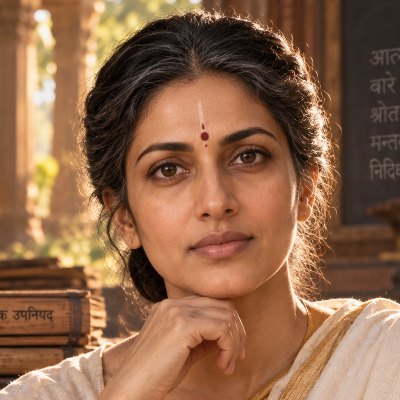
Maitreyi — Brahmavadini Philosopher, Second Wife of Yajnavalkya
Maitreyi · Sulabha Maitreyi (Mahabharata designation) · Auddalaki (in some references) · Brahmavadini
Maitreyi is one of the most celebrated women philosophers of the Vedic tradition, estimated to have lived in approximately the eighth century BCE in the Mithila region associated with the court of King Janaka of Videha. She is described as a Brahmavadini — a female expounder of the Vedas and Brahman — and is named in the Brihadaranyaka Upanishad (2.4 and 4.5) as the second wife of the sage Yajnavalkya. The two dialogue sections of the Brihadaranyaka Upanishad bearing her name contain Yajnavalkya's most sustained exposition of the nature of the Atman and constitute some of the earliest and most philosophically significant passages on Advaita in the primary textual record. She is identified in the Asvalayana Grhyasutra as the daughter of the sage Maitri — from whom her name is derived — and is described in the hagiographic tradition as the niece of the philosopher Gargi Vachaknavi. The Mahabharata and certain Grhyasutras present a divergent account in which Maitreyi appears as an unmarried scholar who never married, creating a genuine textual inconsistency between the two traditions.
✦ The Name
The name Maitreyi is a feminine patronymic derived from the name of her father, the sage Maitri. It means "daughter of Maitri" or "belonging to the Maitri lineage." The root maitri also means friendship, goodwill, or benevolence in Sanskrit, giving the name a secondary sense of "one who is characterised by friendliness." The designation Sulabha Maitreyi appears in the Asvalayana Grhyasutra and in the Mahabharata's Shanti Parva, where Sulabha is an additional personal name and Maitreyi functions as the patronymic element.
✦ Lineage
- Father: Maitri — a sage of the Videha region associated with the court of King Janaka; in the Asvalayana Grhyasutra, Maitreyi is referred to as "Sulabha Maitreyi" and her father is described as a minister in the court of King Janaka of Videha; the name Maitreyi is directly derived from his name.
- Familial connection: Gargi Vachaknavi — the woman philosopher celebrated in the Brihadaranyaka Upanishad for her debate with Yajnavalkya; described in the hagiographic tradition as Maitreyi's aunt (her father Maitri's sister or related figure). This relationship is not confirmed in the primary texts consulted and rests on secondary sources.
- Husband (Brihadaranyaka Upanishad tradition): Yajnavalkya — the Upanishadic philosopher and receiver of the Shukla Yajurveda; Maitreyi is his second wife in this tradition and is the interlocutor in the two celebrated dialogues at Brihadaranyaka Upanishad 2.4 and 4.5.
✦ The Dialogue in the Brihadaranyaka Upanishad
The Brihadaranyaka Upanishad presents the Yajnavalkya-Maitreyi dialogue at two points — chapters 2.4 and 4.5 — as one of the foundational expositions of Upanishadic philosophy. In both versions Yajnavalkya announces his intention to renounce household life, calls both his wives before him, and proposes to divide his material wealth equitably between them. Maitreyi responds not with acceptance but with a question: whether material wealth, however abundant, could make her immortal. When Yajnavalkya acknowledges that it cannot — that wealth can bring only the material comfort of the well-to-do, not liberation — Maitreyi rejects her portion of the estate and asks instead to be taught the means of immortality.
Yajnavalkya's response to Maitreyi constitutes the philosophical heart of both dialogue sections. He teaches that all love — the love of a husband for a wife, of a wife for a husband, of parents for children, of children for parents — is ultimately love for the Atman, the Self, which is the innermost reality of all beings. The Atman is not an object among other objects; it is the subject that underlies all experience, the ground from which all love and all knowledge arise. He articulates the essential teaching of Advaita — non-duality — by demonstrating that the apparent multiplicity of objects of love and knowledge dissolves when the Atman is known as Brahman: the one self-luminous reality that is both the ground of individual consciousness and the ground of all existence. The formula associated with this teaching — "Neti, neti" (not this, not this) — is among the most quoted phrases in the Upanishadic tradition and appears in the Brihadaranyaka Upanishad in the context of Yajnavalkya's teaching to Maitreyi and to King Janaka.
✦ Textual Variants and Inconsistencies
A significant discrepancy exists between the Brihadaranyaka Upanishad's presentation of Maitreyi as a married wife of Yajnavalkya and the account found in the Mahabharata's Shanti Parva (Mokshadharma Parva, section 321) and in certain Grhyasutra texts. The Mahabharata presents a figure called Sulabha Maitreyi as an unmarried female ascetic and philosopher who debates King Janaka of Videha, entering into his body through yogic power to demonstrate the non-dual nature of the self as unbound by gender, body, or social role. In this presentation, Maitreyi's philosophical authority is grounded precisely in her refusal of marriage and her absolute independence. The Grhyasutras similarly describe her as a permanent Brahmavadini who never married. These two presentations — the married scholar of the Brihadaranyaka Upanishad and the celibate ascetic of the Mahabharata — cannot be reconciled within a single continuous biography, and the primary sources offer no resolution. The profile records both traditions as attested in their respective primary texts.
The Wikipedia article on Maitreyi notes that some scholars resolve this by treating the Brihadaranyaka Upanishad Maitreyi and the Mahabharata Sulabha Maitreyi as two distinct figures who share the name, while others treat the Mahabharata account as a later elaboration of a single figure's philosophical reputation. Neither resolution is supported by explicit primary-source statement.
✦ Theological Significance
Maitreyi is one of a small group of women in the Vedic period — including Gargi Vachaknavi and Lopamudra — who are designated Brahmavadini and who engage with male philosophers as intellectual equals in the primary texts. Her question to Yajnavalkya — whether material wealth can grant immortality — is the pivot on which the Brihadaranyaka Upanishad's most consequential philosophical teaching turns. The question is not rhetorical but genuinely philosophical: it articulates the distinction between the instrumental value of material goods and the unconditional value of liberation. The Indian Scriptures account notes that her reasoning — that if Yajnavalkya himself was willing to leave everything behind it must be for something greater — is presented in the tradition as exemplary spiritual discernment rather than as renunciation for its own sake.
✦ References
Primary Sources
- Brihadaranyaka Upanishad, 2.4 and 4.5: The two Yajnavalkya-Maitreyi dialogue sections; the primary textual sources for Maitreyi's identity as Yajnavalkya's wife, her philosophical question on immortality and wealth, and Yajnavalkya's teaching on the Atman as the ground of all love and knowledge.
- Asvalayana Grhyasutra: Names her as Sulabha Maitreyi and identifies her father as the sage Maitri, a minister in the court of Janaka of Videha; describes her as a woman scholar of the Vedic era; cited in the Wikipedia Maitreyi article.
- Mahabharata, Shanti Parva, Mokshadharma Parva, section 321: Presents Sulabha Maitreyi as an unmarried female ascetic and Advaita philosopher who debates King Janaka; the source of the textual variant in which Maitreyi does not marry.
Secondary and Reference Works
- Wikipedia — "Maitreyi": The most comprehensive secondary account consulted; source for the Asvalayana Grhyasutra reference, the Mahabharata Sulabha Maitreyi variant, and the scholarly discussion of whether the two figures are identical; cites Patrick Olivelle (2008), page 140, for the Brihadaranyaka Upanishad reference.
- Grokipedia — "Maitreyi": Source for the Mahabharata Shanti Parva section 321 detail of Maitreyi entering Janaka's body through yogic power; cites the Grhyasutra characterisation of her as never having married.
- Devvrat Yoga Sangha — "Yogini Maitreyi in Vedic Period": Source for the identification of her father as Mitra Rishi and her familial connection to Gargi; locates her birth in Mithila in the time of King Janaka.
- Indian Scriptures (Hinduscriptures.in) — "Maitreyi": Source for the reasoning attributed to Maitreyi that if Yajnavalkya was willing to leave everything it must be for something greater; records her father as Mitra Rishi and her birth in Mithila.
- Kamakoti.org — "Essence of Yajnavalkya Smriti": Source for the reference to Maitreyi's own Upanishad (the Maitreyi Upanishad or Maitreyopanishad) in which she expounds the principles of self-awareness; notes her as the Maha Grihini whose philosophical attainments are separately enshrined in her own text.