
About
Vaishampayana — Disciple of Veda Vyasa, Custodian of the Krishna Yajurveda, Narrator of the Mahabharata
Vaishampayana · Vaisampayana · Vaishampayana Mahabharatacharya
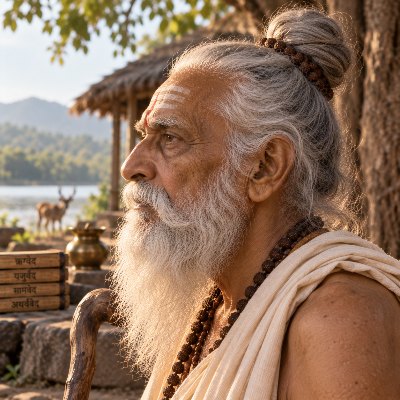
Vaishampayana is one of the five principal disciples of the sage Veda Vyasa and one of the most consequential figures in the transmission of Vedic and epic knowledge in the Hindu tradition. He is the appointed custodian and transmitter of the Krishna Yajurveda — the Black Yajurveda — which the Agni Purana (chapter 150) records he divided into seven branches. He is the traditional narrator of the Mahabharata in the form in which it was first recited publicly, performing this recitation before King Janamejaya at that king's Sarpa Satra, the great snake sacrifice. He also narrated the Harivamsha, the supplementary appendix to the Mahabharata detailing the lineage and life of Krishna. For these twin roles the Ashvalayana Grhya Sutra honours him with the title Mahabharatacharya. He is mentioned in both the Taittiriya Aranyaka and the Ashtadhyayi of Panini, confirming his recognition across distinct primary textual traditions. His sister Sunanda Devi married the sage Devarata — also named Brahmaratha in the Vishnu Purana — and their son was the sage Yajnavalkya, the great Upanishadic philosopher, making Vaishampayana Yajnavalkya's maternal uncle as well as his first Guru. The dispute between them over the Veda-transmission penance is one of the defining episodes in the history of the Yajurveda's bifurcation into its two major branches.
✦ The Name
The name Vaishampayana is a Sanskrit patronymic or clan-name, conventionally understood as deriving from a root associated with the name Vishampaya or a related ancestral name. No primary source offers an explicit etymology for the name in the context of this figure's own identity. The honorific title Mahabharatacharya — meaning "teacher of the Mahabharata" — is conferred on him by the Ashvalayana Grhya Sutra and reflects his unique status as the primary human transmitter of the epic in its public form.
✦ Lineage
- Teacher: Veda Vyasa — the sage credited with compiling and classifying the Vedas, composing the Mahabharata, and appointing his five disciples each to transmit one of the four Vedas and the epic; Vaishampayana is Vyasa's disciple for the Yajurveda and the Mahabharata.
- Co-disciples under Vyasa: Paila — appointed to transmit the Rigveda; Jaimini — appointed to transmit the Samaveda; Sumantu — appointed to transmit the Atharvaveda; Shuka — Vyasa's own son, the fifth disciple of the group named in the Mahabharata (Adi Parva, 1.1.63 and 1.57.73–75).
- Sister: Sunanda Devi — who married the sage Devarata (Brahmaratha) and bore Yajnavalkya; her marriage into the Vishvamitra gotra made Vaishampayana the maternal uncle of the most celebrated sage of the Upanishadic period.
- Nephew and disciple: Yajnavalkya — whose mother Sunanda was Vaishampayana's sister; Vaishampayana was his first Guru in the Vedic curriculum, teaching him the Taittiriya Samhita of the Krishna Yajurveda before the rupture between them.
✦ Custodian of the Krishna Yajurveda
The primary framework for the transmission of the four Vedas records that Vyasa divided the single Vedic corpus into four recensions and assigned one to each of his four principal disciples: the Rigveda to Paila, the Samaveda to Jaimini, the Yajurveda to Vaishampayana, and the Atharvaveda to Sumantu. Vaishampayana's portion — the Yajurveda — is the Krishna Yajurveda or Black Yajurveda, characterised by the interweaving of mantras and Brahmana commentary within its text rather than their separation into distinct compositions. The Agni Purana, chapter 150, records explicitly that Vaishampayana, the disciple of Vyasa, divided the Yajurveda into seven branches — a statement that places him as the origin point of the Yajurveda's seven sakhas or recensions within the Krishna Yajurveda tradition. The most prominent of these sakhas, which came to bear the name Taittiriya, arose from the circumstances of the dispute with Yajnavalkya, as described below.
✦ The Brahmahatya Episode and the Rupture with Yajnavalkya
The Kamakoti.org account of the Yajnavalkya Smriti's essence, drawing on the Vedic biographical tradition, records the precise context of Vaishampayana's incurring of the Brahmahatya sin. The assembled rishis near Mount Meru had established a rule that any sage absent from the association at the appointed time would incur the sin of Brahmahatya — the gravest of ritual offences, equivalent to the killing of a Brahmin — for seven days. On the day of the appointed assembly, Vaishampayana's attendance was prevented by his father's Shraaddha ceremony — the obligatory post-death rites that a son must perform — creating an irresolvable conflict between two absolute duties of Brahminic life. He therefore missed the assembly and incurred the sin.
Vaishampayana then asked his disciples to perform expiatory fasts and penances on his behalf to discharge the sin collectively. Yajnavalkya stepped forward and declared that he alone was capable of discharging the entire penance and that the other disciples were not equal to the task. Vaishampayana interpreted this as a grave insult to his other students and an act of arrogance unworthy of a disciple. He dismissed Yajnavalkya with the command to give back all the Vedic knowledge he had been taught. Yajnavalkya, through the power of yoga, physically vomited forth the acquired Vedic knowledge. The other disciples, on Vaishampayana's instruction, assumed the form of tittiri birds — partridges — in order to consume the vomited matter, which in its original state was unusable to human beings. Because these tittiri birds consumed the knowledge, the Yajurveda transmitted through this episode came to be called the Taittiriya Samhita — the partridge recension — which is the primary text of the Krishna Yajurveda. The DLSHQ account of Sage Yajnavalkya confirms this sequence and notes that Vaishampayana, upon learning that Yajnavalkya had subsequently received an entirely new Vedic recension directly from Surya, was pleased and asked Yajnavalkya to teach this new knowledge to his own disciples as well.
✦ The Recitation of the Mahabharata at Janamejaya's Sarpa Satra
The Mahabharata tradition records three successive stages of the epic's textual history, each associated with a different sage and a different scale of the text. Vyasa composed the original version, called Jaya, consisting of 8,800 verses, and taught the epic to his five disciples. The version associated with Vaishampayana's recitation is the Bharata, consisting of 24,000 verses. The final and largest version, comprising over 100,000 verses and known as the Mahabharata, is the recension attributed to Ugrasrava Sauti, the son of Lomaharshana, who narrated it to the sages of Naimisharanya. The Wikipedia Mahabharata article confirms all three redactions and their associated narrators. Some traditions, including the Vedpedia account drawing on the Adi Parva, state that Vyasa taught Vaishampayana the full 100,000-verse text, which Vaishampayana then recited at Janamejaya's sarpa satra — representing the alternative tradition in which Vaishampayana's recitation is the complete Mahabharata rather than the intermediate Bharata.
The occasion for the public recitation was the Sarpa Satra of King Janamejaya, the great-great-grandson of Arjuna. Janamejaya performed this massive snake sacrifice to avenge the death of his father Parikshit, who had been killed by the serpent Takshaka. During this ceremony, Janamejaya asked Vaishampayana to recount the full history of his ancestors — the Kuru dynasty, the Pandavas, and the great war of Kurukshetra. Vaishampayana narrated the entire epic in this setting. The Mahabharata's Adi Parva, which is Vaishampayana's recitation to Janamejaya, is thus the framing structure through which the entire epic reaches its audience within the primary text.
✦ The Harivamsha and Other Texts
Vaishampayana is also the narrator of the Harivamsha, the extensive appendix to the Mahabharata that traces the ancestry and life of Krishna, the Yadava lineage, and events following the great war. The Wikipedia Vaishampayana article confirms that the Harivamsha Purana is recited by him and that it includes the legend of Prithu's emergence from Vena. He is additionally mentioned in the Taittiriya Aranyaka — consistent with his identity as the transmitter of the Taittiriya tradition — and in the Ashtadhyayi of Panini, the foundational grammar of Classical Sanskrit, confirming that his name was already in circulation in the Vedic and pre-classical grammatical tradition.
✦ The Sukanasa Tradition: A Different Figure
A separate figure named Vaishampayana appears in the Sanskrit court literary tradition — specifically in Somadeva's Kathasaritsagara and in Banabhatta's Kadambari — where he is the son of Sukanasa, the wise minister to King Tarapida of Ujjayini, and a figure in a narrative of entirely different character and setting from the Vedic sage. The Wisdomlib definition entry for Vaishampayana notes both figures. These two figures share only a name. The Sukanasa-son Vaishampayana is a character of Sanskrit narrative literature, not a Vedic sage, and has no connection to the Yajurveda transmission, the Mahabharata narration, or the Yajnavalkya episode. They must not be conflated.
✦ Connection to the Wider Genealogy
Vaishampayana stands at the junction of two major genealogical streams in the Hindu textual tradition. As the disciple of Vyasa and custodian of the Krishna Yajurveda, he is the origin point of the entire Taittiriya Shakha lineage — all teachers and students who transmitted the Taittiriya Samhita, Taittiriya Brahmana, and Taittiriya Upanishad trace their lineage back through him to Vyasa. As the maternal uncle of Yajnavalkya, he is connected by family to the Vishvamitra gotra tradition of the Shukla Yajurveda — the very tradition that arose from the rupture with his own teaching. His role in the origin of both the Krishna and Shukla Yajurveda branches is thus genealogically embedded: the Taittiriya Samhita derives from his transmission, and the Vajasaneyi Samhita arose from the departure of his nephew from that transmission.
✦ References
Primary Sources
- Mahabharata, Adi Parva, 1.1.63 and 1.57.73–75: Names Vyasa's five disciples including Vaishampayana; establishes Vaishampayana as the narrator of the Mahabharata at Janamejaya's Sarpa Satra; frames the Adi Parva and the entire epic as Vaishampayana's recitation.
- Agni Purana, chapter 150: States that Vaishampayana, the disciple of Vyasa, divided the Yajurveda into seven branches; the primary source for his role in the sevenfold division of the Krishna Yajurveda sakhas.
- Ashvalayana Grhya Sutra: Confers on him the title Mahabharatacharya — teacher of the Mahabharata — alongside the other disciples named as Bharatacharyas; one of the oldest texts to acknowledge his canonical role.
- Taittiriya Aranyaka: Contains a reference to Vaishampayana consistent with his identity as the transmitter of the Taittiriya tradition; cited in the Wikipedia Vaishampayana article.
- Ashtadhyayi of Panini: Mentions Vaishampayana by name; confirms his presence in the grammatical and Vedic-scholarly tradition predating the classical period.
- Kamakoti.org — Essence of Yajnavalkya Smriti (drawing on primary Vedic tradition): Provides the precise account of the Meru assembly, the Shraaddha conflict as the cause of Vaishampayana's absence, and the sequence of the dispute with Yajnavalkya leading to the vomiting of the Veda and the tittiri-bird episode.
Secondary and Reference Works
- Wikipedia — "Vaishampayana": Confirms his role as narrator of both the Mahabharata and the Harivamsha; cites the Agni Purana chapter 150 for the sevenfold division of the Yajurveda; confirms the Ashvalayana Grhya Sutra title and the Panini and Taittiriya Aranyaka references.
- Wikipedia — "Mahabharata": Confirms the three-stage redaction account — Jaya (8,800 verses, Vyasa), Bharata (24,000 verses, Vaishampayana's recension), Mahabharata (100,000 verses, Ugrasrava) — and cites this as the scholarly framework for the epic's textual development.
- Wisdomlib — "Vaishampayana: 19 definitions": Compiles dictionary and Puranic encyclopaedia entries; notes both the Vedic sage and the Sukanasa-son Vaishampayana of the Kathasaritsagara and Kadambari as distinct figures.
- DLSHQ — "Sage Yajnavalkya": Source for the detail that after Yajnavalkya received the Shukla Yajurveda from Surya, Vaishampayana was pleased and asked him to teach it to his own disciples; confirms the full sequence of the rupture and its resolution.
- Dharmawiki — "Vaishampayana": Source for the summary of his role as Vedic transmitter and Mahabharata narrator; confirms the Harivamsha narration and the Sarpa Satra context.
- Ithihas.wordpress.com — "Vyasa the Literary Genius of Ancient India": Source for the three-stage verse-count reconstruction and the five-disciple framework, drawing on the Adi Parva primary text.