
About
Shrutavati — Daughter of Bharadvaja, Brahmacariṇī, and Wife of Indra
Shrutavati · Shrutāvatī · Sruvavati · Shrutavali · Śrutāvatī
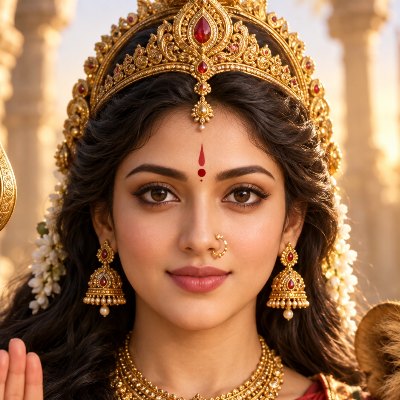
Shrutavati is a daughter of the sage Bharadvaja and a sister of Drona, the royal preceptor of the Pandavas and Kauravas. Her story is narrated in the Mahabharata's Shalya Parva (chapter 48, verse 63) as part of Balarama's tirthayatra — his pilgrimage along the sacred Sarasvati River — during which the histories and sanctities of various tirthas are recounted by Vaishampayana. Like her brother Drona, she was born not in the conventional manner but through the involuntary arousal of Bharadvaja upon beholding the apsara Ghritachi — a second incident involving the same sage and the same apsara that had earlier produced Drona. Bharadvaja performed her birth rites and named her Shrutavati in an assembly of Devarshis. She lived as a strict brahmacariṇī — a female celibate ascetic — of unparalleled beauty, devoted entirely to austerity and the study of sacred scripture, with the singular aim of obtaining Indra, the king of the gods, as her husband. At the sacred tirtha of Badarapachana, she performed extraordinary penance. Indra appeared before her, was satisfied with her tapas, and granted her wish. She cast off her mortal body and ascended to Svarga, where she became Indra's wife. The tirtha where she performed her penance was named Badarapachana by Indra himself and declared to be a remover of all sins. This figure must be distinguished from Shrutakirti, the daughter of Kushadhvaja and wife of Shatrughna in the Ramayana, who shares no genealogical connection with the Bharadvaja family.
✦ The Name
The Sanskrit name Shrutavati is formed from shruta, meaning heard, learned, or that which has been studied, and the suffix vati, denoting possession, yielding the sense "she who is learned" or "she who possesses scriptural knowledge." The name thus encodes her defining characteristic as a Vedic scholar. It was conferred by Bharadvaja himself during the formal naming ceremony he performed for her in the assembly of Devarshis, as recorded in the Shalya Parva's account. The variant form Sruvavati or Shrutavali appearing in some manuscript traditions represents orthographic variation rather than a distinct name. The Gita Press edition and Vedapath translation consistently use Shrutavati as the operative form.
✦ Lineage
- Father: Bharadvaja — one of the most revered sages of the Vedic tradition, belonging to the Angiras lineage and the founder of the Bharadvaja gotra; celebrated as an ascetic; also the father of Drona and, in some traditions, of Yavakri; the sage who performed Shrutavati's jatakarma and namakarana rites.
- Mother (biological cause): Ghritachi — a prominent apsara of Indra's court, celebrated for her beauty across the Mahabharata, Ramayana, and Puranas; she was the involuntary cause of both Drona's and Shrutavati's birth through separate encounters with Bharadvaja, without constituting a mother in the conventional sense in either case.
- Brother: Drona — the military preceptor of the Pandavas and Kauravas, son of Bharadvaja born from an earlier encounter between Bharadvaja and Ghritachi; his birth is narrated in the Mahabharata's Adi Parva (chapter 149), with his name derived from the droṇa vessel in which the vital fluid was collected.
- Half-brother (some traditions): Yavakri — the tragic figure whose story is narrated in the Mahabharata's Vana Parva (chapters 135–138) as the son of Bharadvaja; if the identification of Katyayani wife of Yajnavalkya as a daughter of Bharadvaja is accepted, Shrutavati and Katyayani would be sisters. This sibling relationship is consistent with the tradition across DLSHQ, Sanskriti, and Hindupedia but is not independently stated in the Shalya Parva passage itself.
- Husband: Indra — the king of the Devas and ruler of Svarga; he appeared before Shrutavati at the tirtha of Badarapachana, satisfied with her penance, and granted her wish to become his wife.
✦ The Birth
The Shalya Parva records Shrutavati's birth as resulting from a second encounter between Bharadvaja and the apsara Ghritachi — a parallel to the earlier episode in which Drona was born. As in Drona's case, the encounter arose from the involuntary arousal of Bharadvaja upon beholding Ghritachi's beauty rather than from a conventional union. The Shalya Parva chapter 48 verse 63 states that from a similar incident involving the two, a daughter was born named Shrutavati. The specific detail of the vessel or container in which the vital fluid was collected — central to the Adi Parva account of Drona's birth, where the droṇa vessel gives Drona his name — is not specified in the Shalya Parva's account of Shrutavati's birth. Bharadvaja himself performed all the samskara rites for the child, from jatakarma onward, and named her Shrutavati in an assembly of Devarshis. After completing these rites, he departed for the Himalayan forests, leaving her at his ashrama.
✦ The Penance at Badarapachana and the Marriage to Indra
The Shalya Parva narrates that Shrutavati, possessed of matchless beauty on earth and resolute in her spiritual discipline, made a firm decision: that Indra, the lord of the gods, would be her husband. With this singular intent she undertook severe and many-branched austerities, observing numerous vows and disciplines with great determination. The sacred place where she performed these austerities is named in the Sanskrit text as Badarapachana — a tirtha within the region of Balarama's pilgrimage route along the Sarasvati. The Vedapath translation of chapter 48 confirms the Sanskrit: "idam ca te tirthavaram sthiram loke bhavisyati, sarvapapapham subhru namna badarapachanam" — Indra addressing her as "one of beautiful brows" and declaring that the sacred tirtha would remain permanently established in the world, removing all sins, under the name Badarapachana.
Many years passed in the performance of these austerities. Indra appeared before her, satisfied by the intensity and purity of her tapas and her unwavering vow. He confirmed to her that her aspiration would be fulfilled: that she would dwell with him in Tridiva — the highest realm of heaven — and that she should cast off her mortal body. The Shalya Parva records that she did so, ascending to Svarga. Indra simultaneously established the name and sanctity of the tirtha as an act of consecration of the place of her penance, declaring it to be a remover of all sins, celebrated in the three worlds, and frequented by Brahmarshis.
✦ The Tirtha of Badarapachana
The Shalya Parva's account of Shrutavati is embedded in the larger narrative of Balarama's tirthayatra — his pilgrimage along the Sarasvati River undertaken during the eighteenth day of the Kurukshetra war. The chapter proceeds through a series of tirthas along this route, each associated with a legend of divine or ascetic significance. Badarapachana is one of these tirthas, and its founding legend is the story of Shrutavati. The name Badarapachana, meaning approximately "the cooking of badara fruits" or "the ripening of jujube," is not explained etymologically in the Shalya Parva passage itself; the name is conferred by Indra as an act of naming rather than as a description of the events. The tirtha's characteristics as stated in the primary text are that it is stable, celebrated in the three worlds, frequented by Brahmarshis, auspicious, and a remover of all sins.
✦ Shrutavati as Brahmacariṇī and Vedic Scholar
The Shalya Parva describes Shrutavati as a brahmacariṇī — a female celibate ascetic who observed the brahmacharya vow of self-restraint — and as one who devoted her life to penance and the study of sacred scripture. The Mahabharata states that alongside her spiritual discipline she possessed a beauty that had no equal on earth. The simultaneous attribution of extreme asceticism, divine beauty, and focused single-minded devotion toward a specific divine goal is characteristic of the Mahabharata's portrayal of accomplished female ascetics. She is cited in discussions of women's Vedic scholarship in the tradition as one of the figures who practised Vedic study as an unmarried female ascetic prior to marriage, in the category of women who lived the brahmacharya life alongside their spiritual pursuit — a category that also includes Gargi Vachaknavi and Maitreyi.
✦ Connection to the Wider Genealogy
Shrutavati belongs to the Bharadvaja lineage — the Angiras gotra established by her father Bharadvaja — by birth. Through her father she is a sister of Drona and, in the traditions that identify Katyayani wife of Yajnavalkya as a daughter of Bharadvaja, a sister of that Katyayani as well. Through Drona she is an aunt of Ashvatthama, Drona's son by Kripi. Her marriage to Indra places her within the divine genealogy of Svarga, though no children of Shrutavati by Indra are recorded in any primary text consulted. The tirtha of Badarapachana, named after the events of her penance and ascension, is the sole lasting material legacy attributed to her in the Mahabharata's geographical-sacred framework.
✦ References
Primary Sources
- Mahabharata, Shalya Parva, chapter 48, verse 63: The primary and sole extended source for Shrutavati's biography; narrates her birth through a second Ghritachi-Bharadvaja encounter, her identity as a brahmacariṇī of unparalleled beauty, her penance at Badarapachana with the intent to marry Indra, Indra's appearance and grant of the boon, her ascension to Svarga, and the naming and sanctification of the Badarapachana tirtha; narrated by Vaishampayana to Janamejaya as part of the Balarama tirthayatra account.
- Mahabharata, Adi Parva, chapter 149: The parallel account of Drona's birth from the earlier Ghritachi-Bharadvaja encounter; establishes the pattern of which the Shalya Parva account of Shrutavati's birth is a second instance.
Secondary and Reference Works
- Wikipedia — "Ghritachi": Lists Shrutavati explicitly as a child of Ghritachi by Bharadvaja in its genealogy infobox; confirms both Drona and Shrutavati as children of Ghritachi through Bharadvaja.
- Wikipedia — "List of characters in the Mahabharata": States directly that "Bharadvaja was the father of Drona and Shrutavati"; confirms her inclusion in the canonical character list of the epic.
- Vedapath — Shalya Parva Adhyaya 48 (Gita Press edition, Tagalog translation): The most complete translated text of the Shalya Parva chapter 48 consulted; source for the Sanskrit verse "idam ca te tirthavaram sthiram loke bhavisyati, sarvapapapham subhru namna badarapachanam"; confirms the naming ceremony performed by Bharadvaja, the brahmacariṇī characterisation, the Badarapachana episode, and Indra's grant of the boon and the tirtha's name.
- Manuscrypts.com — "Ghritachi": Confirms the reference to Shalya Parva chapter 48 verse 63 as the source for Shrutavati's birth from a second Ghritachi-Bharadvaja encounter; provides the parallel with the Adi Parva Drona birth account.
- Wisdomlib — Mahabharata English Summary, Shalya Parva: Confirms the Badarapachana episode and Shrutavati's ascent to Svarga as the etiological foundation for that tirtha's sanctity.
- Dharmavidya.com — Shalya Parva chapter summaries: Source for the broader context of Balarama's tirthayatra along the Sarasvati as the narrative frame within which Shrutavati's story is embedded in chapter 48.