
About
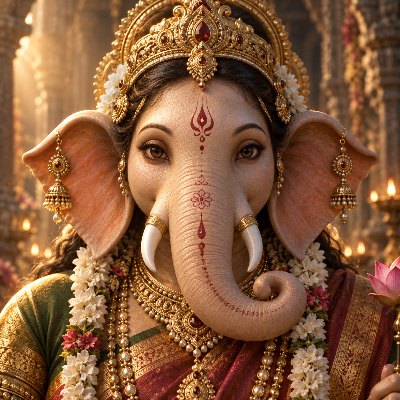
Malini — Elephant-Headed Goddess, Alternate Birth-Mother of Ganesha, and Attendant of Parvati
Malini · Mālinī · Gajanana Yogini (Tantric tradition) · Elephant-headed companion of Parvati
Malini is an elephant-headed divine being who appears in several Puranic and Tantric traditions in connection with the birth and upbringing of Ganesha, the elephant-headed son of Shiva and Parvati. She occupies two distinct roles across the textual tradition that cannot be merged into a single continuous narrative: in one account she is the being who gave physical birth to Ganesha after drinking Parvati's sacred bathwater, making her the gestational or surrogate mother of the god; in a separate tradition preserved in the Ganesha Purana context she is named as Parvati's personal maid and attendant who was present at Parvati's bathing and became associated with the infant Ganesha as a nursemaid. The Wikipedia Ganesha article confirms the bathwater-birth tradition as one of several alternative accounts of Ganesha's origin in the Puranic literature. The Wikipedia Vinayaki article notes that Malini is an elephant-headed demoness or divine being who is "remotely linked to Ganesha as a mother" but is not identified as Vinayaki in the primary sources. In the Tantric tradition she is associated with elephant-faced Yogini figures venerated in the medieval Chausath Yogini temple tradition, though a specific named identification of Malini as a listed Yogini by that name is not confirmed in the primary sources consulted. No parentage, origin narrative, or birth lineage for Malini herself is recorded in any primary source. The name Malini is also borne by several entirely distinct figures in the Puranic tradition — including a divine mother created by Shiva to drink the blood of Andhaka demons in the Matsya Purana (179.8) and a Shakti listed in the Brahmanda Purana (IV.36.76) — none of which are the same figure as the elephant-headed companion of Parvati.
✦ The Name
The Sanskrit name Malini is formed from mala, meaning garland or necklace, and the suffix ini, denoting a feminine possessor, yielding the sense "she who wears garlands" or "the garlanded one." In the dhyana descriptions of Tantric iconography, Malini is depicted wearing garlands of wild forest flowers, which is the etymological grounding of her name in that tradition. The name Malini is common in Sanskrit literature and applies to multiple distinct figures, requiring contextual identification in each case. The Wisdomlib compilation entry for Malini lists at least nine distinct figures who bear this name across the Puranic corpus, ranging from a river name to a Shakti designation to the divine mother figure of the Matsya Purana, none of whom are the elephant-headed companion of Parvati.
✦ The Bathwater Birth Account
The Wikipedia Ganesha article, drawing on the Puranic tradition, records the bathwater-birth account as one of the several alternative narratives of Ganesha's origin. In this account, Parvati was bathing in a sacred pool or river; the water that had washed her body — infused with her divine bodily paste and the generative energy inherent in the body of the goddess — flowed into or merged with the river Ganga. An elephant-headed being named Malini, who was nearby, drank this sacred water. Because the water carried the divine energy of Parvati, Malini became pregnant through this act of drinking. She subsequently gave birth to a child with four arms and five elephant heads. Shiva recognised the child as Parvati's own son — since the essential life-force of the child originated from Parvati's divine body — and declared him to be Parvati's child. Shiva reduced the five heads to a single elephant head and established the child as Vigneshvara, the remover of obstacles. The reflections.live account of lesser-known Ganesha stories, drawing on the Padma Purana tradition, confirms the five-headed birth detail and Shiva's recognition and reduction of the heads.
This account presents Malini neither as a conventional mother — since the child's essential identity derives from Parvati — nor as entirely separate from the birth process, since she was the physical being from whose body the child emerged. The tradition acknowledges this ambiguity by placing the resolution of Malini's claim to the child in Shiva's authoritative declaration rather than in any biological or legal framework. The specific Puranic text in which this account appears in full primary form is identified in secondary sources as belonging to the Padma Purana tradition; the Mudgala Purana and Matsya Purana are sometimes associated with related Ganesha birth narratives in secondary accounts but the specific chapter and verse reference for the Malini bathwater-birth account in those texts has not been independently confirmed in the primary sources consulted.
✦ Malini as Parvati's Attendant and Ganesha's Nursemaid
A separate and distinct tradition identifies Malini not as Ganesha's birth mother but as Parvati's personal maid and bathing attendant. The Kamakoti.org summary of the Ganesha Mahima — drawing on the Ganesha Purana tradition — explicitly names Malini as Parvati's maid who was present in the bathing room when Parvati, in a state of anger at having been interrupted during her union with Shiva, entered the bath. In this context Malini is identified as a member of Parvati's immediate household and inner circle of attendants rather than as a free-standing divine being.
In the Shaivite tradition preserved in secondary sources including the devdutt.com account and the MyLordGanesha.wordpress account, Malini was appointed after Ganesha's birth as the infant's nursemaid and foster mother. She nursed and cared for the infant Ganesha in the mountains and was deeply devoted to him. These two traditions — Malini as attendant present at the bathing and Malini as nursemaid after the birth — may represent two aspects of the same figure's story in a single extended Puranic account, or may represent independent traditions that converged on the same name. The MyLordGanesha.wordpress account notes explicitly that images sometimes identified as Vinayaki, the female form of Ganesha, may instead represent Malini the elephant-headed nursemaid companion of Parvati.
✦ Malini and the Elephant-Faced Feminine in the Tantric Tradition
The Wikipedia Vinayaki article surveys the tradition of elephant-faced female figures in the Puranas and Tantric temple tradition. The Harivamsha, the Vayu Purana, and the Skanda Purana all describe elephant-faced Matrikas — divine mothers — and ganas bearing names such as Gajananā (elephant-faced), Gajamukhi (elephant-faced), and Gajasya (elephantine). These figures form a broader category of elephant-headed feminine divine beings in the Shaiva and Tantric traditions within which Malini belongs. The Matsya Purana and the Vishnu-dharmottara Purana list Vinayaki — the shakti of Ganesha — among female warrior goddesses; some scholars and devotional traditions identify Malini as a manifestation or precursor figure within this broader elephant-headed feminine category, though the Wikipedia Vinayaki article is explicit that Malini "is not called Vinayaki" in the primary sources and is only "remotely linked to Ganesha as a mother."
In the Tantric tradition associated with the medieval Chausath Yogini temples — circular hypaethral shrines built between approximately 900 and 1200 CE at sites in Odisha and Madhya Pradesh — elephant-faced Yogini figures appear among the sixty-four divine female forces venerated in those temples. The Hirapur Chausath Yogini Temple (Odisha, circa 864 CE) and the Ranipur Jharial site contain Yogini sculptures with animal heads including elephant faces. The Scroll.in account of Vinayaki, drawing on the scholarly work of Prithvi K. Agrawala, confirms that one figure in the Hirapur temple — identified by Agrawala as Vinayaki rather than Malini — dances in the catura pose on a boar. Whether any of the elephant-faced Yogini figures in these temples is specifically identified as Malini in the inscriptional or textual record of those sites is not confirmed in the primary sources consulted; the association of Malini with the Chausath Yogini tradition rests on the broader identification of elephant-faced divine women in Tantra rather than on a named inscription or Yogini list that specifies her.
✦ Textual Variants and Inconsistencies
The two roles of Malini — birth mother and nursemaid attendant — cannot be reconciled within a single narrative without creating a circular account. If she is the being who gestated and birthed Ganesha from the bathwater, she cannot also be the pre-existing maid attendant who was present before the bathing episode that caused the pregnancy. The two traditions reflect different Puranic frameworks and different understandings of what Malini is: an independent elephant-headed divine being associated with the natural world who happened to drink the sacred water, or a domestic attendant already integrated into Parvati's household who became involved in Ganesha's upbringing.
The identification of the specific primary Puranic source for the bathwater-birth account varies in secondary literature. The reflections.live account attributes it to a Padma Purana tradition. The Wikipedia Ganesha article cites the account without naming a specific Purana. Secondary accounts cite the Matsya Purana, Skanda Purana, and Mudgala Purana variously, without providing chapter and verse references that would permit independent primary verification. This evidential situation is noted honestly: the bathwater-birth account is well attested as a recognised Puranic tradition but the precise canonical location of its fullest primary statement has not been independently confirmed in the sources consulted.
The name Malini itself requires disambiguation from at least two other figures in the Puranic literature. The Matsya Purana (179.8 and 179.35) records a Malini who is a mind-born divine mother created by Shiva to drink the blood of the Andhaka demons — an entirely different figure in a completely separate narrative context. The Brahmanda Purana (IV.36.76 and 96) and the Shiva Purana record Malini as a Shakti or mind-born mother in a further distinct context. Neither of these Purana references connects the figure named Malini to the elephant-headed companion of Parvati or to the Ganesha birth narrative.
✦ References
Primary Sources
- Padma Purana (tradition cited in secondary sources): The bathwater-birth account of Malini and Ganesha's five-headed birth is attributed in the reflections.live summary to the Padma Purana tradition; the specific chapter reference has not been independently verified.
- Matsya Purana, 179.8 and 179.35: Names a Malini among the mind-born divine mothers created by Shiva to drink the blood of Andhaka demons; this is a distinct figure from the elephant-headed companion of Parvati and is cited here for disambiguation.
- Brahmanda Purana, IV.36.76 and 96: Lists Malini as a Shakti and mind-born mother; a further distinct figure cited for disambiguation purposes.
- Ganesha Purana tradition (summarised in Kamakoti.org, Essence of Ganesha Mahima, V.D.N. Rao): The passage explicitly naming Malini as Parvati's maid who massaged her in the bathing room — "Gauri entered the Snana shaala and asked her maid Malini to massage her body" — is the primary source for the attendant tradition; the full Ganesha Purana chapter reference has not been independently verified.
- Harivamsha, Vayu Purana, Skanda Purana: Describe elephant-faced Matrikas and ganas bearing names such as Gajananā, Gajamukhi, and Gajasya; cited by the Wikipedia Vinayaki article as the textual basis for the broader tradition of elephant-headed feminine divine beings within which Malini is situated.
- Matsya Purana and Vishnu-dharmottara Purana: List Vinayaki — the shakti of Ganesha — among female warrior goddesses; cited in the MyLordGanesha.wordpress account as the source for the identification of the elephant-headed feminine divine with Ganesha's tradition.
Secondary and Reference Works
- Wikipedia — "Ganesha": Confirms the bathwater-birth account as one of the recognised alternative Puranic traditions of Ganesha's origin; states plainly that "he was born from the elephant headed goddess Malini after she drank Parvati's bath water that had been thrown in the river."
- Wikipedia — "Vinayaki": The most comprehensive secondary account of the elephant-headed feminine divine in the Hindu tradition; states that Malini is "remotely linked to Ganesha as a mother" but "not called Vinayaki" in the primary sources; provides the survey of elephant-faced Matrikas across the Harivamsha, Vayu Purana, and Skanda Purana.
- Wisdomlib — "Malini: 39 definitions": The most comprehensive compilation of all figures named Malini across the Puranic corpus; confirms the Matsya Purana 179.8 and Brahmanda Purana IV.36.76 references; establishes the need for disambiguation between multiple distinct figures of this name.
- Reflections.live — "Lesser-Known Stories of Lord Ganesha": Source for the five-headed birth detail and Shiva's recognition and reduction of the heads; attributes the Malini account to the Padma Purana tradition.
- Kamakoti.org — Essence of Ganesha Mahima (V.D.N. Rao): Source for the naming of Malini as Parvati's personal maid in the bathing room context; confirms the attendant tradition within the Ganesha Purana framework.
- MyLordGanesha.wordpress.com — "Ganesha Stories": Source for the observation that images sometimes identified as Vinayaki may represent Malini the elephant-headed nursemaid companion of Parvati; draws on the Matsya Purana and Vishnu-dharmottara Purana references for Vinayaki.
- Scroll.in — "Vinayaki: The Lesser-Known Story of the Elephant-Headed Goddess": Source for Prithvi K. Agrawala's identification of the dancing Yogini figure at the Hirapur Chausath Yogini Temple as Vinayaki rather than Malini; provides scholarly context for the elephant-faced Yogini in the Chausath Yogini temple tradition.
- Prithvi K. Agrawala, Goddess Vinayaki: The Female Ganesa (scholarly monograph): The principal modern scholarly work on the elephant-headed feminine divine in Hindu tradition; cited in the Scroll.in account for the iconographic analysis of the Hirapur temple figure.