
About
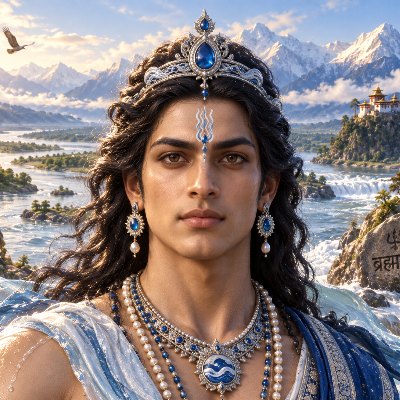
Brahmaputra — Son of Brahma, River God of Kamarupa, the Lauhitya
Brahmaputra · Lauhitya · Luit · Yarlung Tsangpo (Tibetan) · Brahmapuravāhī · Son of Brahma
Brahmaputra is a divine being and river deity whose origin myth is narrated principally in the Kalika Purana — an Upapurana composed in Kamarupa (present-day Assam), dated by scholarship to the ninth or tenth century CE — specifically in chapters 85 and 86. An earlier and shorter account appears in the Padma Purana's Srishti Khanda (the fifth book). He is the son of Brahma, the creator deity of the Hindu trinity, born through the mortal agency of Amogha, wife of the sage Shantanu of the eastern hill country, and placed by Shantanu at the centre of four sacred mountains where he assumed the form of a vast lake before flowing out as the river that bears his name. He is the only major river of the Indian subcontinent referred to in the masculine grammatical gender — all other principal rivers of India are feminine — a distinction the tradition grounds directly in his divine male parentage. His ancient name, preserved across the Ramayana, the Mahabharata, and the Puranas, is Lauhitya, derived from the lake Lohita near which his earthly parents dwelt. The Kalika Purana records that after his formation as the Brahmakunda lake, Parashurama — the sixth avatar of Vishnu, who was on pilgrimage after the sin of killing his own mother — came to the Brahmakunda, bathed there, and cut a channel with his axe through one side of the encircling mountains, releasing the waters to flow through Kamarupa and down to the southern sea.
✦ The Names
The name Brahmaputra is a Sanskrit compound formed from Brahma and putra — son — yielding the literal sense "son of Brahma." It is the name by which the river is known in Sanskrit, Assamese, and most Indian languages. The ancient name Lauhitya derives from the lake Lohita — the reddish or crimson-hued lake — near the mountain Gandhamadana on the outskirts of Kailasa where the sage Shantanu and his wife Amogha lived; the Kalika Purana connects the child's earliest identity to this lake. The Tibetan name Yarlung Tsangpo and the Arunachali designation Siang or Dihang are geographical designations for the same river in different portions of its course and carry no mythological significance of their own in the Hindu textual tradition. The river is called Luit in Assamese, a designation associated with the folk and cultural tradition of Assam. The name Brahmakunda designates the original lake form that the child Brahmaputra took when placed among the four mountains.
✦ Lineage
- Father (divine): Brahma — the creator deity of the Hindu tradition, first of the divine trinity, born of the golden cosmic egg or of the lotus emerging from Vishnu's navel; his energy was the source of Brahmaputra's being.
- Father (earthly, by adoption and placement): Shantanu — a sage of the eastern hill country of Kamarupa, who lived with his wife Amogha on the banks of the lake Lohita on the mountain Gandhamadana near Kailasa; the figure who placed the newborn child among the four mountains and thereby established the Brahmakunda. This Shantanu is entirely distinct from the Shantanu of the Mahabharata — the king of Hastinapura, husband of Ganga and Satyavati, and grandfather of the Kuru princes — who belongs to a completely different lineage and narrative tradition. The Hindutva.online account of the Kalika Purana explicitly notes this disambiguation.
- Mother (earthly and gestational): Amogha — wife of the sage Shantanu; the woman through whose body Brahmaputra was born; for whose piety and fitness Brahma selected her as the vessel for his son. The full account of her role is given in the Amogha profile.
✦ The Birth and Formation of the River
The Kalika Purana's chapters 85–86, as summarised in the Studies in the Upapuranas entry preserved at Wisdomlib, narrate the birth and early form of Brahmaputra with precision. Brahma, desirous of producing a son who would benefit humanity, selected Amogha, the wife of the sage Shantanu, as the appropriate vessel for this purpose. The Wisdomlib account of the Kalika Purana gives the mechanism of conception as follows: Brahma's energy was transferred to Amogha through the agency of Shantanu. A variant account in the Grokipedia Brahmaputra River article, also drawing on the Kalika Purana tradition, presents the conception differently: Amogha, having captivated Brahma with her beauty and piety, received his blessing directly and bore his son as a divine boon. Both accounts agree that the child was born with the nature of water rather than human flesh — the Kalika Purana uses the phrase jala-rupam tanayam, a son having the form of water — and that from the moment of birth he was not a human child but a divine aquatic being.
Shantanu, recognising the child's divine water-nature, placed him at the centre of four sacred mountains: Kailasa on the north, Gandhamadana on the south, Jarudhi on the west, and Samvartaka on the east. The Wisdomlib Studies extract records that the son of Brahma, once placed among these four mountains, created a kunda — a sacred lake — for himself and began to grow in volume over a long period, until he covered five yojanas with his waters and appeared like a second sea. This is the Brahmakunda, the originary sacred lake of the river. The Kalika Purana further records that this steady son of Brahma flooded Kamarupa, covering all its pools and holy places in his rising waters.
✦ Parashurama and the Release of the Waters
The Kalika Purana records a second major episode in Brahmaputra's sacred history — the act by which he was released from the Brahmakunda to flow as a river. Parashurama — the sixth avatar of Vishnu, who had committed the sin of killing his own mother at his father Jamadagni's command and whose axe had become stuck to his hand as a mark of that sin — was advised by sages to undertake a pilgrimage to sacred tirthas. He came eventually to the Brahmakunda, the lake formed by Brahmaputra among the four mountains. There he bathed and performed sacred acts. Brahma, pleased with Parashurama's devotion, used him as the instrument for releasing the river's waters for the benefit of humanity. The Kalika Purana records that Parashurama — described in the Wisdomlib Studies extract as Jamadagnya — cut a channel through one side of the surrounding mountains with his axe, releasing the rising waters of the Brahmakunda to flow downward through Kamarupa. Through this channel the waters descended and became the river. The same act released Parashurama's axe from his hand, thereby purifying him of the sin of his mother's killing. The spot where Parashurama cut the channel and bathed is known as Parashurama Kunda and is one of the most sacred tirthas associated with the Brahmaputra.
✦ The Vasishtha Curse and the Hidden Holy Places
The Wisdomlib Studies in the Upapuranas extract records a further detail from the Kalika Purana narrative: that as Brahmaputra flooded Kamarupa, covering all its pools and holy places, those sacred sites became hidden — submerged or concealed — as a result of a curse of the sage Vasishtha. The text states that those who could distinguish the Lauhitya and bathe in it would attain the results of such a bath, but that it would be impossible for them to find the pools and holy places which had begun to be hidden as a result of Vasishtha's curse. The nature and occasion of Vasishtha's curse are not elaborated in the Wisdomlib extract from the Kalika Purana; the tradition acknowledges the concealment as a theological fact without providing its full backstory in the passages consulted.
✦ Theological and Geographical Significance
Brahmaputra's theological significance is rooted in his unique status as the only major river of India that is male in gender — a distinction encoded in his name and affirmed by the tradition at every level. His divine parentage through Brahma gives him a cosmic status equivalent to the Ganga's divine status as the daughter of Himalaya and wife of Shiva. The Kalika Purana, composed in Kamarupa, presents the Brahmaputra not merely as a river but as the presiding divine presence of the northeastern region — his flooding of Kamarupa is not destructive but sanctifying, and bathing in his waters is presented as conferring the accumulated merit of bathing at all the holy places he covers. The Wikipedia Brahmaputra article notes that the river's sacredness in Hindu ritual is directly tied to its divine masculine parentage and to its role as the physical form of Brahma's son on earth.
✦ Textual Variants and Inconsistencies
The Padma Purana's Srishti Khanda (fifth book) is identified by the Theindianme.com account as the earliest textual narration of the Brahmaputra's origin story, predating the Kalika Purana's more detailed chapters 85–86. The Padma Purana account and the Kalika Purana account share the core elements — Shantanu, Amogha, Brahma's son, the four mountains, the Brahmakunda — but the Kalika Purana is the primary text that develops the Parashurama episode and the Vasishtha curse tradition. The mechanism of Brahma's energy entering Amogha is presented differently in different secondary summaries of the Kalika Purana, reflecting either manuscript variation or different emphases in the retelling tradition. The precise chapter references for the Padma Purana account have not been independently verified in the primary sources consulted.
✦ References
Primary Sources
- Kalika Purana, chapters 85–86: The principal primary source for the Brahmaputra origin myth; chapter 85 is titled "Rajadharma" and chapter 86 contains the story of the birth of Lauhitya from Amogha, wife of Shantanu; the Wisdomlib Studies in the Upapuranas entry (chapter 6.3) provides the most detailed extracted summary of these chapters, confirming the four mountains by cardinal direction, the Brahmakunda formation, the jala-rupam tanayam phrase, the Parashurama episode, and the Vasishtha curse tradition. The Kalika Purana is an Upapurana composed in Kamarupa, dated to between the ninth and tenth centuries CE.
- Padma Purana, Srishti Khanda (Book 5): Identified as the earliest textual narration of the Brahmaputra origin story; the Kalika Purana's account is understood as a later and more developed version of the same tradition; the specific chapter reference within the Srishti Khanda has not been independently verified.
Secondary and Reference Works
- Wisdomlib — Studies in the Upapuranas, chapter 6.3 (Kalika Purana study): The most detailed secondary account consulted; provides the extracted Sanskrit details of Kalika Purana chapters 85–86 including the jala-rupam tanayam phrase, the four mountains with cardinal directions, the Brahmakunda growing to five yojanas, the Parashurama axe-cutting episode, and the Vasishtha curse on the hidden holy places.
- Wisdomlib — Contents Summary of the Kalikapurana: Confirms chapter 85 as concerning rajadharma and identifies the Brahmaputra birth narrative as appearing in the adjacent chapters; confirms the Kalika Purana as the text describing the Brahmaputra River and the Kamakhya Temple in Kamarupa.
- Hindutva.online — "Brahmaputra River: Son of Brahma Story": The most explicit secondary account confirming the disambiguation of the Kalika Purana's Shantanu from the Mahabharata's Shantanu; provides the narrative sequence of the Kalika Purana's chapters 85–86.
- Grokipedia — "Brahmaputra River": Source for the variant account of Amogha captivating Brahma with her beauty; confirms the Kalika Purana as the tenth-century Tantric text and the river's sacred status in Hindu ritual.
- Theindianme.com — "Rivers in Indian Literature: The Brahmaputra": Source for identifying the Padma Purana's Srishti Khanda as the earliest textual narration; provides the name Lauhitya as the river's earliest designation and the Parashurama Kunda connection.
- Wikipedia — "Brahmaputra River": Confirms the river's unique masculine gender in the Indian river tradition and its sacred status derived from Brahma's paternity; provides the geographic details of the river's course through Tibet, Arunachal Pradesh, Assam, and Bangladesh.