
About
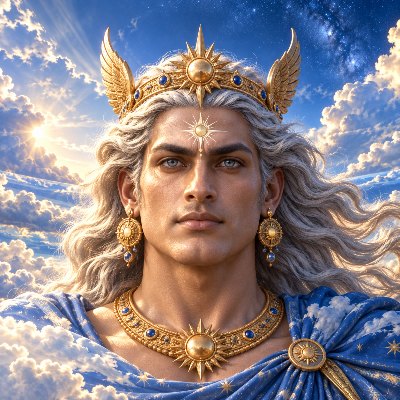
Dyaus — Vedic Sky Father and Progenitor Deity
Dyaus Pitar · Dyau · Dyaus Pita
Dyaus is one of the most archaic deities named in the Rigveda, personifying the sky or heaven in its paternal aspect. Together with Prithvi, the earth, he forms the primal parental dyad Dyava-Prithvi, addressed jointly in several Rigvedic hymns as the progenitors of the gods and of the created order. Dyaus has no hymn dedicated solely to him, but is named directly in a small number of verses across the first and fourth books of the Rigveda, where he is called the father of Indra, Agni, and Ushas. Separately, the name Dyaus is also applied, according to the Brihadaranyaka Upanishad's naming scheme for the eight Vasus, to the Vasu whom the Mahabharata's Adi Parva calls Prabhasa — the Vasu cursed by the sage Vasishtha and subsequently reborn as Bhishma, grandsire of the Kuru house. This profile treats the primordial Vedic sky father and this later Vasu identification as related but textually distinct layers of tradition, stated separately rather than merged into a single account.
✦ The Name
Dyaus derives from the Sanskrit root div, "to shine," and is cognate with the Latin deus and the Dyeus-pater underlying Iuppiter, as well as with the Greek Zeus, reflecting a shared Indo-European sky-father figure. The word dyaus, used without the epithet pitar, simply denotes the visible daylight sky and occurs in this plain sense hundreds of times across the Rigveda. When paired with pitar, "father," it names the personified god, Father Heaven, standing at the head of the pantheon's oldest genealogical layer.
✦ Lineage
- Spouse: Prithvi, goddess and personification of the earth, together forming the dual deity Dyava-Prithvi.
- Children: Indra, the storm-god and later king of the Vedic gods, is directly called Dyaus's offspring in one hymn; Ushas, goddess of the dawn, is repeatedly styled his daughter; and the wider company of gods, including Agni, are collectively described in Rigvedic verse as born of the Dyava-Prithvi pair.
✦ The Dyava-Prithvi Hymns
The clearest picture of Dyaus comes not from verses addressed to him alone but from hymns addressed to the joined pair, Heaven and Earth. In these hymns the two are praised as a mighty, unfailing couple who sustain all creatures, are entreated to grant strength, fame, and offspring to those who perform the sacrifice, and are asked to shelter worshippers from harm. The pair is occasionally described in feminine dual terms, as though both members were envisioned as sisters, alongside the more usual father-and-mother framing. Elsewhere, Dyaus alone is called a roaring bull, a mighty and adamant figure who is imagined smiling through the clouds, an image the tradition associates with lightning.
✦ The Vasu Narrative: Curse of Vasishtha and Rebirth as Bhishma
In the Mahabharata's Adi Parva, the eight Vasus, attendant deities of Indra representing the elements, wander into the forest ashram of the sage Vasishtha accompanied by their wives. There they see Nandini, a wish-granting cow belonging to Vasishtha. At the urging of one Vasu's wife, the group steals the cow. Vasishtha discovers the theft through his ascetic power and curses all eight to be born as mortals. Persuaded to soften the curse, he decrees that seven of the Vasus will be freed from mortal life within a year of birth, while the one who actually took the cow must live out a full human lifetime. The Vasus ask the river-goddess Ganga to be their mother; she marries King Shantanu on condition that he never oppose her, and drowns each of the first seven infants at birth to release them from the curse. When Shantanu finally stops her from drowning the eighth child, Ganga departs, leaving the boy to be raised as Devavrata, later renowned as Bhishma. The epic's own list of Vasu names calls the one who bore the curse's full weight Prabhasa, while the Brihadaranyaka Upanishad's separate list of eight Vasus gives the corresponding figure the name Dyaus, and tradition treats the two names as referring to the same individual under different textual conventions.
✦ Textual Variants
The Brihadaranyaka Upanishad names the eight Vasus as Agni, Prithvi, Vayu, Antariksha, Aditya, Dyaus, Soma, and the Nakshatras (the constellations), placing Dyaus among them. The Mahabharata's own enumeration instead gives Dhara, Anala, Anila, Apa, Pratyusha, Prabhasa, Soma, and Dhruva, with Prabhasa identified as the Vasu who commits the theft and is reborn as Bhishma. The two lists do not share a common naming convention, and later retellings differ on whether to call this figure Dyaus or Prabhasa, though both are understood to designate the same mortal-born Vasu.
✦ Theological Significance
Dyaus represents an inherited sky-father figure whose independent cult had already receded by the time the Rigveda took shape, with functional primacy passing to Indra, Varuna, and Agni. The plain noun dyaus, meaning the visible sky, occurs constantly through the text, while the personified god addressed as such receives comparatively little direct invocation, a pattern consistent with an older deity retained in genealogy and epithet more than in active worship.
✦ Connection to the Wider Genealogy
As the male member of the primal parental pair, Dyaus stands at the head of the Vedic pantheon's genealogical structure, named as father of Indra and of Ushas. Through the separate Vasu identification, his mortal incarnation as Bhishma places him, in an entirely different narrative register, at the founding generation of the Kuru dynasty, born to Ganga and King Shantanu and standing as celibate grand-uncle to both the Pandavas and the Kauravas.
✦ References
- Rigveda (1.89.4, 1.90.7, 1.159, 1.160, 1.164.33, 1.185, 1.191.6, 4.1.10, 4.17.4): source for Dyaus's independent verses and the Dyava-Prithvi dyad hymns.
- Brihadaranyaka Upanishad: source for the eight-Vasu list naming Dyaus among them.
- Mahabharata, Adi Parva (Sambhava Parva): source for the Vasu curse narrative and Bhishma's birth.
- Vettam Mani, Puranic Encyclopaedia: secondary reference for the Vasu entries and the Prabhasa/Dyaus identification.
- A. A. Macdonell, Vedic Mythology: secondary scholarly reference on Dyaus's diminished cultic role and Indo-European cognates.
- Monier-Williams Sanskrit-English Dictionary: secondary reference for the etymology of dyaus from the root div.