
About
Alakshmi — Goddess of Misfortune and Elder Sister of Lakshmi
Jyeshtha · Jyeshtha Devi · Daridra · Kalahapriya · Moodevi
Alakshmi is the Puranic goddess who personifies misfortune, poverty, discord, and inauspiciousness, standing as the direct counterpart to her younger sister Lakshmi, goddess of wealth and prosperity. She is most commonly identified with Jyeshtha, "the elder," a name reflecting the tradition that she emerged from the churning of the cosmic ocean, Samudra Manthana, before Lakshmi did. Where Lakshmi is said to dwell among the virtuous, clean, and industrious, Alakshmi is said to take up residence wherever there is filth, quarrel, laziness, and vice. Her story is told at greatest length in the Padma Purana's Kartika Mahatmya section, with further and partly conflicting references in the Linga Purana, the Markandeya Purana, and the Kalki Purana, and an early invocation against her appears in the Shri Sukta, an appended hymn transmitted with the Rigveda.
✦ The Name
Alakshmi combines the negating prefix a- with Lakshmi, "goddess of fortune," yielding the sense "not-Lakshmi" or "anti-Lakshmi." Her alternate name Jyeshtha means "the elder," marking her precedence over Lakshmi in the churning-of-the-ocean tradition. Daridra relates to poverty, and Kalahapriya means "one who loves quarrel," both descriptive epithets rather than proper names. In parts of South India she is also called Moodevi, a name carrying the same sense of an unwelcome, ill-omened elder goddess.
✦ Lineage
- Sister: Lakshmi, goddess of wealth and prosperity, later consort of Vishnu, born alongside or immediately after Alakshmi from the churning of the ocean.
- Spouse (Linga Purana): the sage Dussaha, to whom Vishnu gives her in marriage; he later abandons her once he discovers she cannot bear the presence of anything auspicious.
- Spouse (Padma Purana, Kartika Mahatmya): the sage Uddalaka, whom Vishnu personally persuades to marry her as his brother-in-law; the marriage likewise ends when her nature proves incompatible with his devout household.
- Spouse (Kalki Purana and Mahabharata references): Kali, the asura who personifies the current cosmic age, the Kali Yuga.
- Spouse (Markandeya Purana): Mrityu, the god of death, by whom she is said to have borne fourteen sons; the same text treats Nirriti, another wife of Mrityu, as a distinct goddess from Alakshmi rather than as another name for her.
✦ Birth at the Churning of the Ocean
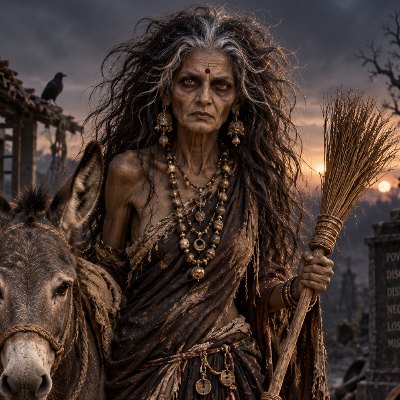
The Padma Purana places Alakshmi's origin at the Samudra Manthana, the churning of the milk ocean by the gods and demons, where she is said to have arisen from the poison that dripped from the mouth of the serpent Vasuki as he was used as the churning rope, appearing with a dark countenance, red eyes, rough and tawny hair, and an aged body, ahead of Lakshmi's own emergence, radiant and youthful, from the same ocean. Her precedence in this sequence is the basis for her name Jyeshtha, "the elder."
✦ Marriage to Uddalaka
According to the Padma Purana's Kartika Mahatmya, when Lakshmi emerged from the ocean, she refused to marry Vishnu ahead of her unmarried elder sister, out of concern for the religious impropriety of a younger daughter marrying first. Vishnu therefore approached the sage Uddalaka and asked him to marry Alakshmi, praising her as most worthy despite her appearance. Uddalaka agreed out of devotion to Vishnu and took Alakshmi to his hermitage. There she found she could not tolerate the chanting of Vedic hymns, the honoring of guests, or the performance of rituals, and declared that she felt at home only in places marked by gambling, theft, adultery, and disregard for sacred duty. In one telling she leaves the ashram of her own accord, unable to remain; in another, Uddalaka himself, unable to live with her, leads her into a forest, leaves her waiting beneath an Ashvattha (peepal) tree, and never returns, abandoning her there.
✦ Textual Variants
Alakshmi's origin, spouse, and even her relationship to other inauspicious goddesses are given differently across sources. Alongside the Vasuki-poison account of her birth, one tradition holds that Lakshmi was born from the radiance of Prajapati's face while Alakshmi was born from his back, and the Kartika Mahatmya elsewhere attributes her origin to the mud formed at the great dissolution of the universe, Mahapralaya, when all pure existence was absorbed into Narayana and only impurity remained behind as residue in the waters. Her husband is named as the sage Dussaha in the Linga Purana and as the sage Uddalaka in the Padma Purana's Kartika Mahatmya, while separately the Kalki Purana and passages associated with the Mahabharata make her the consort of the asura Kali, and the Markandeya Purana instead makes her a wife of Mrityu, Death himself. The Markandeya Purana further treats Nirriti and Alakshmi as two distinct goddesses sharing the same divine husband, whereas other sources use Nirriti as a further alternate name for Alakshmi outright. This profile records each version as given in its source rather than reducing them to a single account.
✦ Iconography and Worship
Alakshmi is depicted as an unattractive, unkempt woman with dishevelled hair, a sagging or emaciated body, and a countenance marked by hunger and greed, in deliberate contrast to Lakshmi's youthful radiance. She is associated with the donkey and the crow as mounts or emblems, and with the broom, symbolizing both the sweeping away of filth and her own habitation of unswept, neglected places. Households traditionally hang chilies and limes at thresholds and shop entrances in the belief that Alakshmi, drawn to consume them, will be satisfied and pass by without entering further. Sculptural depictions of Jyeshtha survive from early medieval South India, including an image at the Kailasanatha temple in Kanchipuram, though her active worship as a distinct temple deity became rare in later centuries.
✦ Theological Significance
Alakshmi functions in Puranic thought as the necessary shadow of Lakshmi, expressing the belief that prosperity and misfortune are not distributed at random but follow from a household's conduct: cleanliness, honesty, hospitality, and devotion invite Lakshmi's presence, while filth, deceit, and neglect of ritual duty invite Alakshmi's. The Shri Sukta, an appended hymn transmitted with the Rigveda, contains an explicit prayer asking that hunger, thirst, and the impurity named Jyeshtha Alakshmi be banished from the worshipper's home, indicating that the goddess of misfortune was invoked negatively, as something to be warded off, from a relatively early period of the textual tradition.
✦ Connection to the Wider Genealogy
Alakshmi's genealogical significance rests chiefly on her sisterhood with Lakshmi, both figures counted among the beings produced by the churning of the cosmic ocean by the gods and the demons. Through this shared origin she is placed alongside the other products of that churning within the itihasa-Puranic tradition, while her several marriages, to the sages Dussaha and Uddalaka, to the asura Kali, and to the god Mrityu, extend her genealogical connections outward into quite different corners of the tradition depending on which text is followed.
✦ References
- Padma Purana (Kartika Mahatmya section, Uttara Khanda): principal source for Alakshmi's birth from Vasuki's poison, her marriage to Uddalaka, and her abandonment beneath the Ashvattha tree.
- Linga Purana: source for the alternate marriage account naming the sage Dussaha as her husband.
- Markandeya Purana: source for Alakshmi as a wife of Mrityu bearing fourteen sons, and for distinguishing her from Nirriti.
- Kalki Purana: source for Alakshmi as consort of the asura Kali in the Kali Yuga.
- Shri Sukta (Khila appendix transmitted with the Rigveda): source for the early invocation banishing Jyeshtha Alakshmi from the household.
- Vettam Mani, Puranic Encyclopaedia: secondary reference cross-checking the variant spouse and origin traditions.
- Monier-Williams Sanskrit-English Dictionary: secondary reference for the etymology of Alakshmi and Jyeshtha.