
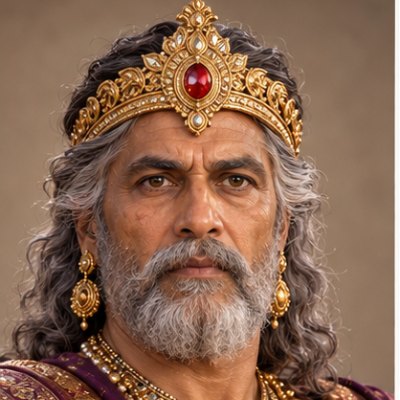
About
Dirghatamas — King of the Kashi Line, Father of Dhanvantari
Dirghatama · Dirghatapa
This Dirghatamas is a king of the Kashi branch of the Lunar dynasty, recorded as the son of Rashtra in the Bhagavata Purana's version of the lineage, as the son of Kasiraja in the Vishnu Purana's shorter version, or as one of two sons of Kasha in the Harivamsha's version, and in all three as the father of Dhanvantari, the Kashi king credited with founding Ayurvedic medicine. He appears solely within these Kashi genealogical lists, with no independent narrative episode recorded of him beyond his position in the succession. This king must be clearly distinguished from the far better attested Rigvedic sage of the same name, Dirghatamas, son of the sage Ucathya and Mamata, a blind seer credited with hymns in the first book of the Rigveda; the two figures share only a name and are never identified with one another in the genealogical sources consulted here.
✦ The Name
Dirghatamas combines dirgha, "long," with tamas, "darkness," giving the sense "one of long darkness." The Harivamsha's variant, Dirghatapa, substitutes tapas, "penance" or "ascetic heat," for tamas, yielding instead "one of long penance." The difference in meaning between the two forms is substantial enough that they may preserve two originally separate name-traditions rather than a simple spelling variation.
✦ Lineage
- Father: named Rashtra in the Bhagavata Purana, Kasiraja in the Vishnu Purana, or Kasha in the Harivamsha, depending on the source's version of the preceding generations.
- Son: Dhanvantari, held by the tradition to be a shaktyavesha incarnation, an empowered partial incarnation, of Vishnu, and credited as the founder of Ayurveda. This Dhanvantari is described in the same sources as a second birth into the world of men, following the completion of Dirghatamas's austerities, of the being who had earlier arisen from the ocean bearing the vessel of amrita during the churning performed by the gods and demons — a figure this profile treats as textually identified with, but narratively distinct in origin from, the king born as Dirghatamas's son.
✦ Disambiguation from the Rigvedic Sage Dirghatamas
The Rigvedic Dirghatamas is an unrelated figure: a sage born blind, son of the sage Ucathya and his wife Mamata, credited with a number of hymns in the Rigveda's first book. Later epic and Puranic tradition tells of this sage being cast adrift on a river by his own resentful sons, being rescued by King Bali of the Anga kingdom, and fathering, through the practice of niyoga upon Bali's queen Sudeshna, five sons — Anga, Vanga, Kalinga, Pundra, and Suhma — who became the eponymous ancestors of the kingdoms bearing their names. No source consulted for the Kashi royal genealogy identifies this Rigvedic sage with the king Dirghatamas who fathered Dhanvantari; the resemblance is one of name alone.
✦ Connection to the Wider Genealogy
Dirghatamas stands as the last purely human generation of the Kashi line before Dhanvantari's incarnation, marking the transition point in the dynasty between its ordinary royal succession and the arrival, in his son, of a figure the tradition regards as directly empowered by Vishnu. Dhanvantari's own descendants, Ketumat, Bhimaratha, and Divodasa, continued to rule the Kashi kingdom for several further generations.
✦ References
- Vishnu Purana, Book IV, Chapter XIX (Wilson translation): source for the Kasiraja-Dirghatamas-Dhanvantari sequence.
- Bhagavata Purana (9.17.4–5): source for the Rashtra-Dirghatama-Dhanvantari sequence and Dhanvantari's status as a shaktyavesha incarnation of Vishnu.
- Harivamsha (Dutt translation, Chapter 29): source for the Kasha-Dirghatapa-Dhanvantari sequence and Dhanvantari's rebirth from the ocean.
- Rigveda, Book I and associated Puranic and epic material (Anga/Vanga/Kalinga origin story): source for the unrelated Rigvedic sage of the same name, cited here for disambiguation only.
- Vettam Mani, Puranic Encyclopaedia: secondary reference distinguishing the two figures named Dirghatamas.
- Monier-Williams Sanskrit-English Dictionary: secondary reference for the etymologies of dirgha, tamas, and tapas.