
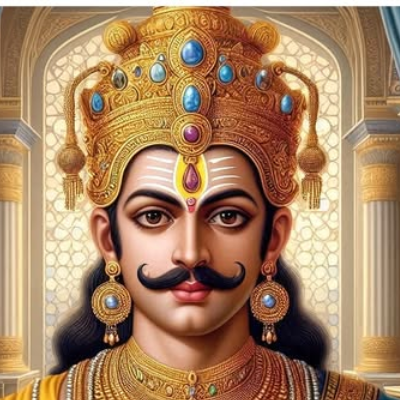
About
Yudhishthira — Dharmaraja, the Just King of the Kuru Line
Dharmaraja · Ajatashatru · Bharatashreshtha · Pandavagrajah · Kurushreshtha · Partha · Sahayapandava
Among the five Pandavas, Yudhishthira is the most paradoxical — the most revered and the most questioned, the most righteous and the most ruinous, the king who won an empire and then gambled it away, the man who never spoke an untruth and yet whose silences and omissions caused catastrophes. He is the eldest son of Pandu, born of the god Dharma himself, and he carries that divine parentage as both a crown and a cross. To study Yudhishthira is to confront the most searching questions the Mahabharata poses: What is dharma when it conflicts with itself? What is truth when it destroys? What is a king's duty when the scales of justice tip against his own kin?
✦ Born of Dharma — The First and the Just
Yudhishthira was born to Kunti through the invocation of Yama-Dharmaraja — the god of death, justice, and cosmic order. His birth was the first fruit of Kunti's divine mantra, and from the very beginning he was marked as one set apart. Celestial voices at his birth proclaimed that he would be the greatest king of his age, unmatched in virtue, and that his fame would spread across the three worlds. His very name — Yudhishthira, "steadfast in battle" — contained a prophecy, though the steadfastness he would most famously display was not on the battlefield but in the court of conscience.
As a child and young prince at Hastinapura, Yudhishthira was distinguished above all by his calm, his fairness, and his absolute refusal to speak falsehood — a quality so consistent and so absolute that the earth itself, it was said, trembled slightly when he eventually broke it. He trained under Dronacharya alongside his brothers and the Kauravas, excelling most in the wielding of the spear — though it was never his weapons but his words and his silences that shaped the course of events around him.
✦ Lineage — The Eldest Thread of the Lunar Weave
Yudhishthira stands at the head of the Pandava line within the grand Chandravamsha — the Lunar Dynasty — as the eldest son of Pandu and the legal heir of Hastinapura.
- Divine Father: Yama (Dharmaraja) — lord of death, justice, and cosmic order; keeper of the balance of karma
- Mother: Kunti (Pritha) — princess of the Yadava line, adopted daughter of Kuntibhoja
- Legal Father: King Pandu of Hastinapura — son of Vyasa and Ambalika
- Paternal Grandfather: Vyasa (Krishnadvaipayama) — the great rishi, compiler of the Vedas and author of the Mahabharata itself
- Younger Brothers: Bhima (son of Vayu), Arjuna (son of Indra), Nakula and Sahadeva (sons of the Ashvins by Madri)
- Half-Brother: Karna — the tragic elder, born of Kunti and Surya before her marriage, whose identity was concealed from Yudhishthira until after the war
- Paternal Uncle: Dhritarashtra — the blind king of Hastinapura, father of the Kauravas
- Dynastic Line: Lunar Dynasty (Chandravamsha) → Kuru → Shantanu → Pandu → Yudhishthira
Wife and Son:
- Draupadi (Panchali) — his first and primary queen among the five shared wives; bore him Prativindya, slain in Ashvatthama's night raid
- Devika — princess of Shibhi, married during his conquest of kingdoms; bore him Yaudheya
- Grandson: Parikshit — son of Abhimanyu, revived by Krishna and crowned as successor to the Kuru throne
✦ The Rajasuya — A Kingdom at Its Zenith
The crowning achievement of Yudhishthira's early reign was the Rajasuya Yajna — the imperial consecration ceremony that proclaimed him sovereign over all kings of Bharata. To perform this sacrifice, every king on the subcontinent had to be brought into submission — through tribute, alliance, or conquest. His brothers campaigned in all four directions: Arjuna to the north, Bhima to the east, Nakula to the west, and Sahadeva to the south, each subduing kingdoms and returning with tribute.
The Rajasuya was held at Indraprastha — the magnificent new capital built for the Pandavas by the divine architect Maya on the site of the Khandava forest — and was attended by kings, sages, and gods from across the known world. The honour of the first offering was given to Sri Krishna at Bhishma's insistence, enraging the proud Shishupala, whose hundred accumulated offences against Krishna were finally answered with death. The ceremony marked the peak of Pandava power — and, as such, the very moment that made the Kauravas' envy and Shakuni's scheming irresistible.
✦ The Dice Game — The One Fall That Felled an Age
No episode in Yudhishthira's life casts a longer shadow than the dice game of the Sabha Parva. Invited by Dhritarashtra to Hastinapura for a game of dice, and unable to refuse without appearing to violate the code of a kshatriya — for a king must not refuse a challenge — Yudhishthira sat across from Shakuni, who played in Duryodhana's stead with loaded dice.
He lost steadily and catastrophically: his treasury, his kingdom of Indraprastha, his armies, his brothers one by one, himself — and finally, most devastatingly, Draupadi. The staking and loss of Draupadi is the act for which Yudhishthira has been both condemned and defended across millennia of commentary. Was he entitled to stake her after having already lost his own freedom? Was it a failure of dharma or a helpless submission to kshatriya compulsion? The Mahabharata poses the question with shattering force and declines to give a clean answer.
This single act of gambling set in motion the entire chain of exile, humiliation, and war. Yudhishthira himself, in moments of bitter self-reflection during the forest years, acknowledged that his addiction to dice — which he called his one great vice — was the proximate cause of every suffering his family endured. His honesty about his own failure is, paradoxically, one of his most human qualities.
✦ The Forest Years — A King Without a Throne, a Man With a Mirror
The thirteen years of exile — twelve in the forest and one incognito — were for Yudhishthira less a physical ordeal than a prolonged spiritual examination. He received Surya's Akshayapatra to feed his family, studied statecraft and dharma under visiting sages, and received from the sage Brihadashva the story of Nala and Damayanti — a parable of a king destroyed by dice, who yet reclaimed his kingdom — as both consolation and instruction.
The most philosophically celebrated episode of the exile is the Yaksha Prashna — the riddle contest at a forest lake. A crane-demon (later revealed as Yama himself in disguise) had killed each of Yudhishthira's brothers when they tried to drink from the lake without answering his questions. Yudhishthira alone sat down calmly to answer. The Yaksha's questions ranged across cosmology, ethics, statecraft, and the nature of the self — and Yudhishthira answered every one with such precision and wisdom that Yama revealed himself, praised his son, and restored all four brothers to life. As a boon Yudhishthira asked only that Nakula be restored, so that Madri's line not be entirely extinguished — an act of generous equity over personal love that revealed the full measure of his character.
During the incognito year at King Virata's court, Yudhishthira served as Kanka, a brahmin skilled in dice — a bitterly ironic disguise — and served as the king's gaming companion. Even in humiliation, he maintained perfect composure and concealment.
✦ The Half-Truth That Won a War — and Its Cost
On the fifteenth day of the Kurukshetra war, with Dronacharya fighting in an unstoppable fury that threatened to annihilate the Pandava forces, Krishna devised a stratagem: spread the news that Drona's son Ashvatthama had been killed, so that Drona's will to fight might be broken. Bhima killed an elephant named Ashvatthama and shouted the news across the battlefield.
Drona refused to believe it unless Yudhishthira confirmed it — for Yudhishthira had never spoken an untruth. Under tremendous pressure from Krishna, Yudhishthira declared: "Ashvatthama is dead" — and then added, almost inaudibly, "the elephant." It was the only near-falsehood of his life. Its consequence was immediate and symbolic: his chariot, which had always ridden four fingers above the earth as a mark of his perfect truthfulness, descended and touched the ground. Drona, broken by grief, laid down his arms and was slain by Dhrishtadyumna.
This single compromise — made for the greatest of strategic reasons — haunted Yudhishthira for the rest of his life, and forms one of the Mahabharata's most precise moral investigations: whether a lie in service of a righteous war is still a lie, and whether the universe adjusts its scales regardless of intention.
✦ The Weight of the Crown — Rulership, Grief, and the Shanti Parva
After the war, Yudhishthira was crowned emperor at Hastinapura — but he was a man hollowed by grief. The deaths of millions, the fall of Abhimanyu, the revelation that Karna was his elder brother whom he had fought against and whose death he had implicitly sanctioned — all of this pressed upon him with tremendous weight. He wished to renounce the throne and retire to the forest. It was Bhishma, lying on his bed of arrows at Kurukshetra, who called him back to duty.
The Shanti Parva and Anushasana Parva of the Mahabharata — two of its longest sections — record the vast teachings Bhishma delivered to Yudhishthira from his deathbed: on dharma, on statecraft, on the duties of a king, on the nature of liberation. These sections, containing hundreds of sub-stories and philosophical discourses, exist because Yudhishthira asked the right questions of the right man at the right moment — and had the patience and humility to receive the answers. In this sense Yudhishthira is not only the subject of the epic but one of its primary vehicles of wisdom.
✦ The Ashvamedha, the Farewell, and the Dog That Walked to Heaven
Yudhishthira performed the Ashvamedha Yajna to cleanse the sin of the war from his lineage and consolidate his imperial rule. He reigned for thirty-six years after Kurukshetra — a reign described as just, prosperous, and marked by the absence of conflict — until the news of Krishna's departure from the mortal world reached Hastinapura.
With Krishna gone, Yudhishthira knew the age of the Pandavas was over. He installed Parikshit on the throne, dressed himself in bark garments, and led the Mahaprasthana — the great final journey — northward through the Himalayas toward Mount Meru. His brothers and Draupadi fell one by one along the way. When each fell, Yudhishthira did not stop — for one who has renounced the world does not turn back for the fallen. He walked on, increasingly alone, until only he remained — and a small stray dog that had followed the party from the beginning.
At the gates of Svarga, the god Indra came in his chariot to receive Yudhishthira — the only mortal to be invited to heaven in his physical body. But Indra said the dog could not enter. Yudhishthira refused to abandon the dog, which had followed him faithfully: "I cannot abandon one who is devoted to me and who is afraid — this is my eternal vow." He was willing to forgo Svarga itself rather than betray a creature that trusted him. The dog then revealed itself as Yama — his divine father — and declared that this final test was the greatest Yudhishthira had ever passed.
✦ The Trial of Heaven — Hell Witnessed and Dharma Confirmed
Even upon reaching Svarga, Yudhishthira's trials were not complete. He found his cousins the Kauravas — Duryodhana included — seated in celestial splendour, while he was shown his brothers and Draupadi suffering in a region of hell. Outraged, he chose to stay with those who suffered rather than enjoy heaven without them. This final act of solidarity prompted the gods to reveal that it was one last illusion — a test — and that his family was in truth already in their celestial abodes. Yudhishthira was then bathed in the divine river, shed his mortal body, and ascended to his eternal place among the gods — Dharmaraja reunited at last with Dharma.
✦ Eternal Legacy — The Mirror of Dharma
Yudhishthira's legacy is the most morally complex of all the Pandavas. He is neither a flawless hero nor a cautionary failure — he is something far more true and far more difficult: a good man navigating an impossible world, making choices that are simultaneously virtuous and catastrophic, righteous and ruinous. The Mahabharata does not vindicate him simply, nor does it condemn him simply. It presents him as the fullest possible portrait of what it means to try to live by dharma when dharma itself is uncertain.
He is revered across India as the embodiment of satya (truth) and ahimsa (non-harm), and his name is synonymous with justice and equanimity in the face of loss. His epithet Ajatashatru — one who has no enemies — speaks not of military dominance but of a quality of spirit so fair and so without malice that even those who opposed him could not sustain personal hatred toward him. In the end, he walked into heaven with a dog at his heels — and refused to enter without it. That is Yudhishthira's truest monument.
✦ Primary Scriptural References
- Mahabharata (Vyasa) — Adi Parva, Sabha Parva (dice game and Draupadi's humiliation), Vana Parva (Yaksha Prashna, Nala-Damayanti), Virata Parva, Udyoga Parva, Drona Parva (the half-truth about Ashvatthama), Shanti Parva, Anushasana Parva, Ashvamedha Parva, Mahaprasthanika Parva, Svargarohana Parva
- Bhagavata Purana — references to Yudhishthira's reign, his relationship with Krishna, and his role in the Rajasuya yajna and the events following Krishna's departure
- Vishnu Purana — Yudhishthira's lineage within the Lunar Dynasty and the prophetic accounts of his reign marking the transition into the Kali Yuga
- Yaksha Prashna — preserved as an independent philosophical text within the Vana Parva, widely studied as a standalone compendium of dharmic wisdom in the form of riddles and answers
- Dharmashastra literature — Yudhishthira's dialogues with Bhishma in the Shanti and Anushasana Parvas are extensively quoted in later commentarial traditions on kingship, ethics, and moksha dharma
"He never claimed to be without fault — and that honesty, more than any victory, was the truest mark of the just king."