
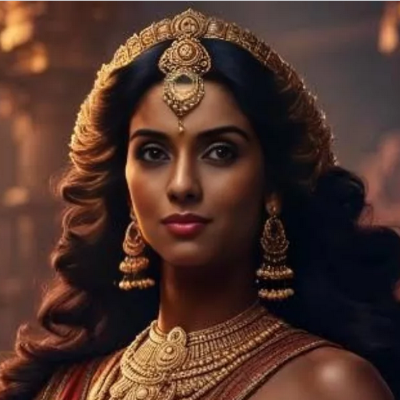
About
Draupadī — Pāñcālī, the Fire-Born Queen
Yajñaseni · Kṛṣṇā · Mahābhāratī · Sairandhri · Nitāyuvanī
Among all the women who grace the vast canvas of Itihāsa, Draupadī stands apart — radiant, complex, and utterly irreducible. Born from sacred fire rather than a mortal womb, she was not merely a queen or a wife; she was the living instrument of cosmic reckoning. Her life is inseparable from the great wheel of dharma and adharma that turns at the heart of the Mahābhārata, and her suffering — as much as her dignity — set in motion the annihilation of an age.
✦ The Birth from Sacred Flame
Draupadī did not enter the world through natural birth. She arose — fully formed, clothed in celestial garments, adorned with divine fragrance — from the Yajñakuṇḍa, the sacrificial fire-pit of King Drupada of Pāñcāla. Her emergence was the fruit of a great putrakāmeṣṭi yajña performed by the seers Yaja and Upayaja at the king's behest, who desired both a son to avenge his humiliation at the hands of Droṇācārya, and a daughter destined to be the cause of that avenger's glory.
At her emergence, a disembodied celestial voice proclaimed: "She shall accomplish the purpose of the gods; she will be the cause of the destruction of many kṣatriyas." Her complexion was described as dark like a blue lotus — hence her name Kṛṣṇā — and her beauty was said to surpass the apsarās themselves. Her twin brother Dhṛṣṭadyumna arose simultaneously, destined to slay Droṇa.
✦ Lineage & The Web of Kinship
Draupadī belongs to the Lunar Dynasty (Candravamśa) through her marriage into the Pāṇḍava line, though her natal lineage traces to the ancient Pāñcāla kingdom.
- Father: Drupada (Yajñasena), King of Pāñcāla — a monarch of the Lunar line, friend-turned-rival of Droṇācārya
- Mother: Pṛṣatī (Queen of Pāñcāla) — though tradition holds Draupadī had no biological mother, being fire-born
- Twin Brother: Dhṛṣṭadyumna — Commander-in-Chief of the Pāṇḍava forces at Kurukṣetra
- Husbands (the Five Pāṇḍavas):
- Yudhiṣṭhira — eldest, born of Dharmarāja; she bore him Prativindya
- Bhīma — born of Vāyu; she bore him Śrutasoma
- Arjuna — born of Indra; she bore him Śrutakīrti
- Nakula — born of the Aśvins; she bore him Śatānīka
- Sahadeva — born of the Aśvins; she bore him Śrutakarman
- Sons (the Upapāṇḍavas): Prativindya, Śrutasoma, Śrutakīrti, Śatānīka, and Śrutakarman — five princes who fell in the night raid of Aśvatthāmā
- Spiritual Guardian: Lord Śrī Kṛṣṇa — her sakhā (sacred friend and protector), who called her Sakhi and she called him Sakha
✦ The Svayaṃvara — An Arrow, a Fish, and a Crown
King Drupada devised a near-impossible svayaṃvara challenge to secure the greatest archer in the world as his daughter's husband: a mechanical revolving fish suspended high above a pool of water, to be struck in the eye using only its reflection as guide, with a bow of extraordinary weight. Princes from every kingdom — Duryodhana, Karṇa, Śalya, and countless others — failed or were refused. Only Arjuna, disguised as a brahmin, succeeded.
Through the words of Kuntī — spoken without knowing the context — Draupadī became wife to all five Pāṇḍavas. The sage Vyāsa confirmed the arrangement as dharmic, revealing that in a prior life she had performed austerities and asked Śiva for a husband five times — Śiva granted her five husbands across her next birth. Each Pāṇḍava was her husband for one year in rotation, and during that time she was wholly devoted to that husband alone.
✦ The Great Desecration — and the Vow That Shook the World
The most searing episode in Draupadī's life — and one of the most consequential moments in all of Itihāsa — occurred in the Sabhāparva of the Mahābhārata. Having lost everything in the rigged dice game orchestrated by Śakuni, Yudhiṣṭhira staked and lost Draupadī herself. She was dragged by her hair into the court of Hāstinapura by Duḥśāsana, where Duryodhana commanded her disrobing before the assembled kings and elders.
As her sari was pulled, Draupadī — in absolute surrender and with unshakeable devotion — cried out to Śrī Kṛṣṇa. He, though absent in body, responded: an infinite flow of cloth poured from her garment, exhausting Duḥśāsana's arms. This divine protection became one of the most celebrated acts of bhakti and grace in all of the Purāṇic canon.
In that court, Draupadī posed a question that no elder — not Bhīṣma, not Droṇa, not Vidura — could definitively answer: "Was a man who had already gambled himself away still the master of his wife?" Her intellectual and moral challenge to the assembly remains one of the earliest recorded arguments for the dignity and legal personhood of women in ancient literature. She extracted three boons from the shaken Dhṛtarāṣṭra and secured the Pāṇḍavas' freedom. Before leaving, she let her unbound hair remain loose — a vow: she would not bind it again until it was washed in Duḥśāsana's blood.
✦ The Exile, the Forest, and Unfailing Resolve
During the twelve years of forest exile and the year of ajñātavāsa (incognito), Draupadī was not a passive companion but a fierce moral force. She repeatedly stirred Yudhiṣṭhira and Bhīma from resignation, invoking the duties of a kṣatriya to protect his family and reclaim honour. When the sage Jayadratha abducted her, it was her resolute spirit — and Bhīma's pursuit — that led to his humiliation.
During the year of disguise at King Virāṭa's court, she served as Sairandhri, a ladies' attendant. When Kīcaka made improper advances, she orchestrated his death through Bhīma — even in disguise, she never once surrendered her dignity.
The Akṣayapātra — the inexhaustible vessel granted by Sūrya — was given specifically for Draupadī's sake, so that she could feed her husbands and the guests who came to them in the forest without ever exhausting provisions.
✦ Kurukṣetra — The Debt Repaid in Blood
The eighteen-day war at Kurukṣetra was, in no small measure, the manifestation of Draupadī's unfulfilled vow. On the fourteenth day, Bhīma slew Duḥśāsana, tore open his chest, and brought his blood to Draupadī — who, at last, bathed her hair and bound it again. Her vow, held across years of exile and humiliation, was fulfilled. Duryodhana was slain by Bhīma thereafter.
Yet her grief did not end with victory. On the final night of the war, Aśvatthāmā crept into the Pāṇḍava camp and slew all five Upapāṇḍavas — her sons — as they slept. This loss, perhaps the most devastating of all, she bore with the restrained anguish of a queen. She demanded justice; Arjuna captured Aśvatthāmā and his divine gem was stripped from him as penance — though he was spared death at Draupadī's own insistence, for he was the son of her guru Droṇa.
✦ The Mahāprasthāna — The Final Walk
After the Pāṇḍavas installed Parīkṣit on the throne of Hāstinapura, they renounced the world and undertook the great mahāprasthāna — the final journey northward toward the Himālayas. Draupadī walked with them. She was the first to fall during the ascent. Yudhiṣṭhira, when asked why, answered quietly: she had favoured Arjuna above the others. It was the only flaw named — and it was also, perhaps, the truest and most human truth about her.
✦ Eternal Legacy
Draupadī endures not as a symbol of victimhood, but as one of the most morally complex, intellectually fierce, and spiritually luminous figures in world literature. She embodies the tension between dharma and krodha (righteous anger), between devotion and pride, between duty and desire. Her relationship with Kṛṣṇa — as sakhī to sakha — is revered as one of the purest examples of divine friendship and surrender. She is worshipped as a goddess in parts of South India, particularly in Tamil Nadu, where her cult — Draupadī Amman — includes fire-walking festivals in her honour.
✦ Primary Scriptural References
- Mahābhārata (Vyāsa) — Ādi Parva, Sabhā Parva, Āraṇyaka Parva, Virāṭa Parva, Udyoga Parva, Strī Parva, Mahāprasthānika Parva
- Devī Bhāgavata Purāṇa — references to her past life austerities and Śiva's boon granting her five husbands
- Skanda Purāṇa — passages on her divine nature and veneration in regional traditions
- Mahābhārata Tātparyanirṇaya of Madhvācārya — theological commentary on Draupadī as an avatāra of the goddess Śrī
- Folk Mahābhāratas of Tamil Nadu — Draupadī cult texts forming the liturgical basis of Draupadī Amman temple traditions
"She was not destroyed by the fire — she was born of it. And in that distinction lies the whole truth of Draupadī."