
About
Yaudheya — The Sivi King, Son of the Just, Dharma Continued
Yaudheya · Devaka · Siviraja · Yudhishthira-suta · Govasana-pautra · Dharmaputra-anuja
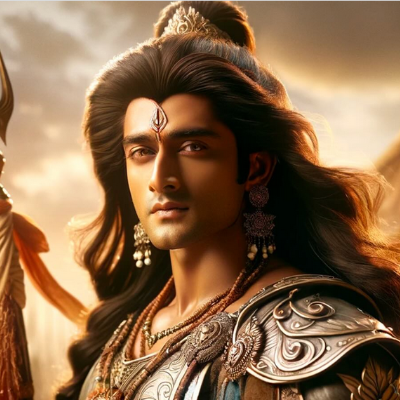
Among the sons of Yudhishthira, Yaudheya stands apart in one decisive respect: he survived the Kurukshetra war. Where Prativindhya — Yudhishthira's son by Draupadi, the eldest of the five Upapandavas — was killed in the Sauptika night raid alongside his four brothers, Yaudheya — son of Yudhishthira by Devika, prince of the Sivi kingdom — lived through the war, inherited his maternal grandfather's kingdom when Govasana fell at Kurukshetra, and ruled the Sivi realm as a king of dharmic character in the post-war generation. He is the son of the most just man in the epic, born of a Sivi princess who embodied the most refined qualities of her ancient and compassionate royal lineage, taught by both Vedavyasa and Krishna in the traditions that record his formation, and shaped by his half-brothers the Upapandavas into a cordial and warm fraternal relationship that lasted until the Sauptika night took them all in a single stroke. He is, in his survival and in his kingship, one of the rare continuing threads of Yudhishthira's direct lineage — proof that dharma, embodied fully enough across two generations, does sometimes persist into a world that has done everything in its power to consume it.
✦ The Name — Born of Yudhishthira, Carrying His Essence
The name Yaudheya is a metronymic and patronymic construction drawn directly from his parents' identities. Its primary formation derives from Yudhishthira — condensed and transformed through the standard Sanskrit metronymic suffix into Yaudheya: he who is of Yudhishthira's line, son of the steady-in-battle one, the Yudhishthirian one. It is the name that announces, in its very syllables, whose son he is — the name that places his entire identity within the frame of his father's defining characteristic.
He is also recorded in some traditions as Devaka — a name derived from his mother Devika, following the same metronymic pattern: he who is of Devika's line, the Devika-born one. The Vishnu Purana passages that invert the names — calling the mother Yaudheyi and the son Devaka — are a textual variant that scholars note, but the more widely established tradition across the secondary sources gives the son's name as Yaudheya and the mother's name as Devika. That he carries two possible names — one from his father, one from his mother — reflects his position at the exact intersection of the Pandava-Kuru tradition and the Sivi-Shaivya tradition, belonging fully to both.
✦ Born Between Two Worlds — Pandava Prince and Sivi Heir
Yaudheya was born the son of Yudhishthira and the grandson of King Govasana of the Sivi kingdom — which placed him simultaneously in two distinct dynastic positions. Through his father he was a prince of the Chandravamsha, a Pandava, a member of the Kuru family that stood at the centre of the entire epic's conflict and resolution. Through his mother he was heir to the Sivi kingdom — a realm whose martial tradition was shaped by the ancient heritage of King Shibi's legendary compassion and self-sacrifice, and whose ruler Govasana had brought the kingdom's forces to Kurukshetra.
His position as a Pandava prince who was also, through his maternal line, heir to an independent kingdom gave Yaudheya a future that none of his half-brothers the Upapandavas possessed: when Govasana fell in the Kurukshetra war, there was a kingdom to inherit, a throne to occupy, a realm to govern with the dharmic principles his father had embodied and his grandfather had served. The Upapandavas, by contrast, were heirs to the Pandava kingdoms that Yudhishthira would rule — and their deaths removed them from any succession entirely. Yaudheya's survival and his inheritance of Sivi was, in this sense, one of the Mahabharata's rare instances of a direct male descendant of the Pandavas continuing into the post-war world in a position of actual sovereign authority.
✦ Lineage — The Dharmic Thread Between Two Kingdoms
- Father: Yudhishthira (Dharmaraja, Ajatashatru) — eldest Pandava, son of Yama-Dharmaraja, emperor of Indraprastha and Hastinapura
- Mother: Devika — daughter of King Govasana of the Sivi kingdom, described as a ratna among women, Yudhishthira's second wife by svayamvara
- Paternal Divine Grandfather: Yama (Dharmaraja) — lord of death, justice, and cosmic order
- Maternal Grandfather: King Govasana of the Sivi kingdom — who fell in the Kurukshetra war, leaving the Sivi throne to Yaudheya
- Paternal Grandmother: Kunti — the great matriarch of the Pandava family
- Elder Half-Brother: Prativindhya — Yudhishthira's son by Draupadi, eldest of the five Upapandavas, killed in the Sauptika night
- Half-Brothers: Sutasoma, Shrutakarma, Shatanika, Shrutasena — the remaining Upapandavas, all killed in the Sauptika night
- Half-Sister: Suthanu — Yudhishthira's daughter by Draupadi, who survived the war and married Swarabhanu, son of Krishna
- Paternal Uncles: Bhima, Arjuna, Nakula, Sahadeva — who by the traditions that record Yaudheya's character treated him with affectionate warmth as Yudhishthira's son
- Divine Lineage: Lunar Dynasty (Chandravamsha) → Kuru → Shantanu → Pandu → Yudhishthira → Yaudheya
- Also known as: Devaka (metronymic from his mother Devika, recorded in some Puranic sources)
✦ Formation — Taught by Vyasa and Krishna
The HinduPad source, drawing from the traditions that preserve Yaudheya's character and formation, records that Rishi Veda Vyasa and Lord Krishna both taught Yaudheya divine subjects, making him a scholar of considerable accomplishment — a detail that places him in extraordinary company as a student. To be taught by Vyasa — the sage who composed the Mahabharata itself, who saw the entire cosmic drama unfold with the clarity of a seer standing outside time — and simultaneously to receive instruction from Krishna — the divine presence whose counsel to Arjuna constituted the Bhagavad Gita — was to receive the most complete possible education in both sacred knowledge and practical wisdom that the post-war world could offer.
That both of these supreme teachers chose to invest in Yaudheya's formation speaks to their recognition of something significant in him — some quality of receptivity, of dharmic orientation, of genuine intellectual and spiritual capacity that made the investment worthwhile. The tradition records that he was well trained in all kinds of arts and an expert in the handling of weapons — the full Kshatriya formation — alongside this sacred scholarly depth. He was, in other words, both warrior and scholar: a man equipped for the full complexity of royal governance that his Sivi inheritance would require.
✦ His Relationship with the Upapandavas — The Sixth Brother
The HinduPad source records specifically that Yaudheya moved with his half-brothers, the Upapandavas, in a cordial manner — a detail that carries more weight than it might initially appear. The Upapandavas were raised largely at Drupada's Panchala court, trained together, and formed as a cohort with a shared identity and a shared destiny. Yaudheya, as the son of Devika rather than Draupadi, was not formally part of that cohort — but in the tradition's imagination of the Pandava family's internal life, he participated in it warmly and was received with warmth in return.
This cordial relationship with his half-brothers means that the Sauptika night — which took all five Upapandavas in a single devastating stroke — was experienced by Yaudheya as the loss of all five of the brothers he had grown up alongside and loved. He survived; they did not. The survivor's particular grief of outliving brothers in a war — knowing that the men he had trained with, grown up with, and regarded as family were gone — would have been one of the formative experiences of his post-war life, informing the quality of the reign he then had to carry out in the Sivi kingdom.
✦ At Kurukshetra — Participation and Survival
The sources are not in full agreement about whether Yaudheya participated in the Kurukshetra war directly or was held back from it. One source (Glorious Hinduism, drawing from a regional tradition) states that Yaudheya did not participate in the Mahabharata war — reasoning that the Pandavas, knowing what the war would cost, may have kept him apart from the battlefield as a precaution to preserve continuity of the Sivi lineage, especially given that Govasana himself was fighting. The INVC source states the opposite: that Yaudheya took part in the war and was killed — but this appears to be a textual confusion, since other more reliable sources including the List of Characters in the Mahabharata (Wikipedia) and HinduPad explicitly record that he survived the war and became king of the Sivi kingdom.
The most consistent and reliable position across the better-sourced traditions is that Yaudheya survived the war — and this is confirmed by the specific, unambiguous record that he succeeded Govasana as king of the Sivi kingdom after his grandfather's death in the war. A man who was killed in the war cannot then become king of a kingdom after the war. His survival is the foundation of his entire post-war existence, and the traditions that record his kingship necessarily establish his survival as their starting premise.
✦ King of the Sivi Kingdom — Dharma in Practice
After the Kurukshetra war, with Govasana dead and the Sivi kingdom requiring a successor, Yaudheya became king of the Sivi realm — taking his place on the throne of his mother's family, in a kingdom whose foundational traditions emphasised compassion, moral governance, and the protection of those who sought refuge. The traditions that describe his reign are consistent in their assessment: he ruled as his father had ruled — with dharmic principle as his guide, with friendly relationships maintained with other kings, and with the quality of a sovereign who had been taught by both Vyasa and Krishna and who carried that formation into every dimension of his governance.
The HinduPad source describes him as having given a golden rule as king of the Sivi kingdom — a reign of justice and prosperity characterised by the same unwavering commitment to dharma that had defined his father Yudhishthira's entire life. He was, in the most direct sense, the continuation of Yudhishthira's moral legacy into the next generation and into a new geographical domain — the Sivi tradition of compassionate kingship now governed by a man who combined it with the Pandava tradition of absolute truthfulness and dharmic discipline.
His reign also fulfilled one of the Mahabharata's implicit moral arguments: that the qualities Yudhishthira had embodied so completely — justice, truthfulness, equanimity, dharmic steadfastness — were not merely personal virtues but transmissible ones, capable of being passed through blood and formation and teaching into a son who would carry them forward in a different kingdom and a different generation. Parikshit inherited the Kuru throne; Yaudheya inherited the Sivi throne. Between them, two branches of the Pandava legacy continued into the post-war world, each governed by a young man whose quality the war's terrible accounting had preserved rather than consumed.
✦ The Affectionate Son of All the Pandavas
The HinduPad source preserves one further detail of Yaudheya's character that deserves its own attention: it records that he was the affectionate son for all the Pandavas — not merely Yudhishthira's son, but a presence in the larger Pandava family who extended his filial warmth to all five brothers. This detail speaks to the quality of a young man who understood that his father's identity was inseparable from the brotherhood of the five — that to be Yudhishthira's son was to inhabit a family that included Bhima's enormous generosity of spirit, Arjuna's fierce protective love, Nakula's graceful warmth, and Sahadeva's deep and knowing silence — and who chose to honour that entire family with the full affection it deserved.
It is a small detail in a sparse record. But it is, in its way, the fullest possible portrait of who Yaudheya was: a young man of dharmic formation, scholarly depth, martial competence, and warmth — who loved all his fathers, mourned all his half-brothers, and governed his kingdom the way his father had governed his empire, with justice as the only standard worth applying and compassion as the only quality worth embodying.
✦ Primary Scriptural and Traditional References
- Mahabharata (Vyasa) — Adi Parva, Chapter 90, Verse 83: the canonical mention of Devika and their son Yaudheya; List of Characters in the Mahabharata confirms Yaudheya as son of Yudhishthira and Devika, grandson of Govasena of the Sivi kingdom, who succeeded his grandfather after Govasena's death in the war
- Vishnu Purana — genealogical passages recording Yaudheya (or Devaka in variant readings) as Yudhishthira's son by Devika, within the Kuru dynastic succession
- Bhagavata Purana — dynastic records noting Yaudheya's position within the post-war Pandava lineage
- HinduPad (drawing from regional Puranic sources) — records Yaudheya's training by Veda Vyasa and Krishna, his expert weapons formation, his dharmic character mirroring Yudhishthira's own, his cordial relationship with the Upapandavas, and his golden rule as king of the Sivi kingdom
- List of Characters in the Mahabharata (Wikipedia, drawing from Puranic sources) — confirms explicitly that Yaudheya succeeded Govasena as king of the Sivi kingdom after Govasena's death in the Kurukshetra war
- Note on textual variants: Some Puranic sources invert the name pattern, giving the mother as Yaudheyi and the son as Devaka; some regional traditions (notably the Sarala Mahabharata of Odisha) present different accounts of Yudhishthira's second wife altogether; these variants are acknowledged but the primary canonical identification — Devika as mother, Yaudheya as son — remains the most textually established
"He was taught by Vyasa. He was taught by Krishna. He loved all five of his fathers and mourned all five of his half-brothers. And then he became king of the Sivi realm and ruled it the way his father had ruled the world — with dharma as the only thing worth building anything on. In a story that consumed so many of its sons, Yaudheya endured. And endured justly."