
About
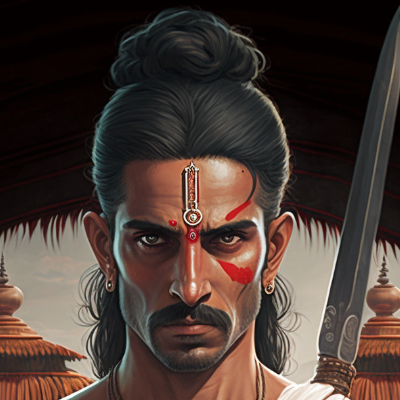
Prativindhya — The First-Born of the Upapandavas, Son of Dharma's King
Prativindhya · Yaudheya · Draupadeya-jyeshtha · Upapandava-agraja · Dharmaraja-suta
In the vast and intricate genealogical tapestry of the Mahabharata, Prativindhya occupies a place that is simultaneously central and heartbreaking. He is the eldest of the five Upapandavas — the sons born of Draupadi to each of the five Pandava brothers — and as the son of Yudhishthira and Draupadi, he carries in his very name and lineage the convergence of the two most morally weighty figures of the entire epic. He did not live long enough to build the kind of legend his fathers and uncles forged across decades of exile and war. He was young, gloriously trained, and full of promise — and he was cut down in the darkness of a single terrible night that also took his four brothers, ending an entire generation of Pandava heirs in one act of vengeful slaughter. To speak of Prativindhya is to speak of what was lost at Kurukshetra beyond the warriors the world remembers — the futures that never arrived, the reigns that never began, the sons who never became fathers.
✦ The Name and Its Meaning — Conqueror of the Vindhyas
The name Prativindhya is itself a proclamation of royal ambition and martial destiny. It derives from prati — meaning "against" or "matching" — and Vindhya — the great mountain range that divides northern and southern Bharata, ancient, immovable, and mythically resonant as a symbol of supreme natural power. To name a child Prativindhya was to declare him one who would stand equal to mountains, who would match the immovable with his own strength and will.
In some traditions the name is interpreted as "one who has conquered the Vindhya" — marking him as a prince of imperial ambition from the moment of birth, destined for the kind of sovereignty that spans the subcontinent from its northern plains to its southern ranges. That this name was given by Yudhishthira — the Dharmaraja, the most deliberate and meaningful of the Pandavas in all matters of language and propriety — suggests it was not chosen lightly. Prativindhya was meant to be a king of the entire land his father had once ruled from Indraprastha, and then lost at the dice table, and then won back through the most devastating war in the memory of the age.
✦ Birth and Early Life — Raised Between Exile and Empire
Prativindhya was born to Yudhishthira and Draupadi during the period of the Pandavas' early prosperity at Indraprastha — the magnificent capital built by the divine architect Maya on the banks of the Yamuna, before the dice game shattered the family's fortunes. He was thus born into a moment of Pandava glory: into a palace whose floors were so perfectly polished they reflected the sky, into a household that received sages and kings, into the first years of a reign that seemed destined for unchallenged greatness.
The five Upapandavas — Prativindhya, Shrutasoma, Shrutakirti, Shatanika, and Shrutakarman — were born in sequence, each to Draupadi by a different Pandava during their respective years of exclusive companionship with her. As the eldest, Prativindhya would have been a young child when the dice game occurred and the family was driven into exile. The thirteen years that followed — twelve in the forest and one incognito — formed the crucible of his boyhood. He and his brothers were sent to Drupada's court at Panchala during the exile years, where they were raised under their maternal grandfather's care and received training in arms, scripture, and statecraft befitting princes of the Kuru and Panchala lines simultaneously.
At Drupada's court, Prativindhya received his martial training under masters of the Panchala tradition — one of the most rigorous schools of kshatriya education in the known world. He was trained in archery, sword-fighting, chariot warfare, mace combat, and the full range of martial arts expected of a prince who would one day command armies. The Mahabharata records that by the time of the Kurukshetra war, he had become a maharatha — a warrior capable of fighting ten thousand enemies simultaneously — a designation that places him among the elite combatants of the age.
✦ Lineage — Where Two Great Rivers Meet
Prativindhya's lineage is among the most distinguished in the entire epic — drawing from both the Pandava line of Hastinapura and the Panchala royal house of Drupada, uniting in his person two of the most powerful kshatriya dynasties of northern Bharata.
- Father: Yudhishthira (Dharmaraja) — eldest Pandava, son of Yama-Dharmaraja, emperor of Hastinapura and Indraprastha
- Mother: Draupadi (Panchali, Krishnaa) — fire-born daughter of King Drupada of Panchala, the most celebrated woman of her age
- Paternal Grandfather (divine): Yama — lord of dharma, death, and cosmic justice
- Paternal Grandfather (legal): King Pandu of Hastinapura
- Maternal Grandfather: King Drupada (Yajnasena) of Panchala — the king whose sacrificial fire produced both Draupadi and Dhrishtadyumna
- Maternal Uncle: Dhrishtadyumna — commander-in-chief of the Pandava forces at Kurukshetra, born from the same sacrificial fire as Draupadi
- Paternal Uncles: Bhima, Arjuna, Nakula, and Sahadeva — the four remaining Pandavas
- Brothers (the Upapandavas): Shrutasoma (son of Bhima and Draupadi), Shrutakirti (son of Arjuna and Draupadi), Shatanika (son of Nakula and Draupadi), Shrutakarman (son of Sahadeva and Draupadi)
- Divine Lineage: Lunar Dynasty (Chandravamsha) → Kuru → Shantanu → Pandu → Yudhishthira → Prativindhya
✦ At Kurukshetra — Five Young Flames in the Storm
The Upapandavas fought at Kurukshetra as a unified cohort — five young princes of extraordinary lineage and formidable training, fighting under the Pandava banner alongside their fathers, uncles, and grandfather Drupada's forces. Prativindhya, as the eldest, carried a particular weight of expectation and responsibility among the five, and the Mahabharata records that he acquitted himself with the full dignity of his parentage.
Across the eighteen days, the Upapandavas fought primarily in the Pandava formation's central and forward sections, engaging Kaurava commanders and warriors of significant rank. Prativindhya is specifically noted in the Drona Parva and Karna Parva sections of the Mahabharata as having engaged in combat with several of the Kaurava warriors and having demonstrated the full force of his maharatha classification. He fought with the composed authority of a prince who had been raised knowing that this war was the culmination of everything his family had endured — the dice game, the exile, the humiliation of his mother, the death of kinsmen across both sides.
The Upapandavas survived the eighteen days of open battle — a remarkable fact in itself, given the carnage that consumed warriors of far greater experience and celestial armament on both sides. They had fought through the fall of Bhishma, through Dronacharya's devastating campaigns, through the horror of Abhimanyu's death in the Chakravyuha, through Karna's onslaught, and through the final collapse of the Kaurava army. When Duryodhana fell on the eighteenth day and the Pandavas celebrated their victory, all five Upapandavas were alive. The worst was believed to be over.
✦ The Night of Ashvatthama — When the War's True Cost Was Paid
The night following Duryodhana's fall was the night that truly ended the Pandava line's future. Ashvatthama — son of Dronacharya, one of the three surviving Kaurava warriors — consumed by grief at his father's death and by a fury that had curdled into something beyond reason, crept into the Pandava camp in the darkness with Kritavarma and Kripacharya.
The Upapandavas were sleeping in their own encampment, separated from the main Pandava position. Ashvatthama, guided by rage and possibly by a demonic possession the text describes through his encounter with a terrifying night-form at the camp's entrance, moved through the sleeping camp and killed all five Upapandavas as they slept — mistaking them in the darkness for the five Pandava brothers themselves, or in some interpretations, knowingly slaying them as the next generation of Pandava power.
Prativindhya was slain in his sleep — the eldest of the five, the son of the just king, the boy named for the mountains he was meant to surpass. He had survived eighteen days of the most violent war in the age's memory, only to be killed in the night's silence without the chance to raise his bow or draw his sword. The five Upapandavas — the entire next generation of the Pandava line — were extinguished in a single night's act of grief-maddened vengeance.
When Draupadi learned what had happened — that her five sons, born of five divine fathers, raised through thirteen years of exile and a devastating war, were dead — her grief was of a kind that the Mahabharata describes with unusual restraint, as though the text itself hesitated before the enormity of it. She demanded justice. She demanded Ashvatthama's death. Arjuna captured him; the debate over his fate became one of the epic's most searching moral dialogues. In the end, Ashvatthama was stripped of his divine gem and banished — spared at Draupadi's own insistence, because he was the son of her guru Dronacharya, whose lineage she would not extinguish even in the depths of her grief.
✦ The Weight of What Was Lost — Yudhishthira's Grief
For Yudhishthira — a man already hollowed by the grief of war, already staggered by the revelation that Karna was his elder brother, already burdened by the knowledge that millions had died in a conflict his gambling had made inevitable — the death of Prativindhya was a loss of particular and personal devastation. Prativindhya was his son. His only child by Draupadi. The boy who carried within him the blood of Dharma and the fire of Panchala, who bore a name that proclaimed an imperial destiny, who had trained for a reign that would consolidate everything the Pandavas had suffered to win back.
The Stri Parva of the Mahabharata records the lamentations of the women over the fallen — and among the voices of grief are those mourning the Upapandavas, young men cut down before their time, their potential unrealised, their futures dissolved in a single night of another man's madness. Yudhishthira's grief over Prativindhya cannot be separated from his larger grief over the entire war — the sense that victory had come at a cost so total that the word victory itself had become hollow.
✦ The Succession — Parikshit and the Line That Continued
With the deaths of all five Upapandavas and the childlessness of most of the surviving Pandava brothers at the time of their renunciation, the continuation of the Kuru line fell entirely to Parikshit — the posthumous son of Abhimanyu, revived in his mother Uttara's womb by Krishna after Ashvatthama's Brahmastra had killed him before birth. Parikshit was the sole surviving heir of the entire Pandava generation.
The cruel irony is not lost in the text: Prativindhya, born of the eldest Pandava and the most celebrated woman of the age, raised with the most distinguished pedigree of all the Upapandavas, trained for kingship — was bypassed by fate in favour of the son of a son, a child who had been dead before he was born and was brought back by divine intervention. The Kuru throne passed not through Yudhishthira's line but through Arjuna's, through Abhimanyu, through Parikshit — and from Parikshit through the long chain of kings who ruled into the Kali Yuga.
✦ Eternal Legacy — The Prince Who Embodied Promise
Prativindhya's legacy is not one of great deeds accomplished but of great potential extinguished — and in that extinguishing, of a moral truth the Mahabharata insists upon with characteristic relentlessness: that war does not spare the innocent, that the children of even the most righteous warriors are not protected by their parents' virtue, and that the cost of adharma — of Duryodhana's refusal, Shakuni's scheming, and the dice game's destruction — was paid not only by those who made the choices but by those who had no part in making them.
In the iconography of the Upapandavas as a group, Prativindhya is always placed first — the eldest, the most directly connected to Yudhishthira's dharmic authority, the one whose existence most clearly symbolised the possibility of a just succession after the war's devastation. In temple traditions and folk retellings that venerate the Upapandavas collectively — particularly in parts of Tamil Nadu, Andhra Pradesh, and Karnataka — Prativindhya is honoured as the senior among the five, a prince who died with his dharma intact and his promise unfulfilled, waiting for a reign that the night robbed from him.
His story is finally a meditation on inheritance — on what it means to be born at the confluence of greatness, to carry the names and blood and expectations of extraordinary parents, and to be given no time to become anything other than what you were at the moment fate intervened. Prativindhya was Yudhishthira's son and Draupadi's child — and that, in the Mahabharata's moral universe, was both the fullness of his distinction and the entirety of what the world was permitted to know of him.
✦ Primary Scriptural References
- Mahabharata (Vyasa) — Adi Parva (birth of the Upapandavas at Indraprastha), Drona Parva and Karna Parva (participation in the Kurukshetra war), Sauptika Parva (the night raid of Ashvatthama and the deaths of all five Upapandavas), Stri Parva (lamentations of Draupadi and the women over the fallen Upapandavas)
- Bhagavata Purana — genealogical passages listing Prativindhya among the Upapandavas within the broader Kuru dynastic succession, and references to the extinction of the Upapandava line as context for the singular importance of Parikshit's survival
- Vishnu Purana — dynastic listings of the Kuru line in which Prativindhya appears as the son of Yudhishthira and Draupadi, with notation of his death before accession and the subsequent passing of the lineage to Parikshit through Abhimanyu
- Regional Mahabharatas — Tamil, Telugu, and Kannada folk retellings in which the Upapandavas as a group receive expanded treatment, with Prativindhya consistently portrayed as their eldest and most regally destined member, whose death in the Sauptika Parva is treated as among the war's most grievous moral consequences
- Harivamsha — supplementary genealogical sections tracing the Pandava line and noting the Upapandavas' place within the dynastic record, with Prativindhya listed as Yudhishthira's heir whose death necessitated the installation of Parikshit as the sole surviving Kuru successor
"He was named for mountains — and like the mountains, he stood firm through the storm of eighteen days — only to be taken not by thunder and lightning, but by the silent, unheroic dark."