
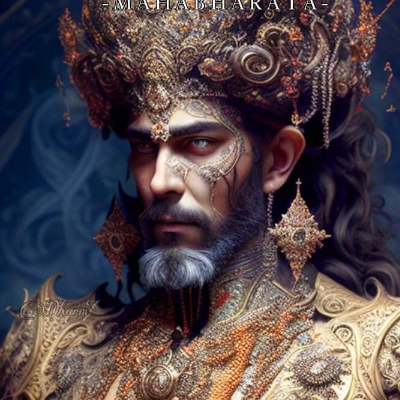
About
Pandu — King of Hastinapura, Father of the Pandavas, and the Pale King of the Kuru Line
Pandu · Panduraja · Pandava-pita · Kuntipati · Madripati · Vyasaputra · Ambalikasuta · Kururajakumara
Pandu is the second of three sons born of the sage Vyasa's levirate union with the widows of Vichitravirya — the king of Hastinapura who died without heirs — arranged by Satyavati, the queen mother, to continue the Kuru royal line. His biological mother is Ambalika — the younger of the two Kashi princesses who were Vichitravirya's wives — who turned pale with terror during Vyasa's visit, and from this pallor the child received the name Pandu, meaning the pale or white one. He is the nominal son of Vichitravirya in the dynastic succession and the king of Hastinapura in the generation before the Kurukshetra war. Pandu is the nominal father — through a complex arrangement involving divine paternity — of the five Pandavas: Yudhishthira, Bhima, Arjuna, Nakula, and Sahadeva, the protagonists of the Mahabharata's central conflict. His own biography is marked by a curse — pronounced by the sage Kindama after Pandu shot him while he was in the form of a deer in the act of union with his wife — that forbade Pandu all conjugal relations on pain of immediate death, driving him to the forest and ultimately causing his death when he forgot the curse in a moment of desire for his younger wife Madri. Pandu appears across the Mahabharata's Adi Parva and is referenced in the Vishnu Purana, the Bhagavata Purana, and the Harivamsa.
✦ The Names
The name Pandu derives from the Sanskrit pandu or pandura, meaning pale, white, or yellowish-white — a colour associated with pallor, with certain types of clay, and with the complexion of illness or constitutional whiteness. The name was given to him because of Ambalika's pale complexion during Vyasa's visit — her terror caused her blood to drain from her face, and this pallor was transmitted to the child she conceived. The name thus encodes the circumstances of his birth in the most direct possible way. The patronymic Ambalikasuta identifies him as the son of Ambalika. Pandava-pita means "father of the Pandavas" — the most consequential of his identities in the tradition. Kuntipati and Madripati mean "husband of Kunti" and "husband of Madri" respectively.
✦ Lineage
- Biological father: Vyasa — born Krishna Dvaipayana, the son of Satyavati and the sage Parashara, composer of the Mahabharata and the eighteen Mahapuranas. Vyasa was called by his mother Satyavati to father children on the widows of Vichitravirya through the levirate arrangement, and Pandu was the child born of his union with Ambalika. The pallor of Pandu's complexion is attributed in the Mahabharata to Ambalika's terror during this encounter — Vyasa's formidable appearance, his matted hair, his dark complexion, and the intensity of his presence caused her to go white with fear, and this transmitted a pale complexion to the child.
- Nominal father: Vichitravirya — the king of Hastinapura who died of consumption without fathering children, and in whose name and succession Pandu and his brothers were born through the levirate arrangement.
- Mother: Ambalika — the younger of the two Kashi princesses who were Vichitravirya's wives. She is described as a woman of beauty and refinement whose reaction of pale terror during Vyasa's visit transmitted the characteristic pallor that gave her son his name.
- Paternal grandmother: Satyavati — the queen mother who arranged the levirate and who is Vyasa's biological mother, making her simultaneously Pandu's biological paternal grandmother and his nominal grandmother as the mother of Vichitravirya.
- Elder brother: Dhritarashtra — born of Vyasa's union with Ambika, the elder Kashi princess, who closed her eyes during the encounter, and the child born was blind. Dhritarashtra is the elder of the two brothers by birth but was passed over for the active kingship because of his blindness. Profiled separately in this series.
- Younger brother: Vidura — born of Vyasa's union with a maidservant of the household who received Vyasa without fear, and the child born was of perfect composure and wisdom. Vidura is identified in the Mahabharata as a partial incarnation of Dharma himself. Profiled separately in this series.
- Guardian: Bhishma — the son of Shantanu and the goddess Ganga, who had renounced his own claim to the throne and his right to marriage and children in order to enable Shantanu's marriage to Satyavati. Bhishma served as regent, guardian, and protector of Pandu and his brothers throughout their childhood and education.
- First wife: Kunti — born Pritha, the daughter of Shurasena of the Yadava clan and subsequently adopted by her father's cousin Kuntibhoja, from whom she received the name Kunti. She had received a mantra from the sage Durvasa in her youth that allowed her to invoke any god and bear a child by him. Through this mantra she bore three children before and during her marriage: Karna — born before her marriage to Pandu, from the sun god Surya, whom she invoked out of curiosity and whose child she abandoned on the river in shame — and Yudhishthira by Dharma, Bhima by Vayu the wind god, and Arjuna by Indra the king of the gods, during the forest exile after Pandu's curse.
- Second wife: Madri — the princess of the Madra kingdom, given to Pandu in marriage as a second wife. Madri was given the mantra by Kunti and used it once to invoke the twin Ashvins, the divine physicians, who fathered Nakula and Sahadeva upon her. Madri's death — her self-immolation on Pandu's funeral pyre — is narrated in the Adi Parva and reflects the tradition's representation of her grief and love for her husband.
- Sons — the five Pandavas:
- Yudhishthira — born of Kunti and the god Dharma; the eldest Pandava, king after the war, the figure of supreme dharmic rectitude.
- Bhima — born of Kunti and Vayu the wind god; the second Pandava, of immense physical strength.
- Arjuna — born of Kunti and Indra; the third Pandava, the greatest archer of the age and the recipient of the Bhagavad Gita.
- Nakula — born of Madri and the Ashvins; the fourth Pandava, renowned for beauty and skill with horses.
- Sahadeva — born of Madri and the Ashvins; the fifth Pandava, renowned for wisdom and knowledge of omens.
✦ Pandu's Reign and Martial Achievements
The Mahabharata's Adi Parva records that despite his pale complexion — the mark of his unusual birth — Pandu grew into a figure of exceptional physical beauty and martial ability. Because his elder brother Dhritarashtra was blind, Pandu was installed as the active king of Hastinapura, with Dhritarashtra occupying an honoured position in the royal household but not exercising sovereign functions. Pandu governed Hastinapura with great effectiveness and expanded its power and territory through a series of military campaigns in which he defeated the kings of surrounding regions, extending Kuru sovereignty and bringing tribute from many kingdoms. The Mahabharata describes his campaigns as covering the eastern, northern, western, and southern directions — the traditional four-direction conquest (digvijaya) that establishes a king's claim to supreme sovereignty. He brought great wealth to Hastinapura and is presented as a king of considerable military and administrative achievement during the brief period of his active reign.
✦ The Curse of Kindama and the Retreat to the Forest
The central and most fateful episode of Pandu's biography is the incident of the sage Kindama's curse. The Mahabharata's Adi Parva narrates that Pandu, engaged in a hunting expedition in the forest, came upon a pair of deer in the act of union and shot the male deer with his arrow. The deer, pierced, cried out in a human voice — for he was in truth the sage Kindama, who had assumed the form of a deer with his wife to enjoy union in the forest. Kindama, dying from Pandu's arrow, pronounced a devastating curse: that Pandu, who had interrupted the most sacred and private act of union at the height of its pleasure, would himself die the moment he attempted to approach his wife in desire. The curse was precise and inescapable — any attempt at conjugal union would bring instant death.
Pandu was struck to the depths of his soul by this curse — not merely because it deprived him of conjugal pleasure but because it meant he would die without fathering sons, and for a Kshatriya king the failure to produce heirs was a profound dharmic failure. He handed over the governance of Hastinapura to Bhishma and Dhritarashtra, renounced his kingdom and his royal life, and retired with both Kunti and Madri to the forests of the Himalayas. He lived as an ascetic in the company of sages and forest dwellers, practising religious austerities, and the Adi Parva describes this period of his life as one of genuine spiritual cultivation despite — or perhaps because of — the terrible constraint under which he lived.
✦ The Birth of the Pandavas Through Divine Paternity
In the forest, tormented by grief at his inability to father children and aware that dying without sons meant his ancestors would not receive their proper ancestral offerings (shraddha), Pandu told Kunti of his anguish and of the tradition's provisions for childless men — including the ancient practice of niyoga, by which a wife could bear children by a brahmin or divine being on her husband's behalf. Kunti then revealed to Pandu the mantra she had received from Durvasa in her youth — a mantra by which she could summon any god and bear a child by him. She also confessed that she had already used this mantra once as a young woman out of curiosity, invoking the sun god Surya and bearing a son — Karna — whom she had placed in a basket on the river in shame and who had been raised by the charioteer Adhiratha and his wife.
Pandu, accepting this revelation with grief for Karna's situation but grateful for the mantra's availability, urged Kunti to use it. She invoked Dharma — the god of cosmic order and righteousness — and bore Yudhishthira. She invoked Vayu the wind god and bore Bhima. She invoked Indra the king of the gods and bore Arjuna. Pandu subsequently requested that Kunti share the mantra with Madri, wishing that his younger wife also have the joy of motherhood; Kunti agreed and Madri invoked the twin Ashvins, bearing Nakula and Sahadeva. Pandu regarded all five boys as his sons — the dynastic convention confirmed them as his sons in the succession regardless of their divine paternity — and lived with his growing family in the forest with great happiness.
✦ The Death of Pandu
Pandu's death is narrated in the Mahabharata's Adi Parva as the direct fulfilment of Kindama's curse. On a day of exceptional natural beauty in the forest, with the spring in full bloom and the air filled with the fragrance of blossoms, Pandu was overcome by desire for Madri — a desire that the Mahabharata attributes to the power of the season and to a momentary lapse in the constant vigilance the curse required. He approached Madri despite her attempts to dissuade him, reminding him of the curse. Pandu, his judgment overwhelmed by desire, embraced Madri — and at that instant Kindama's curse fulfilled itself and Pandu died. Madri, consumed by grief and guilt — for it was upon her that his desire had fallen in that fatal moment rather than upon Kunti — chose to immolate herself on Pandu's funeral pyre rather than live. She entrusted the care of Nakula and Sahadeva to Kunti and died alongside her husband. Kunti returned to Hastinapura with the five boys, and the Pandavas' lives at the Kuru court — the world of the Mahabharata's central narrative — began from this point.
✦ Textual Variants and Inconsistencies
Pandu's pallor and Vyasa's appearance: The account of Ambalika's terror and its transmission to Pandu as a pale complexion is the standard explanation for his name. Some later devotional and regional traditions interpret the pallor differently — as a mark of spiritual luminosity rather than physical pallor — but the Mahabharata's own account is clearly one of constitutional whiteness resulting from the mother's frightened complexion during conception.
The identity of Kindama: The sage Kindama is a minor figure who appears only in this episode. Some later texts give different names for the sage who cursed Pandu, and certain regional traditions vary the details of the deer episode. The Mahabharata's Adi Parva account is the authoritative version and is consistent across the major manuscript traditions.
Karna's prior birth: The revelation that Kunti had used the mantra before marriage and borne Karna by Surya is embedded in the Adi Parva's account of Pandu's curse and the conversation about the mantra. The full Karna birth narrative is given separately in the Mahabharata's later books, particularly in the Karna Parva and the Udyoga Parva, with some variation in detail. The fact of Karna's prior birth is consistently stated across all major sources.
✦ Theological and Philosophical Significance
Pandu's theological significance is primarily structural and genealogical — he is the nominal father through whom the five Pandavas, the protagonists of the Mahabharata, receive their place in the Kuru dynastic succession. His biography also serves a specific moral and cosmological function: the curse of Kindama and its consequences encode the tradition's teaching that the disruption of another being's sacred intimacy — even by accident, even in a hunter's ordinary activity — carries consequences of the most severe kind. Pandu is not presented as a wicked man; his hunting expedition was routine and his discovery of Kindama's true identity only came after the arrow had already been loosed. Yet the curse is not moderated or withdrawn even upon repentance, reflecting the tradition's view that certain violations of cosmic order carry consequences independent of intention.
The extraordinary arrangement through which the Pandavas were born — through divine fathers invoked by a mantra, with Pandu's blessing and in full acceptance of the sons as his own — is one of the tradition's most elaborated instances of the principle that lineage and parenthood in the dharmic world are constructions of intention, acceptance, and social recognition as much as they are biological facts. Pandu accepted all five boys as his sons; the tradition confirmed them as Pandavas — sons of Pandu — despite the gods being their biological fathers; and the Mahabharata's entire central conflict is framed as a conflict over the inheritance of sons who were Pandu's sons in every sense that mattered dynastically.
✦ Connection to the Wider Genealogy
Through his biological father Vyasa and grandmother Satyavati, Pandu connects to the Chedi royal line through Uparichara Vasu. Through his nominal father Vichitravirya and the Kuru-Paurava line, he descends from the Chandravamsha through Shantanu, Pratipa, and many generations back to Puru, Yayati, Pururavas, Budha, and Chandra. Through his sons — Yudhishthira, Bhima, Arjuna, Nakula, and Sahadeva — the Pandava line continues to Abhimanyu, Parikshit, and Janamejaya, the last of whom's serpent sacrifice forms the narrative frame of the entire Mahabharata. Through his wife Kunti's prior son Karna — born of Surya — Pandu is the social father of the Pandavas' greatest rival and half-brother, creating the tragic genealogical irony that the two sides of the Mahabharata's primary contest were half-brothers who did not know it.
✦ References
Primary Sources
- Mahabharata, Adi Parva, sections 100–128: The primary source for Pandu's birth from Ambalika and Vyasa, his pallor, his education, his installation as king, his martial campaigns, the Kindama episode and curse, the retreat to the forest, the birth of the five Pandavas through divine paternity, and Pandu's death from Kindama's curse with Madri's self-immolation.
- Vishnu Purana, Book 4, chapter 20: Confirms Pandu's position in the Kuru genealogy and the birth of the five Pandavas.
- Bhagavata Purana, Book 9, chapter 22: The Kuru genealogy confirming Pandu's place in the succession.
- Harivamsa, chapters 32–34: Additional genealogical material on Pandu and the Kuru royal line.
- Mahabharata, Udyoga Parva, sections 147–149: References to Pandu's character and reign in the context of the prewar diplomatic narratives.
Modern Reference Works
- Vettam Mani, Puranic Encyclopaedia (1975): Entry on Pandu; comprehensive collation of primary references and summary of principal episodes.
- J. A. B. van Buitenen (translator), The Mahabharata, Volume 1 (1973): Critical translation of the Adi Parva with scholarly notes on the Pandu narrative.
- Irawati Karve, Yuganta: The End of an Epoch (1969): Contains analysis of Pandu's character and the consequences of his curse within the broader Mahabharata family narrative.
- Alf Hiltebeitel, The Ritual of Battle: Krishna in the Mahabharata (1990): Contains discussion of the Pandavas' divine parentage and its theological significance, relevant to Pandu's role as their nominal father.