
About
Hidimbi (Hadimba) — Rakshasi of the Himalayan Forest, First Wife of Bhima, Mother of Ghatotkacha, Goddess of the Kullu Valley
Hidimbi · Hiḍimbī · Hidimba · Hiḍimbā · Hadimba · Bhutanadevi · Pallavi · Bhima-patni · Ghatotkacha-mata · Rakshasi-devi · Kullu-adhishthatri
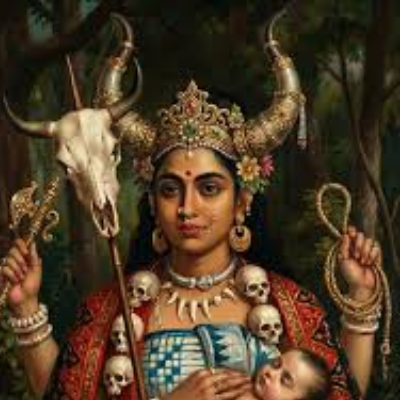
Hidimbi — also known as Hidimba and worshipped in the Himalayan region as Hadimba — is a Rakshasi princess of the forests of the upper Himalayas; the sister of the Rakshasa chief Hidimba who was killed by Bhima; the first wife of Bhima, the second Pandava brother; and the mother of Ghatotkacha — the mighty half-Rakshasa warrior who commanded one Akshauhini of the Pandava army in the Kurukshetra War and was slain by Karna's Vasavi Shakti on the fourteenth night. She is introduced in the Mahabharata's Adi Parva (Hidimba-Vadha Parva) as a man-eating Rakshasi sent by her brother to lure the sleeping Pandavas as prey, who instead fell in love with Bhima, disobeyed her brother's command, warned the Pandavas, and watched Bhima kill Hidimba in the battle that followed. She then approached Kunti directly — without intermediary, without hesitation — to request Bhima's hand in marriage. The Pandavas allowed the marriage on the condition that Bhima would return to his brothers at the end of the day each evening and, after the birth of a child, would leave permanently to continue their journey. She raised Ghatotkacha entirely alone in the Rakshasa kingdom after the Pandavas departed, training him in the powers and arts of the Rakshasa tradition. She is one of the Mahabharata's most psychologically frank characters: she chose love over her family, disobeyed her brother, accepted a marriage condition that ensured she would be abandoned, raised her son without a husband, gave that son to the war knowing he would likely die, and accepted all of this without weeping, without emotional demands, and without a single moment of recorded bitterness. She is venerated as a goddess across the Himalayan region and is the presiding deity of the Kullu valley — at the Hadimba Devi temple at Manali in Himachal Pradesh, one of the most important temples in northern India.
✦ The Names
The name Hidimbi — Sanskrit Hiḍimbī — is the feminine form of Hidimba, simply meaning the female of the Hidimba family or clan; a patronymic in feminine form. Her brother's name Hidimba and her own name Hidimbi are the same root differentiated only by gender suffix. The name has no clear independent etymology beyond the patronymic derivation. She is also referred to in some regional traditions as Bhutanadevi (the divine demoness) and Pallavi (new leaves, fresh growth — a name of tenderness entirely at odds with her Rakshasa birth, suggesting the transformation her love for Bhima wrought). In the Himalayan folk tradition she is called Hadimba — a regional phonetic transformation of the Sanskrit Hidimba — and this is the name under which she is actively worshipped as a living goddess in the Kullu valley. Her devotees in Himachal Pradesh do not primarily know her from the Mahabharata text but from the living oral and ritual tradition of the Himalayan goddess cult in which she is the protector of the valley, the earth mother, the Durga in local form.
✦ Lineage
- Brother: Hidimba — the Rakshasa chief of the Kamyaka forest in the Himalayan region; who prayed on travellers; who sent Hidimbi to lure the Pandavas as food when they entered his forest after escaping the Lakshagriha; who attacked Bhima when he discovered that Hidimbi had warned the Pandavas rather than entrapping them; who was killed by Bhima in the combat that followed
- Parents: not named in any primary canonical source; Hidimba and Hidimbi are described as siblings who inhabited the Kamyaka forest as its Rakshasa overlords; no lineage beyond the sibling pair is recorded in the Mahabharata or the Puranas
- Husband: Bhima — the second Pandava; son of Pandu and Kunti, who invoked the wind god Vayu to father him; of extraordinary physical strength; who killed Hidimba and then agreed to marry Hidimbi at his mother Kunti's direction; who left Hidimbi and their son when they departed for the continuation of the exile and never returned
- Mother-in-law: Kunti — who invoked Vayu to father Bhima; who recognised the practical strategic value of Hidimbi's powers and the son she could provide as an ally in the future conflict; who gave conditional consent to the marriage; who directed Bhima to father a child and then return to his brothers
- Son: Ghatotkacha — born with a bald, pot-shaped head and named for this appearance; who grew to young adulthood in an instant at birth; who inherited Bhima's physical strength and Hidimbi's Rakshasa powers of illusion, flight, and shape-shifting; who vowed to appear before Bhima whenever his father thought of him; who was raised entirely by Hidimbi in the Rakshasa kingdom; who commanded one Akshauhini of the Pandava army; who was slain by Karna's Vasavi Shakti on the fourteenth night of the Kurukshetra War
- Daughter-in-law: Ahilawati — the warrior princess daughter of the Danava Mura, also called Maurvi; who married Ghatotkacha after defeating her in intellectual debate and physical combat at Krishna's recommendation; who bore Ghatotkacha the sons Anjanaparva and Meghavarna
- Grandsons: Anjanaparva — killed by Ashvatthama on the fourteenth night of the war; Meghavarna — who survived the war; and in folk tradition Barbarika — the warrior with three infallible arrows, worshipped as Khatu Shyam
✦ The First Encounter — Love Against the Command
After the Pandavas escaped the burning of the Lakshagriha — Duryodhana and Purochana's plot to kill them in the house of lac — they wandered through the forests of the Himalayas exhausted, without shelter or certainty. One night the brothers and their mother Kunti rested under a tree while Bhima kept watch. Hidimba, the Rakshasa chief of that forest, smelled human flesh from the top of a tree and was immediately hungry. He sent his sister Hidimbi to lure the strangers into a trap from which he could take them for his meal. Hidimbi moved through the forest toward the sleeping Pandavas. When she came upon Bhima — his enormous size, his calm strength, his radiant nobility even in exhaustion — she was struck with love rather than hunger. She transformed herself into a beautiful maiden and approached him. When Bhima asked who she was, she told him the truth: she was a Rakshasi, her name was Hidimbi, her brother had sent her to bring the Pandavas to him as food, but she could not do it — she wanted him as her husband. She begged him to take her and flee with his family before her brother came. Bhima refused to flee. He told her he was a Kshatriya and would not run from a Rakshasa. While they were still speaking, Hidimba, impatient at his sister's delay, came down from the tree. He saw the scene — his sister in the form of a beautiful woman, clearly having betrayed him — and attacked Bhima in fury. Bhima and Hidimba fought while the rest of the Pandavas slept. The battle was fierce and long. Eventually Bhima killed Hidimba. With her brother dead and her family gone, Hidimbi was entirely alone.
✦ The Marriage — Her Plea to Kunti
After Hidimba's death, Hidimbi approached Kunti directly and made her case without intermediary. She told Kunti that as a Rakshasi she had the power to travel anywhere, to take on any form, to protect and serve the Pandavas in the dangerous forests and roads of the exile. She declared her love for Bhima and asked Kunti to persuade her son to marry her. The appeal was to Kunti's pragmatism as much as to her compassion — and Kunti was a pragmatist. She saw the value of a Rakshasi ally who could carry the Pandavas on her back through difficult terrain, protect them at night in unknown forests, and eventually provide a son of Rakshasa power for the war she could see approaching. She directed Bhima to marry Hidimbi. The marriage was agreed on explicit terms: Bhima would spend the days with Hidimbi in the mountains and forests, returning to his brothers each evening. After the birth of a child he would leave entirely. Hidimbi accepted these terms without protest. The Pandavas were in their bleakest period — fugitives without a kingdom, without a fixed home, without certainty about what awaited them. Hidimbi asked for nothing more than what she had been offered and she gave everything she had in return.
✦ The Time Together — The Mountains and the Child
Hidimbi carried Bhima through the Himalayan landscapes in her arms — through mountains, valleys, rivers, and forests — spending the days in a wandering happiness that the Mahabharata records with quiet attention. She had powers of swift travel, transformation, and command over the Rakshasa forces of the region. Bhima, for his part, was with her willingly, not merely compliantly. They were together for the period required for conception and birth. When Ghatotkacha was born — bald, pot-headed, instantly grown to young adulthood in the manner of Rakshasa children — she held him and then she let him go. She had honoured every term of the marriage agreement. Bhima, honouring the same terms, departed with his brothers and his mother. He did not return. There is a single moment in the Mahabharata that records the depth of what Bhima left behind. During the forest exile, years later, when the Pandavas needed to cross difficult Himalayan terrain and Draupadi had fainted from exhaustion, Bhima called upon Ghatotkacha. Ghatotkacha arrived and carried the Pandavas on his shoulders. He had been trained by his mother for precisely this kind of service — his devotion to his father and his uncles was the direct transmission of everything Hidimbi had put into his upbringing. The mother who raised him alone, who taught him his powers, who instilled in him the absolute loyalty that brought him to the Pandavas whenever they needed him, is present in every one of Ghatotkacha's acts of service — even the ones in which she herself is never mentioned.
✦ After the Separation — Raising Ghatotkacha Alone
After Bhima's departure, Hidimbi remained in the Himalayan forests and raised Ghatotkacha entirely alone. The Mahabharata records no further appearance by Hidimbi after the birth and the Pandavas' departure — she simply vanishes from the primary narrative. One folk tradition, however, records an episode in which Ghatotkacha had instituted a practice of human sacrifice in the local area; Bhima, returning through the forest during one of the Pandavas' journeys, came across the scene; Ghatotkacha brought Bhima to his mother to reveal that Bhima was his father; and both Hidimbi and Ghatotkacha agreed to end the practice at Bhima's insistence. This episode — recorded in the Ghatotkacha Wikipedia article — suggests a post-separation encounter in which the family's connection was briefly renewed, but the primary canonical text does not describe this meeting in detail. Hidimbi also appears briefly in one traditional account in which a curse-counter exchange is recorded between her and Draupadi. When Ghatotkacha did not prostrate himself at Draupadi's feet as required by custom — following his mother's instruction — Draupadi was offended and cursed Ghatotkacha's son to die young. Hidimbi responded with her own curse on Draupadi's children's death. The exchange is not in the primary Mahabharata text and belongs to folk tradition; it represents the only recorded instance in which Hidimbi acts in direct opposition to the Pandava household — the moment in which the marginalised first wife registers, however briefly, the cost of her marginalisation.
✦ Ghatotkacha's Death and Hidimbi's Response
On the fourteenth night of the Kurukshetra War, Ghatotkacha was killed by Karna's Vasavi Shakti. He died a warrior's death — the death of a son who had gone to his father's war and held nothing back. One folk tradition records that Hidimbi became deeply spiritual after losing her son in the war and never again supported her husband in any way after that. The Mahabharata itself does not record Hidimbi's response to Ghatotkacha's death. Her silence in the primary text throughout the war, through her son's death, and through everything that followed, is the Mahabharata's most eloquent treatment of her character. The woman who disobeyed her brother, who pleaded openly for a marriage, who carried Bhima through the mountains, who raised the war's most destructive warrior alone in the forest — is given no words by the epic for her grief. The tradition of her deification in the Himalayas may be the cultural world's answer to that silence.
✦ The Hadimba Devi Temple — Living Goddess of the Kullu Valley
The Hadimba Devi temple at Manali in the Kullu valley of Himachal Pradesh is one of the most important temples in northern India and the principal site of Hidimbi's worship as a living goddess. The temple was built in 1553 CE by Maharaja Bahadur Singh on the instructions of the Hadimba deity herself — constructed over a large natural rock that protrudes from the forest floor and is worshipped as a direct manifestation of the goddess. The structure is built in a pagoda style with four tiered roofs of cedar wood decreasing in size toward the apex — a form unique to the Himalayan temple tradition. The interior enshrines the natural rock itself as the deity's primary form; there is no carved image in the conventional sense. The temple stands within a sacred cedar forest — the Dhungiri Van Vihar — whose trees are considered part of the goddess's sacred precinct and are not felled. Hadimba is worshipped as the presiding deity and protector of the entire Kullu valley. Her chariot leads the annual Kullu Dussehra rath yatra — one of the largest religious processions in Himachal Pradesh — and no procession may begin until the Hadimba Devi chariot has moved first. The identification of the Hadimba goddess with the Mahabharata's Hidimbi is a complex subject of scholarly discussion. Scholars including M.N. Srinivas, O.C. Handa, and Richard King have argued that Hadimba was originally a local or Buddhist Tantric goddess who was later absorbed into the Mahabharata tradition through linguistic and theological overlap. B.R. Sharma and Ashok Jerath have proposed that she was a historical tribal queen who was deified after her death. Vogel and Hutchison noted that colonial scholars reinforced the Mahabharata identification by privileging Sanskrit sources over oral traditions. These scholarly debates are noted here for completeness; within the living tradition of the Kullu valley, Hadimba and Hidimbi are the same being without ambiguity.
✦ Temples and Regional Worship
Beyond Manali, Hidimbi is associated with several regional sites of worship and mythological geography. The Kachari Kingdom of Assam and the Mayang village of present-day Assam are connected with Hidimbi in the eastern folk tradition. A small temple dedicated to Ghatotkacha stands near the Hadimba Devi Temple in Manali — mother and son venerated in adjacent sacred spaces. In the regional tradition of the Kullu valley, Hidimbi's devotional importance is primary and independent of the Mahabharata's main narrative — she is the earth mother, the mountain protector, the one who gives blessings for harvests and children and safe passage through the mountains.
✦ References
- Mahabharata (Adi Parva, Hidimba-Vadha Parva, Chapters 9–10) — the primary canonical source: Hidimba sending Hidimbi to lure the Pandavas; Hidimbi falling in love with Bhima; her warning the Pandavas; Bhima killing Hidimba; Hidimbi approaching Kunti for Bhima's hand; Kunti's practical reasoning and consent; the marriage conditions; Ghatotkacha's instant birth and naming; Bhima's departure; Ghatotkacha's vow of service to his father
- Mahabharata (Vana Parva — the Gandhamadana journey) — Bhima invoking Ghatotkacha during the difficult Himalayan crossing; Ghatotkacha carrying the Pandavas on his shoulders; the indirect confirmation that Hidimbi had raised him to be available at need
- Wikipedia — Hidimbi — the most comprehensive modern reference: the canonical narrative; the scholarly debate about the Hadimba-Hidimbi identification; the contributions of M.N. Srinivas, Richard King, O.C. Handa, B.R. Sharma, Ashok Jerath, Vogel and Hutchison, and Mark Elmore; the late identification of Ghatotkacha in the Hadimba cult; the temple history
- Wikipedia — Bhima; Wikipedia — Ghatotkacha — the Hidimbi-Bhima marriage in the context of Bhima's full biography; the Ghatotkacha folk episode of human sacrifice and its ending at Bhima's instance
- Boloji — Hidimba: The Unacknowledged Heroine — the most psychologically attentive essay on Hidimbi's character; the feminist reading of her choices; the temple at Manali; Kunti's strategic motivation for the marriage recorded from the Mahabharata text
- Divine Hindu — Hidimbi and Bhima: A Love Beyond Appearances; The Broken Inkpot — Hidimba: The Forgotten Wife; The Bookish Duet — Hidimbi; Dhwani Astro — Bhim and Hidimba; Godesshidimba Blogspot — Bhima and Hidimba's Son: The Birth of Ghatotkacha; Zee News — Mahabharata's Bhima was married to a Rakshasi: modern summaries drawing from the Vyasa Mahabharata and the living Hadimba goddess tradition