
About
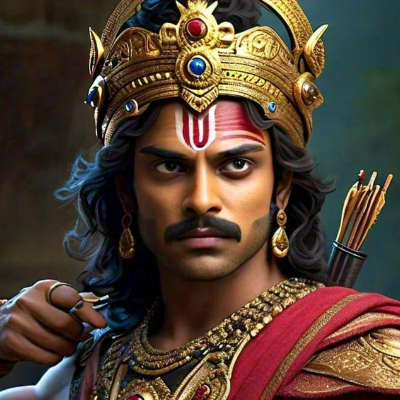
Arjuna — Partha, the Peerless Archer of the Lunar Line
Dhananjaya · Vijaya · Savyasachin · Kiriti · Shvetavahana · Gandivi · Phalguna · Bibhatsu · Kapidhvaja
In the vast firmament of Itihasa, no figure blazes with quite the same brilliance as Arjuna — third of the Pandavas, son of Indra, wielder of the celestial bow Gandiva, and the chosen disciple to whom the eternal wisdom of the Bhagavad Gita was revealed. He is simultaneously the greatest warrior of his age and its most searching spiritual seeker — a man whose moment of supreme doubt on the battlefield of Kurukshetra became the occasion for the most celebrated dialogue in all of human literature. To speak of Arjuna is to speak of dharma tested, of devotion perfected, and of human excellence raised to its outermost limit.
✦ Celestial Origin — Child of Thunder and Earth
Arjuna was born to Kunti — princess of the Yadava Vrishni clan and queen of Hastinapura — through the invocation of Indra, the king of the gods and lord of thunder, lightning, and war. His birth was attended by celestial portents: divine voices announced that he would surpass even Kartikeya in martial glory and would rival the great Parashurama and Dronacharya in the science of weapons. He was born on the auspicious asterism of Uttara Phalguni — hence the name Phalguna — and from his earliest years he was marked by an almost supernatural focus, calm, and hunger for mastery.
As a boy training under Dronacharya at Hastinapura, Arjuna distinguished himself absolutely. The celebrated episode of the wooden bird — in which Drona asked each pupil what they saw before releasing an arrow at a target, and only Arjuna answered "the eye of the bird, nothing else" — revealed the singular quality of his concentration. Drona declared openly that no archer on earth, past or future, would surpass his beloved pupil Arjuna.
✦ Lineage — The Lunar Flame Unbroken
Arjuna stands at a luminous confluence of bloodlines within the Chandravamsha — the Lunar Dynasty — descended from the primordial king Bharata, from whom the land of Bharata takes its name.
- Divine Father: Indra — lord of Svarga, king of the Devas, god of rain and war
- Mother: Kunti (Pritha) — daughter of Shurasena of the Yadava line, adopted by Kuntibhoja
- Legal Father: King Pandu of Hastinapura — son of Vyasa and Ambalika
- Paternal Grandfather: Vyasa (Krishnadvaipayama) — the great rishi and compiler of the Vedas
- Elder Brothers: Yudhishthira (son of Dharma) and Bhima (son of Vayu)
- Half-Brothers: Nakula and Sahadeva — sons of Madri by the twin Ashvins
- Half-Brother (by Kunti and Surya): Karna — his greatest rival and the tragedy of his life
- Dynastic Line: Lunar Dynasty (Chandravamsha) → Kuru → Shantanu → Pandu → Arjuna
Wives and Sons:
- Draupadi (Panchali) — his primary queen, won at the svayamvara; bore him Shrutakirti
- Subhadra — sister of Sri Krishna and Balarama, married in elopement; bore him Abhimanyu — the greatest of his sons, slain at Kurukshetra
- Ulupi — the Naga princess of the underworld kingdom; bore him Iravan, who fell in the war
- Chitrangada — princess of Manipura; bore him Babhruvahana, who later wounded Arjuna in single combat
- Grandson: Parikshit — son of Abhimanyu and Uttara, sole heir of the Kuru line, revived in the womb by Krishna after Ashvatthama's Brahmastra, and crowned king after the Mahaprasthana
✦ The Making of a Master — Weapons, Wanderings, and Divine Grace
Arjuna's martial education was without parallel. Under Dronacharya he mastered every form of archery known to the human world. He then undertook a twelve-year pilgrimage across the sacred tirthas of Bharata — partly as penance for entering Yudhishthira's chamber while Draupadi was there, breaking the agreed protocol. During this pilgrimage he won three of his four wives and encountered sages, nagas, and kings across the length of the subcontinent.
At Yudhishthira's behest before Kurukshetra, Arjuna undertook the greatest weapon-quest in epic literature. He performed severe tapas in the Himalayas and obtained the Pashupatastra — the most devastating weapon in existence — directly from Shiva, who tested him first in the guise of a Kirata (mountain hunter) in single combat. He then ascended bodily to Svarga — Indra's celestial realm — where he spent five years learning music, dance, and divine weaponry from the celestial teacher Chitrasena, and received weapons from Yama, Varuna, Kubera, and Indra himself.
The celestial bow Gandiva — born of Brahma, passed through Prajapati, Shakra, Varuna, and finally Agni — was given to Arjuna along with two inexhaustible quivers. He bore it for his entire career and was inseparable from it as a warrior. His chariot bore the banner of Hanuman — gifted by that great devotee — so that the roar of Hanuman would terrify enemies and protect the Pandavas in battle.
✦ The Gita — When the Archer's Hands Fell Still
On the first day of the Kurukshetra war, standing between the two arrayed armies in his chariot driven by Sri Krishna, Arjuna surveyed the field — and broke. He saw his grandsire Bhishma, his teacher Drona, his cousins and uncles and kinsmen — and his bow slipped from his fingers. He sank into his chariot, overwhelmed by grief, compassion, and existential despair. "What is the good of victory, Krishna? What is a kingdom if those for whose sake we desire it must be slain to obtain it?"
What followed was the Bhagavad Gita — eighteen chapters of the most profound dialogue in human spiritual history. Krishna, as Arjuna's charioteer and innermost friend, revealed to him the nature of the self, the imperishable atman, the mechanics of karma, the paths of jnana and bhakti, the doctrine of nishkama karma (desireless action), and ultimately the vishwarupa — his own cosmic, all-encompassing divine form. Arjuna asked, doubted, questioned, and finally surrendered — rising with clarity to fulfil his duty as a warrior. His question "Kim kartavyam?" — "What must I do?" — is the question of every human soul at its moment of crisis.
✦ Upon the Field of Kurukshetra — Feats Beyond Reckoning
Across the eighteen days of battle, Arjuna's feats formed the martial spine of the entire war. Among his most celebrated acts:
- He slew Bhishma — the invincible patriarch — by using Shikhandi as a shield, for Bhishma had vowed never to raise arms against one he regarded as a woman, while Arjuna's arrows felled him from behind
- He killed Jayadratha — who had obtained a boon to hold all Pandavas at bay for one day — on the fourteenth day, fulfilling a terrible oath sworn over Abhimanyu's death, in a moment engineered by Krishna who briefly obscured the sun to create a false dusk
- He destroyed the Kaurava army's divisions singlehandedly on multiple days, including scattering the Samsaptaka battalions who had vowed to kill him or die trying
- He slew Karna — his greatest rival and secret elder brother — on the seventeenth day, in a battle charged with the weight of destiny, prophecy, and grief. Karna was struck while his chariot wheel was stuck in the earth
- He was the principal slayer of Dronacharya's forces on the fifteenth day, though Drona himself was slain by Dhrishtadyumna
✦ Shadow and Grief — The Losses He Carried
For all his glory, Arjuna's life was threaded through with devastating losses. His son Abhimanyu — perhaps the most beloved figure in the war — was lured into the Chakravyuha formation on the thirteenth day and slaughtered by multiple maharathis simultaneously while Arjuna was held away by the Samsaptakas. The grief of Arjuna over Abhimanyu is described as a wound that never fully healed. His vow to kill Jayadratha by sunset or die — made in his anguish — electrified the war narrative.
After the war, when Krishna departed the mortal world following the destruction of the Yadava clan at Prabhasa, Arjuna's powers visibly diminished. He found, to his anguish, that he could no longer draw the Gandiva with the same force — confirming what he had always known but never spoken: his strength had never been entirely his own. It had always been sustained by Krishna's divine presence. He surrendered the Gandiva into the ocean as instructed by Vyasa, for its purpose in the world was complete.
✦ The Ashvamedha and the Final Journeys
Following the Kurukshetra war, Arjuna led the sacred Ashvamedha horse across the kingdoms of Bharata to consolidate Yudhishthira's imperial sovereignty. During this journey he famously faced and was wounded by his own son Babhruvahana in Manipura — a combat arranged by fate and the Naga Ulupi, who later revived him with the Mritasanjivani gem. The episode served as expiation for his role in Bhishma's fall, which had violated a subtle transgression of dharma.
In the Mahaprasthana — the great final northward journey — Arjuna was among the last to fall, after Draupadi, Sahadeva, Nakula, and Bhima. Yudhishthira named his flaw when asked: Arjuna had boasted he would slay all enemies in a single day, and had not fulfilled it. But those who fell on that journey were not diminished — they were released. Arjuna's celestial self ascended to join Indra in Svarga before following Yudhishthira to the realm beyond.
✦ Eternal Resonance
Arjuna's legacy transcends the battlefield. He is the archetypal human seeker — capable, disciplined, and yet vulnerable enough to collapse before the enormity of life's deepest questions. The Bhagavad Gita exists because Arjuna faltered, and in that faltering, asked the questions all of humanity shares. His relationship with Krishna — as Nara to Narayana, as mortal to the divine — is revered as the perfect model of sacred friendship, surrender, and love. In the Nara-Narayana tradition, Arjuna is considered the eternal companion-avatar of Vishnu, born across every age to assist in the preservation of dharma.
His names alone tell his full story: Vijaya — the ever-victorious; Savyasachin — one who draws the bow equally with either hand; Dhananjaya — winner of great wealth; Bibhatsu — one who abhors unrighteous deeds; Kiriti — the crowned one, gifted his diadem by Indra. Each name is a chapter. Together they compose a life of extraordinary fullness — one of the greatest ever given to literature or to the sacred memory of a civilization.
✦ Primary Scriptural References
- Mahabharata (Vyasa) — Adi Parva, Vana Parva (Tirthayatra and Indraloka sections), Virata Parva, Bhishma through Shalya Parvas, Ashramvasika Parva, Mahaprasthanika Parva
- Bhagavad Gita — eighteen adhyayas of the Bhishma Parva, forming the philosophical heart of Arjuna's story and of the entire Mahabharata
- Bhagavata Purana — accounts of his friendship with Krishna, the elopement of Subhadra, and events following Krishna's departure from the world
- Vishnu Purana — the Nara-Narayana tradition identifying Arjuna and Krishna as eternal twin avataras of the Supreme
- Kiratarjuniya of Bharavi — the celebrated Sanskrit mahakavya narrating Arjuna's penance and combat with Shiva in the form of a Kirata, considered one of the jewels of classical Sanskrit literature
"He was not the greatest because he never failed — he was the greatest because, when he fell, he asked the right questions, and then rose."