
About
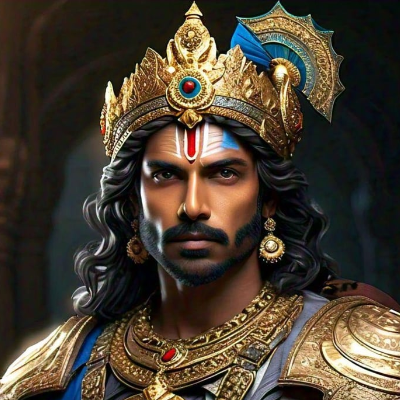
Nakula — The Radiant Twin, Sword-Master of the Pandava Line
Nakula · Madreya · Ashvinisuta · Granthika · Damagranthi · Pandavamadhyama · Shadeva-sahaja
Among the five Pandavas, Nakula is perhaps the most quietly extraordinary — the one most often overlooked in the shadow of his more celebrated brothers, and yet the one whose particular gifts, whose unique genealogy, and whose steadfast loyalty illuminate a dimension of the epic that would otherwise remain dark. He is the fourth Pandava, first of the twin sons of Madri by the divine Ashvin physicians, and he carries within him a celestial inheritance of beauty, healing, horse-craft, and an almost preternatural physical grace that set him apart from every warrior of his age. To read Nakula carefully is to discover a man of rare completeness — handsome as a god, skilled as a master, loyal without reservation, and possessed of a self-awareness about his own gifts that never curdled into vanity.
✦ Born of the Divine Physicians — Grace Descended to Earth
Nakula was born to Madri — the second wife of King Pandu, princess of the Madra kingdom — through the invocation of the Ashvins, the twin celestial physicians of the gods. The Ashvins are among the most ancient and luminous of the Vedic deities — healers, horsemen, harbingers of dawn, and the most beautiful of the divine beings. They ride golden chariots across the sky at the threshold between night and day, and their gifts to the world are rejuvenation, medicine, and the restoration of what has been lost.
From these divine parents, Nakula and his twin Sahadeva were born simultaneously — mirroring the dual nature of the Ashvins themselves. At the moment of their birth, celestial voices declared that the twins surpassed even the Ashvins in beauty and would be unmatched in their respective arts. Nakula inherited from the Ashvins their mastery of horses, their physical perfection, and the healing knowledge that the divine twins carry. He was said to be the most beautiful man of his age — so extraordinarily handsome that he was required to wear a veil in public during the year of incognito exile, lest his appearance draw attention and give away the Pandavas' identities.
✦ Lineage — The Madra Branch of the Lunar Tree
Nakula's lineage weaves together the celestial Ashvin heritage with the royal Madra line and the great Kuru dynastic trunk of the Chandravamsha — the Lunar Dynasty.
- Divine Fathers: The Ashvins (Nasatya and Dasra) — twin gods of dawn, medicine, and horsemanship; physicians of the celestial realm
- Mother: Madri — princess of the Madra kingdom, second wife of King Pandu; renowned for her beauty and dignity
- Maternal Uncle: Shalya — king of Madra, commander of the Kaurava forces on the final day of the Kurukshetra war, and one of the most painful adversaries the Pandavas faced
- Legal Father: King Pandu of Hastinapura — son of Vyasa and Ambalika
- Elder Brothers: Yudhishthira (son of Dharma), Bhima (son of Vayu), Arjuna (son of Indra)
- Twin Brother: Sahadeva — born of the same Ashvin invocation, inseparable companion, master of swords and astrology
- Step-Mother: Kunti (Pritha) — who raised Nakula and Sahadeva after Madri's death on Pandu's funeral pyre, treating them as her own with unfailing love
- Dynastic Line: Lunar Dynasty (Chandravamsha) → Kuru → Shantanu → Pandu → Nakula
Wife and Son:
- Draupadi (Panchali) — his queen among the five shared wives; bore him Shatanika, slain in Ashvatthama's night raid on the Pandava camp
- Karenumati — princess of Chedi, married during the Pandava campaigns; bore him Niramitra
✦ The Arts of the Ashvins — Horse, Sword, and Healing Hand
Nakula's gifts were not the thunderous, world-shaking kind of his elder brothers — they were precise, refined, and extraordinarily deep in their own domains. He was considered the supreme master of the sword among the Pandavas, and his skill with asi yuddha — sword combat — was matched by none in the known world. His swordsmanship was described as combining speed, elegance, and devastating efficiency in a manner that recalled the Ashvins' own swift movement across the dawn sky.
Yet Nakula's most celebrated expertise lay with horses. He was the foremost equestrian of his age — not merely as a rider or charioteer, but as one who understood the nature, medicine, breeding, training, and spiritual significance of horses in a manner that approached the sacred. The horse in Vedic and Puranic tradition is no ordinary animal — it is solar, royal, and divine, the vehicle of kings and the symbol of sovereign power. Nakula's mastery of horses thus carried a dimension beyond the practical; it was a form of priestly and royal knowledge simultaneously.
He was also deeply versed in Ayurvedic medicine — particularly in the treatment of animals and horses — and in the broader healing arts inherited from his divine Ashvin fathers. This knowledge served the Pandavas practically across their years of wandering and also informed his disguise during the year of incognito exile.
✦ The Conquest of the West — Nakula's Campaign of Digvijaya
In preparation for Yudhishthira's grand Rajasuya Yajna, the five Pandavas undertook separate military campaigns to bring all the kingdoms of Bharata under imperial suzerainty. Nakula was entrusted with the western campaign — the Pashchima Digvijaya — and conducted it with a combination of martial brilliance and diplomatic skill that revealed the full range of his abilities.
Setting out from Indraprastha, Nakula subdued the kingdoms of Rohitaka, Shurasena, Matsya, Panchala's western territories, and numerous desert kingdoms. He defeated the powerful Mlechchha tribes of the western regions, brought the rulers of Sindhu and Sauvira under tribute, and reached as far as the regions bordering the western ocean. Particularly notable was his engagement with the kingdoms of Shakala — the capital of his maternal Madra kingdom — where he negotiated with the skill of a diplomat rather than the bluntness of a conqueror, mindful of his own blood ties to that land.
He returned to Indraprastha laden with tribute — horses of every breed and colour from across the western kingdoms, gold, gems, and the pledged loyalty of dozens of rulers. His campaign was considered one of the most successfully conducted of the four, blending speed, precision, and a sensitivity to political relationships that reflected the full breadth of his intelligence.
✦ Granthika — The Horse-Master in Disguise
During the crucial thirteenth year of exile — the ajnatavasa, the year of living incognito — each Pandava assumed a disguise at the court of King Virata of Matsya. The disguise chosen for Nakula was the most natural of all: he served as Granthika, the royal horse-keeper and stable master.
In this role Nakula excelled beyond any expectation — transforming Virata's royal stables, identifying and treating diseased horses, training the king's cavalry mounts to new levels of responsiveness and speed, and earning such trust from King Virata that he was given authority over the entire royal horse establishment. His knowledge was so evidently profound and his manner with the animals so instinctively masterful that even in disguise he could not conceal the depth of his divine inheritance. King Virata's horses, it was said, had never been so healthy, so well-trained, or so magnificent as during the year Granthika served among them.
He was also required during this year to manage his extraordinary beauty — concealing his face when among the women of the court, maintaining a careful anonymity in a role that brought him into daily contact with the most senior members of Virata's household. That he succeeded for the full year without detection speaks to a discipline and self-command not always associated with the fourth Pandava.
✦ At Kurukshetra — The Sword in the Storm
Nakula fought with distinction across the eighteen days of the Kurukshetra war, though the epic's vast narrative inevitably centres most of its martial detail on Arjuna, Bhima, and the great commanders of both sides. Nakula's contributions were nonetheless significant and recorded across multiple parvas.
He engaged and held his own against Karna in direct combat on multiple occasions — an achievement that very few warriors on either side could claim, given Karna's near-supernatural martial power. He fought Shalya — his own maternal uncle, fighting for the Kauravas — in a combat that carried the particular anguish of kinsmen in opposition. He slew numerous commanders and elephant-riders in the Kaurava army and served as one of the key defenders of Yudhishthira's flanks when the eldest Pandava came under direct assault.
On the final day of the war, after Duryodhana fell and the fighting was effectively over, Nakula was among the first to ride through the broken Kaurava formations to confirm the extent of the Pandava victory — his horsemanship and his ability to move swiftly through chaotic terrain serving the cause one final time. He survived the war entirely, as did Sahadeva — the twin pair remaining unbroken when so much else around them had been destroyed.
✦ The One Flaw Named — and What It Reveals
The Mahabharata is a text that does not permit its heroes to be without shadow. In the Mahaprasthanika Parva, as the Pandavas undertook their final journey northward and fell one by one, Yudhishthira named the particular flaw of each fallen companion when asked by Bhima why they had fallen.
When Nakula fell, Yudhishthira said: "Nakula believed that there was no one in the world equal to him in beauty." It is a flaw so slight, so human, and so understandable — given that he was indeed the most beautiful man of his age, and that his beauty was not a vanity he had cultivated but a divine inheritance he had been born with — that it reads less as a condemnation than as a tender acknowledgment of the particular burden of extraordinary gifts. To be born supremely beautiful, to know it, and to take quiet pride in it — this was Nakula's one deviation from perfect equanimity. That this was the only charge the epic could bring against him speaks volumes about the quality of the man.
✦ The Bond of the Twins — Nakula and Sahadeva
No account of Nakula is complete without the bond he shared with his twin Sahadeva — the inseparable other half of the Ashvin pair made mortal. Where Nakula was the master of horses and sword, Sahadeva was the master of cattle-lore, astrology, and strategic wisdom. Together they formed a complementary unity that mirrored their divine parentage: the Ashvins themselves are a pair of complementary forces — one associated with the sun's emergence, one with its retreat; one with action, one with knowledge.
The twins shared not only their divine origin and their physical beauty but a quality of quiet competence — a willingness to serve, to support, to function without demanding the foreground — that made them the steady, reliable foundation upon which the louder, more dramatic energies of their elder brothers could operate. In many folk traditions and regional Mahabharata tellings, the twins are celebrated together as a single sacred pair, inseparable in worship as in life.
✦ Madri's Legacy — The Orphan Who Never Forgot
Nakula and Sahadeva lost their mother Madri in early childhood when she chose to ascend Pandu's funeral pyre — an act of devotion and grief that left the twins motherless before they could form lasting memories of her. They were raised entirely by Kunti, who, to her extraordinary credit, loved them as her own and never distinguished between her biological sons and Madri's children.
This early loss gave Nakula a particular quality of devotion toward Kunti — a gratitude so deep it verged on the sacred — and a lifelong awareness of impermanence and the preciousness of family bonds. It also sharpened his loyalty to Yudhishthira, who as eldest bore the responsibility of holding the family together. When Yudhishthira, during the Yaksha episode at the forest lake, chose to have Nakula restored to life over his own full brothers — so that Madri's lineage would not be entirely extinguished — it was an act of justice and love that Nakula carried in his heart for the remainder of his life.
✦ Eternal Legacy — The Quiet Excellence
Nakula's legacy is that of quiet, irreplaceable excellence — the man whose gifts are so natural, so gracefully worn, and so steadily deployed that they become invisible against the larger drama of the epic. He does not have a Gita preached on his behalf. He does not slay a hundred brothers or tear open an enemy's chest. He does not win the grandest archery contest in history or argue with Yama at a forest lake. He simply does what he does with supreme mastery, absolute loyalty, and an unbroken composure that — in the context of the Mahabharata's storms — is itself a form of heroism.
In regional traditions of South India, Maharashtra, and Nepal, Nakula is venerated alongside his twin as a deity of health, horse-blessing, and physical beauty. Temples in parts of Karnataka and Tamil Nadu include the Pandava twins in their iconography, and folk healers in some traditions invoke Nakula's Ashvin heritage when seeking cures for animal sickness or blessing for horses and cattle. He is, in the deepest sense, the divine physician's son who spent his mortal life tending to what was beautiful, what was swift, and what needed care — and who asked for nothing in return but the company of his twin and the loyalty of his brothers.
✦ Primary Scriptural References
- Mahabharata (Vyasa) — Adi Parva (birth and early life), Sabha Parva (Digvijaya campaign to the west), Vana Parva (Yaksha Prashna, where Nakula's restoration is the measure of Yudhishthira's equity), Virata Parva (service as Granthika), Bhishma through Shalya Parvas (battles at Kurukshetra), Mahaprasthanika Parva and Svargarohana Parva
- Bhagavata Purana — references to the Pandava twins within the broader narrative of the Kuru lineage and Krishna's relationship with the five brothers
- Ashvini Upanishad and related Vedic literature — theological background on the divine Ashvins whose nature and gifts Nakula and Sahadeva inherit and embody in mortal form
- Regional Mahabharatas — Tamil, Kannada, and Telugu folk retellings in which Nakula and Sahadeva are celebrated as a sacred twin pair, with dedicated sections on their beauty, their horsemanship, and their healing arts not always foregrounded in the Sanskrit original
- Vishnu Purana and Harivamsha — genealogical passages recording the Pandava lineage including Nakula's place within the Kuru dynastic succession and the cosmic role of the Ashvin-born twins in the preservation of the solar-lunar balance of the age
"Not all heroes announce themselves with thunder — some arrive at dawn, gentle and luminous as the gods who made them, and do their work so perfectly that the world forgets to ask who held the horses steady while the great battle raged."