
About
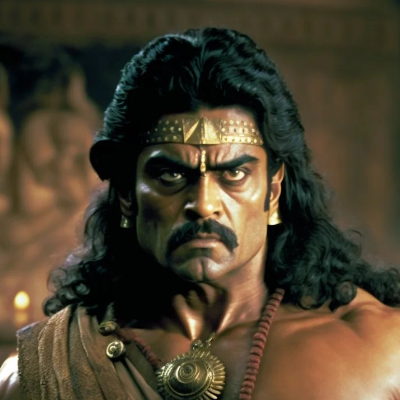
Sutasoma — The Second Flame, Son of the Wind-Born Colossus
Sutasoma · Bhimaseni · Draupadeya-dvitiya · Upapandava-madhyama · Vrikodara-suta · Pavana-pautra
Among the five Upapandavas — those brief, luminous sons of Draupadi who were raised to inherit the world their fathers had bled to reclaim — Sutasoma stands as the second, the son of Bhima and Draupadi, inheritor of the most elemental energy in the entire epic. His father was the wind-born colossus who vowed to drink Duhshasana's blood and shatter Duryodhana's thighs, and who fulfilled both vows with the absolute commitment of his nature. His mother was the fire-born queen whose humiliation had set in motion the destruction of an age. In Sutasoma, the wind and the sacred fire converged — an inheritance of raw, consuming force combined with the moral precision that Draupadi brought to every dimension of her existence. He was named for the extracted essence of the divine Soma, trained to the fullness of his potential, and destroyed in the darkness of the Sauptika night before the world could learn what a man made of those two inheritances might have built.
✦ The Name — Extracted Soma, Manifestation of the Mind
The name Sutasoma carries Vedic resonance of the deepest kind. It derives from suta — meaning "extracted," "pressed out," or "born" — and soma — the sacred ritual nectar of the Vedic sacrifices, the divine drink offered to the gods, the moon in its celestial aspect, and in its philosophical dimension, the very essence of mental clarity and spiritual illumination. Together the name means: one who has extracted the Soma — a prince of sacred ritual mastery — or in its deeper philosophical reading, manifestation of the mind's highest essence.
That Bhima — the most physically oriented of all the Pandavas, the man of mace and muscle and consuming appetite — chose for his son by Draupadi a name so thoroughly rooted in Vedic sacred learning and mental refinement is itself a telling detail. It speaks to a dimension of Bhima that the epic's battle narratives tend to obscure: the man who ate enormously and fought titanically also desired for his son the qualities of sacred knowledge, ritual precision, and the distilled essence of mental and spiritual excellence that the Soma represented. Sutasoma was Bhima's aspiration made into a name — the hope that his son would be as renowned for learning and inner refinement as his father was for the mace.
✦ Born of Wind and Sacred Fire
Sutasoma was born at Indraprastha during the years of Pandava prosperity — into the magnificent capital built by Maya the divine architect, before the dice game shattered everything. He was the son of Bhima by Draupadi, born during Bhima's year of exclusive companionship with her. From Bhima — son of Vayu, possessor of the strength of ten thousand elephants, grandson of the wind god — he inherited a constitution of extraordinary physical vitality. From Draupadi — fire-born daughter of the Panchala yajna flame — he inherited the moral intensity and fierce dignity that made her the most uncompromising figure of the entire narrative.
He also carried through Bhima the divine heritage of Vayu — the cosmic wind, the breath of the universe — in his second generation. And as Draupadi's son he was connected to the sacrificial fire of Drupada's yajna and through it to a lineage of sacred purpose that the celestial voices at Draupadi's birth had declared was the instrument of cosmic reckoning. His half-brother Ghatotkacha — Bhima's son by the rakshasi Hidimba — was among the most powerful warriors of the entire war, and fell on the fourteenth night to Karna's Vasavi Shakti. Sutasoma thus carried into the war the knowledge that his half-brother — the mightiest of Bhima's sons — had already been sacrificed for the Pandava cause.
✦ Lineage — The Second Weave of Wind and Flame
- Father: Bhima (Bhimasena, Vrikodara) — second Pandava, son of Vayu, slayer of Jarasandha, Hidimbasura, Bakasura, Kichaka, Duhshasana, and Duryodhana
- Mother: Draupadi (Panchali, Krishnaa, Yajnaseni) — fire-born queen of the five Pandavas, daughter of King Drupada of Panchala
- Paternal Divine Grandfather: Vayu — the wind god, lord of breath and vital force
- Paternal Legal Grandfather: King Pandu of Hastinapura
- Maternal Grandfather: King Drupada (Yajnasena) of Panchala
- Maternal Uncle: Dhrishtadyumna — commander-in-chief of the Pandava forces at Kurukshetra
- Elder Half-Brother: Ghatotkacha — Bhima's son by Hidimba, the mighty half-rakshasa warrior who gave his life on the fourteenth night of the war
- Brothers among the Upapandavas: Prativindhya (son of Yudhishthira), Shrutakarma (son of Arjuna), Shatanika (son of Nakula), Shrutasena (son of Sahadeva)
- Divine Lineage: Lunar Dynasty (Chandravamsha) → Kuru → Shantanu → Pandu → Bhima → Sutasoma
✦ Raised at Panchala — The Colossus's Son Among Warriors
Like all five Upapandavas, Sutasoma was sent to Drupada's court at Panchala when the dice game drove the Pandavas into exile — a child raised in his maternal grandfather's court while his parents endured thirteen years of forest wandering and incognito servitude. At Panchala he received the comprehensive training in arms, sacred sciences, and statecraft that his lineage demanded. As Bhima's son, his physical gifts would have been evident from the earliest years of his training — the Vayu heritage expressing itself in raw strength, stamina, and the instinct for forward, aggressive combat that characterised his father's entire martial style.
Yet his name's emphasis on sacred Soma knowledge suggests he was also educated deeply in the Vedic sciences — that the aspiration Bhima had encoded in the name found its fulfilment in the boy's actual formation. Sutasoma grew up knowing the full weight of his family's history — the dice game, his mother's humiliation, the thirteen years of displacement — not as distant legend but as the living reason every hour of his training existed.
✦ At Kurukshetra — Advancing Against Drona
The Mahabharata records that all five Upapandavas were classified as Ekarathis by Bhishma in his enumeration of warriors — single-chariot fighters of established competence, fully qualified for the battlefield of Kurukshetra. Sutasoma fought across the eighteen days of the war as part of the Upapandava cohort, demonstrating the full quality of his Panchala formation.
On the twelfth day of the war, the Mahabharata records a specific engagement: Vivimshati — one of the hundred sons of Dhritarashtra and thus Sutasoma's great-uncle by dynastic reckoning — resisted Sutasoma as he advanced with great prowess toward Dronacharya, scattering showers of arrows. Sutasoma, roused to fury, pierced Vivimshati with straight arrows and stood ready for combat clad in his armour. The episode reveals the full character of his fighting style: he was advancing — pressing forward, taking the attack to the enemy, seeking out the most formidable targets on the field — with exactly the aggressive, forward-driving instinct his father Bhima had always exemplified.
The text also records that on the eleventh and fourteenth days of war, all five Upapandavas were singlehandedly defeated by Vrishasena — Karna's son — a detail that speaks both to Vrishasena's extraordinary ability and to the Upapandavas' willingness to engage even the most dangerous opponents on the field. Sutasoma survived both encounters and continued fighting — a testament to his resilience and the quality of his Panchala training.
✦ The Sauptika Night — Wind Extinguished in Silence
Sutasoma survived all eighteen days of open battle. He was alive when the Pandavas celebrated their victory on the evening of the eighteenth day, when Duryodhana lay defeated and the long arc of his family's suffering appeared at last to have found its resolution. The night that followed should have been safe.
Ashvatthama, consumed by grief over Dronacharya's death and by a fury that had dissolved every boundary of dharmic conduct, entered the sleeping Pandava camp and killed all five Upapandavas as they slept. Sutasoma — the son of the wind, named for the sacred essence of the mind's highest distillation — was killed in his sleep, without a weapon in his hand, without the chance to demonstrate any of the forward-driving courage he had shown across eighteen days of war. The Soma he was named for — the sacred nectar, the distilled essence — was extinguished in the night's silence.
✦ Primary Scriptural References
- Mahabharata (Vyasa) — Adi Parva (birth of the Upapandavas), Drona Parva and Karna Parva (battle engagements including the twelfth-day combat with Vivimshati and defeat by Vrishasena), Sauptika Parva (killing by Ashvatthama), Stri Parva (lamentations over the fallen)
- Bhagavata Purana — genealogical passages listing Sutasoma as the son of Bhima and Draupadi within the Upapandava succession
- Vishnu Purana — dynastic records of the Kuru line noting Sutasoma's position and the passing of the succession to Parikshit after the extinction of all five Upapandavas
- Regional Mahabharatas — Tamil, Telugu, and Kannada retellings in which Sutasoma's identity as Bhima's son is given particular narrative weight, his physical gifts and his tragic death receiving expanded treatment
- Draupadi Amman temple traditions — liturgical texts of the Draupadi cult in Tamil Nadu in which the five Upapandavas including Sutasoma are venerated as sacred guardian figures
"He was named for the Soma — the divine nectar pressed from the sacred plant, the essence offered to the gods, the distillation of everything most refined in the universe. His father gave him that name. And in that naming, the wind-born colossus declared what he most wanted his son to be — not merely strong, but essential."