
About
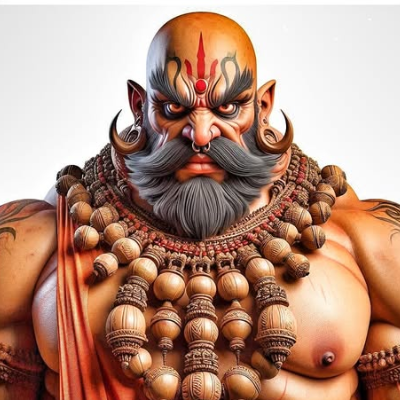
Ghatotkacha — Son of Bhima and Hidimbi, Rakshasa Warrior of the Pandava Side, Slain by Karna's Vasavi Shakti
Ghatotkacha · Ghatotkaca · Ghatotkach · Hidimbaja · Bhimasuta · Rakshasa-vira · Teen-Baandhaari-pita · Anjanaparva-pita · Meghavarna-pita
Ghatotkacha is the son of Bhima — the second of the five Pandava brothers, son of Pandu and Kunti, whose actual progenitor was the wind god Vayu — and Hidimbi (also called Hidimba), a Rakshasi princess whose brother Hidimba had been killed by Bhima when he attempted to attack the Pandavas during their forest exile after escaping the Lakshagriha. He was born in the forests of the Himalayas, grew to young adulthood in an instant at birth, was raised by his mother in the Rakshasa kingdom, and was the eldest of all the Pandavas' sons — born before Abhimanyu, before Shrutakarma, before the Upapandavas. He is described throughout the Mahabharata as loyal, humble, and unconditionally devoted to his father Bhima and his Pandava uncles — present whenever Bhima mentally called for him, available through every crisis of the forest exile and the war. His half-Rakshasa nature gave him powers that no purely human warrior could match: the ability to fly through the air, to grow to the size of mountains, to shapeshift into terrifying forms, to fight with maximum effectiveness at night when Rakshasa powers peak. He commanded one full Akshauhini — one of the seven divisions of the Pandava army — and was the most destructive single fighter on the Pandava side during the fourteenth day of the Kurukshetra War. The entirety of the Kaurava army was on the verge of annihilation from his nocturnal assault when Duryodhana, in desperation, commanded Karna to use the Vasavi Shakti — the divine weapon Indra had given him that could be used only once, which Karna had been carefully saving to kill Arjuna. Karna used it on Ghatotkacha instead. Ghatotkacha died, and with him died the single greatest threat the Kauravas faced on the fourteenth night. Krishna wept and rejoiced simultaneously — weeping for his beloved nephew, rejoicing because the weapon meant for Arjuna was now expended. His sons in the Vyasa Mahabharata are Anjanaparva — killed on the fourteenth day by Ashvatthama — and Meghavarna — who survived the war and participated in the Pandavas' post-war Ashvamedha sacrifice.
✦ The Name
The Sanskrit name Ghatotkacha — written Ghaṭotkaca — is a compound of ghata (a pot, a water jar, a round vessel) and utkacha (bald-headed, without hair, with the head uncovered). The compound means pot-headed, bald as a pot, he whose head is shaped like a pot. The name describes his physical appearance: he was born bald and remained hairless, with a head shaped like the round earthen pot used for carrying water. His name is mentioned in the Bhishma Parva of the Mahabharata in the context of the first day's battle, and in the Drona Parva in the chapters on the fourteenth day. The Glorious Hinduism source notes that at the moment of his birth he was given the name by his parents on account of this distinctive appearance. The Mahabharata's text is consistent in this etymology throughout.
✦ Lineage
- Father: Bhima — the second Pandava; son of Pandu (the Kuru king) and Kunti, who invoked the wind god Vayu to father him; of extraordinary physical strength; who killed Hidimba, the Rakshasa chief of the forest, before marrying Hidimba's sister Hidimbi
- Mother: Hidimbi — also called Hidimba; a Rakshasi princess; sister of the Rakshasa chief Hidimba; who fell in love with Bhima when her brother sent her to lure the Pandavas as food; who disobeyed her brother, warned the Pandavas, and watched Bhima kill Hidimba; who approached Kunti for Bhima's hand in marriage; the Pandavas agreed on the condition that once a child was born they would continue their journey; who raised Ghatotkacha in the Rakshasa kingdom after the Pandavas departed; who is venerated in the Kullu valley of Himachal Pradesh as a goddess in the Hadimba Devi Temple at Manali, one of the most celebrated temples in northern India
- Paternal grandfather: Pandu — the pale king of Hastinapura; who was cursed to die if he engaged in physical intimacy and therefore had his wives invoke divine beings to father his sons; Bhima's actual progenitor was Vayu, the wind god
- Paternal grandmother: Kunti (Pritha) — who invoked Vayu to father Bhima; who gave her conditional blessing to Bhima's marriage with Hidimbi
- Paternal uncles: Yudhishthira, Arjuna, Nakula, and Sahadeva — the other four Pandavas; for whom Ghatotkacha served as a loyal ally throughout the forest exile and the war
- Maternal uncle: Hidimba (deceased) — the Rakshasa chief killed by Bhima before the marriage
- Wife: Ahilawati — also called Ahilavati, Maurvi, Mourvi, and Kamkanthika; described across the sources as the daughter of Ahilabala, the king of Manipura in some accounts; the daughter of Muru (a Yadava king or Daitya general depending on the source) in others; who taught Ghatotkacha and their son the arts of warfare; no primary canonical source gives a definitive account of how the marriage came about
- Sons in the Vyasa Mahabharata: Anjanaparva — also called Anjanparva; killed on the fourteenth day of the Kurukshetra War by Ashvatthama, whose killing of Anjanaparva drove Ghatotkacha into the furious nocturnal assault that led to his own death that same night; and Meghavarna — who survived the Kurukshetra War and participated in Yudhishthira's post-war Ashvamedha sacrifice; the Wikipedia article on Ghatotkacha confirms both sons from the primary Mahabharata text
- Son in folk tradition only — not in the Vyasa Mahabharata: Barbarika — the warrior with three infallible arrows; whose story belongs to the Skanda Purana (Kaumarika Khanda), the oral tradition of Rajasthan and Gujarat, and who is worshipped as Khatu Shyam; his status as Ghatotkacha's son is not recorded in the Vyasa Mahabharata and is explicitly noted by the Wikipedia article on Ghatotkacha as a folk attribution; the Barbarika profile below covers this tradition in full
- Half-brothers: Shrutakarma (son of Bhima and Draupadi); Sutasoma (son of Bhima and Draupadi — the Upapandava); the Upapandavas born of the other Pandavas through Draupadi
✦ Birth — The Instant Man
Ghatotkacha's birth is one of the most remarkable in the Mahabharata's gallery of unusual births. The Glorious Hinduism source records the Mahabharata's account: after Bhima killed Hidimba and the Pandavas agreed to let him stay with Hidimbi during the days while returning each night, Bhima and Hidimbi spent time together in the snowy mountains and forests of the Himalayas. After some months Hidimbi gave birth. The moment the child was born he grew to become a young adult instantly — the Rakshasa rate of growth, in which childhood is compressed into seconds. He was immediately named Ghatotkacha on account of his bald, pot-shaped head. Hidimbi then knew that the time with the Pandavas was at its natural end. Before they parted, Ghatotkacha took a vow: whenever Bhima thought of him, he would appear before him and obey his command. This vow was honoured throughout the epic — Ghatotkacha appeared when summoned, served without condition, and fulfilled his promise at the cost of his own life.
✦ The Forest Exile — Servant of the Pandavas
During the Pandavas' twelve-year forest exile and the one year of living incognito, Ghatotkacha served his father and uncles on multiple occasions. The Bhima Wikipedia source records that when the Pandavas were journeying to the Gandhamadana mountain and Draupadi fainted from exhaustion, Bhima invoked his son Ghatotkacha, who arrived promptly and carried the Pandavas on his shoulders through the difficult terrain. He also assisted during the journey to Kubera's gardens when the Pandavas were confronted by Rakshasa guardians. The Skanda Purana (Kaumarika Khanda, Chapters 59–60) records an additional episode from this period: Ghatotkacha came to visit the Pandavas and Krishna at Indraprastha, during which a significant narrative concerning his household unfolded — the Wikipedia source on Ghatotkacha identifies this Skanda Purana episode as a canonical textual source for his Indraprastha visit.
✦ The Kurukshetra War — Day by Day
Ghatotkacha commanded one full Akshauhini of the seven-division Pandava army. The Wikipedia article on Ghatotkacha records his battlefield activity across multiple days. On the first day of the war he fought against Alambusha — the Rakshasa prince fighting for the Kauravas — Duryodhana himself, and Bhagadatta. The Kauravas, terrified of his terrible assault on that first day, deliberately postponed the evening battle rather than continue engaging him. On the eighth day he had a prolonged clash with Alambusha — he managed to severely wound him but was unable to prevent his retreat. The rivalry between Ghatotkacha and Alambusha — both Rakshasa warriors on opposing sides — was one of the war's recurring sub-narratives. The fourteenth day was the day that defined Ghatotkacha's place in the Mahabharata. During the morning battle his son Anjanaparva was killed by Ashvatthama. The grief and fury of a father who has lost his son transformed Ghatotkacha into an unstoppable force. As evening fell and the battle was continued past sunset by mutual agreement — the night following Jayadratha's death — his Rakshasa powers reached their peak. Rakshasas fight with maximum effectiveness at night; their strength, speed, and magical ability intensify after dark. Ghatotkacha, growing to the size of mountains, trampling soldiers with his feet, hurling rocks and trees, directing his Naga army from the air, annihilated entire divisions of the Kaurava forces. The Mahabharata records that the Kaurava army was on the verge of complete destruction. Duryodhana, watching his army disappear division by division, went to Karna. He implored his greatest warrior to use the Vasavi Shakti — the divine weapon given to Karna by Indra in exchange for his natural armour and earrings, capable of killing any single target against whom it was aimed, usable only once. Karna had been preserving this weapon for Arjuna — the one enemy he feared enough to save his supreme weapon for. He released it against Ghatotkacha. Ghatotkacha died. As he fell, he used the last of his Rakshasa powers to grow to an enormous size and fall upon and crush a large portion of the Kaurava army beneath his body — killing even in death. Krishna, watching Ghatotkacha fall, wept and simultaneously expressed relief. The Mahabharata records his explanation to Arjuna: had that weapon been used on Arjuna as Karna intended, Arjuna would have died and the Pandavas would have lost the war. Ghatotkacha's death preserved Arjuna's life and thus preserved the Pandava victory. His sacrifice — not deliberate but functionally decisive — is the tradition's statement that sometimes the most consequential contribution to a cause is made by those who do not survive to see it win.
✦ Bhima's Grief
The Medium source records a single verse from the Mahabharata (Drona Parva, Chapter 158, Verse 21) that records Yudhishthira's words after Ghatotkacha's death: addressing Bhima, Yudhishthira says he is engulfed by great delusion due to the death of Hidimba's son. The verse catches Bhima in the precise moment of his grief — and simultaneously in the moment of his greatest composure, because Yudhishthira asks him to hold back the Kaurava army while Yudhishthira himself is overwhelmed by grief for the death of that very brother's son. Bhima's response to the loss of his firstborn, fought through his grief to continue fighting for the war his son had just turned with his death, is one of the Mahabharata's most quietly harrowing human moments.
✦ In Regional Traditions and Modern Culture
Ghatotkacha is a particularly beloved figure in South-East Asian traditions of the Mahabharata. An ancient 7th-century Hindu temple in the Dieng Temples complex of Central Java is named after him — one of the oldest surviving structural evidences of the Indian epic's reception in the Indonesian archipelago. In Javanese wayang, Ghatotkacha — called Gatotkaca — is a major heroic figure and the protagonist of numerous dramas, depicted as a noble knight with extraordinary flight powers. He is also the protagonist of the Maya Bazaar narrative — in which he assists his cousin Abhimanyu in winning the hand of Balarama's daughter Sasirekha (Vatsala) by impersonating her former betrothed Lakshmana Kumara; this narrative, though not in the primary Vyasa Mahabharata, has been filmed numerous times in South India in Telugu, Tamil, Kannada, and Malayalam. Temples dedicated to Ghatotkacha exist at Champawat in Uttarakhand — where tradition holds his head fell after Karna's weapon struck him — and near the Hidimba Devi Temple at Manali in Himachal Pradesh.
✦ References
- Mahabharata (Adi Parva, Hidimba-Vadha Parva, Chapters 9–10 of Adi Parva) — the birth episode: Hidimba and the Pandavas; Bhima's killing of Hidimba; Hidimbi's marriage proposal; Kunti's condition; Bhima and Hidimbi in the mountains; Ghatotkacha's instant birth and naming; his vow of service; the Pandavas' departure
- Mahabharata (Vana Parva — multiple chapters) — Ghatotkacha summoned during the Gandhamadana journey; carrying the Pandavas on his shoulders; the Rakshasa encounters at Kubera's gardens
- Mahabharata (Bhishma Parva, Chapters 8, 25–26) — Ghatotkacha's role on the first day; the encounter with Alambusha, Duryodhana, and Bhagadatta; the Kaurava terror at his assaults
- Mahabharata (Drona Parva — the Fourteenth Day chapters) — the death of Anjanaparva at Ashvatthama's hands; Ghatotkacha's grief-fuelled nocturnal assault; the near-annihilation of the Kaurava army; Duryodhana's plea to Karna; Karna's use of the Vasavi Shakti; Ghatotkacha's death and his final crushing of the Kaurava army as he fell; Krishna's simultaneous weeping and relief; Yudhishthira's verse asking Bhima to hold the army while overcome with grief
- Skanda Purana (Kaumarika Khanda, Chapters 59–60) — the episode of Ghatotkacha's visit to the Pandavas and Krishna at Indraprastha; the canonical Puranic reference to his household beyond the Mahabharata itself
- Wikipedia — Ghatotkacha; Wikipedia — Hidimbi; Wikipedia — Bhima; Glorious Hinduism — Ghatotkacha: The Giant Rakshasa; Mythlok — Ghatotkacha: The Divine Rakshasa; Sanatandharmaa — Ghatotkacha; Medium (Hariprasad N) — Bhima Vairagya: The Death of Ghatotkacha; Mahabharataonline — The Story of Ghatotkacha: modern summaries drawing from the above primary sources