
About
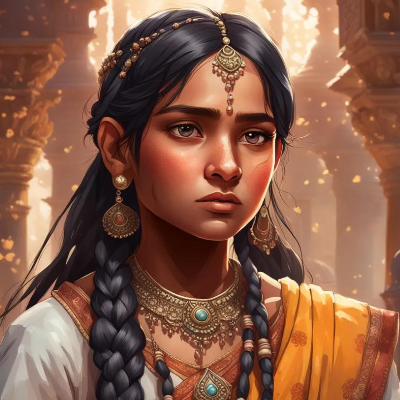
Ahilawati (Maurvi) — Wife of Ghatotkacha, Daughter of Mura, Warrior Princess of Pragjyotisha
Ahilawati · Ahilāvati · Maurvi · Mourvi · Kamkanthika · Kamakatankata · Naga Kanya · Mura-putri · Ghatotkacha-patni · Anjanaparva-mata · Meghavarna-mata · Barbarika-mata
Ahilawati — known before her marriage as Maurvi, meaning daughter of Mura — is the wife of Ghatotkacha, the Rakshasa warrior son of the Pandava Bhima and the Rakshasi Hidimbi; and the mother of Anjanaparva (killed on the fourteenth night of the Kurukshetra War by Ashvatthama), Meghavarna (who survived the war and participated in the Pandavas' Ashvamedha), and in the folk and Skanda Purana tradition, Barbarika (the warrior with three infallible arrows, worshipped as Khatu Shyam — whose identification as Ghatotkacha's son is not in the Vyasa Mahabharata). Her story is narrated most fully in the Skanda Purana (Kaumarika Khanda, Chapters 59–60) and supplemented by regional folk traditions of Rajasthan, Gujarat, and Bengal. Two incompatible traditions exist for her parentage: she is the daughter of Mura — the Danava general and ally of Narakasura at Pragjyotisha, killed by Krishna — per the Skanda Purana and the primary popular account; or she is the daughter of Vasuki, the sacred serpent who wears around Shiva's neck, per a separate folk tradition. Both are recorded honestly below. She was blessed by the goddess Kamakhya with beauty surpassing Rati, sharp intellect, and invincible martial prowess. She had taken a vow to marry only the man who defeated her in both intellectual debate and physical combat, and had killed all previous suitors who attempted and failed.
✦ The Names
The name Ahilawati — written Ahilāvati — is the name she bears after her marriage and the form by which she is most commonly known in the Mahabharata tradition. Its precise Sanskrit etymology is not recorded in the available sources. Her maiden name Maurvi — also written Mourvi and Maurvi — is a straightforward patronymic: daughter of Muru (Mura), the Danava general. In the Skanda Purana's Kaumarika Khanda she appears as Kamkanthika or Kamakatankata — a name evoking themes of desire and adornment — and it is under this name that she fights Krishna at Pragjyotisha and is protected by the goddess Kamakhya. She is also described across traditions as a Naga Kanya — a snake-maiden — a designation that carries over from both the Mura tradition (in which Pragjyotisha had Naga associations) and the Vasuki tradition (in which she is literally a serpent-king's daughter). All four names — Ahilawati, Maurvi, Kamkanthika, and Naga Kanya — refer to the same figure at different stages of her narrative and in different regional and textual traditions.
✦ Lineage — Two Traditions of Parentage
- Father (primary tradition — Skanda Purana): Mura — the Danava general; ally and commander-in-chief of Narakasura, the demon king of Pragjyotisha; who received from Brahma the boon of invincibility in battle against all beings including the devas; who installed sharp defensive stakes around the fortified city of Pragjyotisha; who fought Krishna when he came to defeat Narakasura and was killed by the Sudarshana Chakra along with his sons; whose death at Krishna's hands gave Krishna the epithet Murari — the killer of Mura
- Father (alternate folk tradition): Vasuki — the sacred serpent king who coils around Shiva's neck as his ornament; the king of the Nagas; who gave Bhima the elixir of life obtained from Shiva when Bhima was poisoned by Duryodhana and Shakuni and thrown into a river, sinking into the Naga realm; who did so at Ahilawati's plea — she recognised Bhima as Vayu's son and told her father she would immolate herself in Bhima's funeral pyre if he died
- Curse (in the Vasuki tradition): Ahilawati had been cursed by Parvati — Shiva's consort — for offering stale flowers to Shiva; the curse was that she would receive a mortified man as her husband; this curse connected her destiny to Ghatotkacha, whose father Bhima's near-death state in the poisoned river fulfilled the curse's letter
- Textual note on the two traditions: the Skanda Purana's Kaumarika Khanda identifies her father as Mura the Danava general; the separate folk tradition identifies her father as Vasuki the Naga king. These two traditions are incompatible in their details. The Skanda Purana account has the stronger claim to canonical status as a Mahapurana and is followed as the primary tradition in this profile. The Vasuki-daughter tradition is a regional folk tradition and is recorded here for completeness
- Husband: Ghatotkacha — Rakshasa warrior; son of Bhima (second Pandava) and Hidimbi (the Rakshasi princess); commander of one Akshauhini in the Kurukshetra War; killed on the fourteenth night by Karna's Vasavi Shakti weapon
- Patron goddess: Kamakhya — the great Tantric goddess of Pragjyotisha, whose temple is at Guwahati in Assam; who protected Ahilawati when Krishna was about to kill her with the Sudarshana Chakra; who persuaded her to surrender her anger and accept her father's death as inevitable
- Mother-in-law: Hidimbi — the Rakshasi princess who married Bhima; who raised Ghatotkacha in the Rakshasa kingdom; venerated as a goddess at the Hadimba Devi Temple in Manali, Himachal Pradesh
- Father-in-law: Bhima — the second Pandava; son of Pandu and Kunti, who invoked the wind god Vayu to father him; of extraordinary physical strength
- Sons: Anjanaparva — killed by Ashvatthama on the fourteenth night of the Kurukshetra War; Meghavarna — who survived the war and participated in the Pandavas' Ashvamedha; Barbarika — in the Skanda Purana and folk tradition only, not in the Vyasa Mahabharata
✦ The Battle at Pragjyotisha — Grief and the Goddess
Krishna and his wife Satyabhama set out for Pragjyotisha to defeat Narakasura, who had stolen the divine umbrella of Varuna, the earrings of the goddess Aditi, and had imprisoned sixteen thousand one hundred and eight women in his palace. Mura, as Narakasura's commander-in-chief, was the first great obstacle the divine couple faced at the fortress — his boon-given invincibility making him the most dangerous defender of the city. Before Narakasura himself was reached, Mura had to be overcome. Krishna killed Mura with the Sudarshana Chakra along with his sons and then proceeded to defeat and kill Narakasura. After her father's death, Ahilawati attacked Krishna in grief and rage. She fought valiantly — cutting off his arrows, striking even his mount Garuda — and the battle continued for three days. One tradition records that she wielded a powerful sword given to her by the goddess Kamakhya herself. When Krishna was about to end her life with the Sudarshana Chakra, the goddess Kamakhya appeared and placed Ahilawati under her divine protection, telling Krishna she could not be killed. Kamakhya then turned to Ahilawati and explained that her father's death had been decreed by fate, that it was inevitable, and that continued fighting was futile. Ahilawati, understanding this, surrendered her anger and bowed before Krishna. She returned the sacred sword to the goddess. Krishna consoled her and promised she would be well married. She then continued to live in Pragjyotisha with Narakasura's son Bhagadatta, waiting in the knowledge that the marriage Krishna had promised would come.
✦ The Vow — Warrior, Debater, and Killer of Failed Suitors
Before the Narakasura episode and continuing after it, Ahilawati had taken a formidable vow: she would marry only the man who defeated her in both intellectual disputation and physical combat. She was blessed by the goddess Kamakhya with beauty surpassing Rati — the goddess of love — combined with sharp intellect and martial prowess that made her invincible against ordinary suitors. She sat on a jewelled swing, adorned in divine ornaments, radiating a splendour compared to lightning. Every suitor who came to attempt the tests failed. She killed them all. No man in the three worlds had been found worthy of meeting both conditions simultaneously — the combination of intellectual and martial defeat of a woman blessed by Kamakhya being a standard beyond ordinary human achievement.
✦ Krishna's Recommendation and the Marriage to Ghatotkacha
When Ghatotkacha visited the Pandavas and Krishna at Indraprastha, Yudhishthira expressed his concern about finding a suitable wife for him. Krishna told Yudhishthira the full story: his battle with Mura at Pragjyotisha, Mura's death, Kamkanthika's grief-filled attack on him for three days, the goddess Kamakhya's intervention, Kamkanthika's surrender, and the vow that no ordinary man had been able to fulfil. Krishna said she was the right match for Ghatotkacha and proposed that he be sent to Pragjyotisha to attempt her tests. Ghatotkacha went. He answered all the questions she posed in the intellectual test — she asked him complex questions but he succeeded in answering all of them. He then defeated her in physical combat. Both conditions of her vow were fulfilled. Her vow satisfied, she accepted Ghatotkacha as her husband. The marriage was celebrated. Through this union, Ahilawati became part of the Pandava extended family — the daughter of their enemy's general, converted by Krishna's promise and Kamakhya's counsel into the wife of Bhima's own son.
✦ The Bhima Episode — The Naga Kanya Tradition
In the alternate tradition that identifies Ahilawati as Vasuki's daughter rather than Mura's, a different account of her connection to the Pandavas precedes the marriage. In this tradition, Bhima was poisoned by Duryodhana and Shakuni in his childhood and thrown into a river, sinking into the Naga realm. Ahilawati was the first to recognise him as Vayu's son — she perceived his divine parentage through her Naga wisdom. She went to her father Vasuki and told him that if Bhima died she would burn herself in his funeral pyre. Vasuki, moved by his daughter's plea and her willingness to sacrifice herself for a stranger, obtained the elixir of life from Shiva and administered it to Bhima, who recovered fully and returned to the upper world. In this tradition Ahilawati's compassion for Bhima — who would become her father-in-law — was the act that saved his life and preserved the entire Pandava mission. The two traditions are incompatible: Mura's daughter and Vasuki's daughter belong to entirely different genealogical frameworks, and no primary text attempts to reconcile them.
✦ As Mother — Her Influence on Barbarika
In the tradition that identifies Barbarika as her son — the Skanda Purana and the regional folk tradition of Rajasthan — Ahilawati's most enduring legacy is the moral principle she instilled in him: always aid the defeated, always fight on the side of the weaker party. This maternal teaching became the defining ethical principle of Barbarika's extraordinary life — the vow that would lead him to conclude he could not participate in the Kurukshetra War without destroying both sides, and that eventually led to his offering of his own head to Krishna before the war began. The principle of supporting the losing side — Hare ka Sahara, the refuge of the defeated — is the teaching for which Barbarika is most universally remembered and worshipped as Khatu Shyam. It came from his mother.
✦ References
- Skanda Purana (Kaumarika Khanda, Chapters 59–60) — the primary canonical Puranic source: Ahilawati as Kamkanthika, daughter of Mura the Danava general of Pragjyotisha; her battle with Satyabhama and then Krishna after Mura's death at the Narakasura episode; three days of fighting; the intervention of goddess Kamakhya; her surrender and return of the sacred sword; Krishna's promise of marriage; her subsequent life at Pragjyotisha with Bhagadatta; the vow to marry only a man who defeats her in debate and combat; Ghatotkacha's visit to Indraprastha; Yudhishthira's concern; Krishna's recommendation; Ghatotkacha defeating her in both tests; the marriage
- Bharatpedia — Ahilawati; Wikipedia-on-IPFS — Ahilawati; Today's AI Wiki — Ahilawati — summaries of the Skanda Purana account and the Mura-daughter tradition; the vow and its fulfilment; Ghatotkacha's tests
- Hindu Devotional Blog — Ahilawati Naga Kanyaka — the Vasuki-daughter folk tradition; the Parvati curse for stale flowers; the Bhima rescue episode; Vasuki obtaining the elixir from Shiva
- Sastra Caksusa — Barbarika's Birth — the Skanda Purana identification of Barbarika as Ahilawati and Ghatotkacha's son; Ahilawati's teaching of the principle of aiding the defeated
- Glorious Hinduism — Ghatotkacha — Krishna's first-person account to Yudhishthira at Indraprastha narrating the full Kamkanthika episode from the Skanda Purana; Kamakhya's intervention; the marriage recommendation
- Sanatandharmaa — Ghatotkacha; Quora — Ahilawati Wife of Ghatotkacha; Mahabharataonline — Ahilawati: modern summaries drawing from the Skanda Purana account and regional folk traditions