
About
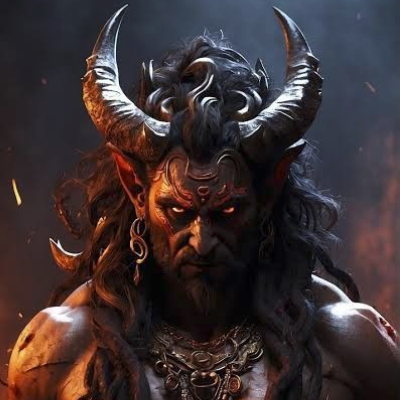
Barbarika (Khatu Shyam) — Son of Ghatotkacha, Bearer of Three Infallible Arrows, Deity of Kali Yuga
Barbarika · Barbarīka · Barbarik · Belarsen · Teen Baandhaari · Sheesh ke Daani · Khatu Shyam · Khatushyamji · Shyam Baba · Hare ka Sahara · Baliyadev · Ghatotkacha-putra · Bhima-pautra
Barbarika — worshipped in Rajasthan and across northern India as Khatu Shyam — is the son of Ghatotkacha (the Rakshasa warrior son of the Pandava Bhima and the Rakshasi Hidimbi) and Ahilawati (also called Maurvi or Mourvi); the grandson of Bhima; the great-grandson of the Pandava Kunti and the wind god Vayu; and the possessor of three infallible arrows — given to him by Shiva — with which he could, by his own reckoning, end the entire Kurukshetra War in one minute. Before the war began, Krishna — approaching him in the disguise of a Brahmin, testing his power, and recognising the catastrophic disruption his participation would cause to the war's dharmic balance — requested his head as a sacred gift. Barbarika gave it willingly. His severed head was placed on a hilltop from which it watched the entire eighteen-day war. After the war, when the victorious Pandavas argued among themselves about who deserved credit for the victory, Krishna directed them to ask Barbarika's head — which had witnessed everything. Barbarika declared that the victory belonged entirely to Krishna. Krishna, pleased with his sacrifice, devotion, and truthful testimony, granted him the boon that in the Kali Yuga he would be worshipped by Krishna's own name Shyam — the dark one — and that his devotees would have their wishes fulfilled. His head was entombed at what is now the village of Khatu in the Sikar district of Rajasthan, where the Khatu Shyam temple is one of the most visited pilgrimage sites in northern India. A critical textual note must be stated at the outset: Barbarika does not appear in the Vyasa Mahabharata — the primary Sanskrit canonical text of the epic. The Wikipedia article on Barbarika confirms this explicitly, stating that he is a folk hero who is not directly attested in the Mahabharata. The multiple sources including the Barbarik Scribd source confirm: there is no mention of any person by the name of Barbarika in the Vyasa Mahabharata. His story belongs to the Skanda Purana (one source attributes an episode to the Kaumarika Khanda), to the regional oral tradition of Rajasthan and Gujarat, and to the medieval Sanskrit and vernacular retellings that developed outside the Vyasa text. His identification as Ghatotkacha's son — while consistently stated across all popular and devotional sources — is similarly a folk attribution. The Vyasa Mahabharata records Ghatotkacha's sons as Anjanaparva and Meghavarna only. This profile presents Barbarika's story fully and with respect while maintaining this textual honesty throughout.
✦ The Names
The Sanskrit name Barbarika — written Barbarīka — derives from the root barbara, meaning stammering, barbarian, a foreigner who does not speak Sanskrit properly, one whose speech is unclear; the suffix ika making it a diminutive or personal form. The name thus means something like the little stammering one or the one of inarticulate speech — an unusual name for a warrior of supreme power that may reflect his identity as a being who stands between the world of the fully initiated and the world of the outsider, just as he stood between the Pandavas and Kauravas in the war, belonging fully to neither side. His epithet Teen Baandhaari means bearer of three arrows, recording his most distinctive attribute. Sheesh ke Daani means the one who donated his head — his most celebrated act. His devotional name Khatu Shyam combines the place-name Khatu (the village in Sikar district where his head was entombed) with Shyam (the dark one — one of Krishna's most common epithets), recording that he bears Krishna's own name in the Kali Yuga by the latter's boon. Hare Ka Sahara — the support of the helpless — is his devotional epithet among the afflicted who seek his grace. Baliyadev is his name in Gujarat. In Nepal he is identified with Yalambar — the Kirati king who is believed to be Barbarika reborn, and who is venerated as Akash Bhairav in the Kathmandu Valley.
✦ Lineage
- Father: Ghatotkacha — the Rakshasa warrior son of Bhima (the second Pandava) and Hidimbi (the Rakshasi princess); the eldest of all the Pandavas' sons; who commanded one Akshauhini in the Kurukshetra War; who was slain by Karna's Vasavi Shakti on the fourteenth night; whose death preserved Arjuna from the weapon Karna had been saving for him
- Mother: Ahilawati — also called Maurvi, Mourvi, Kamkanthika, and Ahilavati; described variously as the daughter of Ahilabala the king of Manipura, or as the daughter of Muru (Danava general — the Sastra Caksusa source identifies Muru as a Yadava king; the Wikipedia article on Barbarika identifies Muru/Moora as the Army Chief of demon king Narakasura and his wife Danavi, making Ahilawati a daughter of a Danava general); the Wikipedia article also records another tradition identifying Ahilawati as the daughter of Vasuki, the sacred serpent; she taught Barbarika the arts of warfare and also magical skills; she features in the narrative after Barbarika's death when the Pandavas bring his head to her to hear his account of the war
- Paternal grandfather: Bhima — the second Pandava; son of Pandu and Kunti, who invoked the wind god Vayu to father him; of extraordinary physical strength; who wept at the death of Ghatotkacha during the Kurukshetra War
- Paternal great-grandmother: Hidimbi — the Rakshasi princess who married Bhima; who raised Ghatotkacha in the Rakshasa kingdom; venerated as a goddess in the Kullu valley
- Paternal great-grandmother: Kunti — who invoked Vayu to father Bhima; whose connection to Krishna (Kunti was the sister of Vasudeva, Krishna's father) made Ghatotkacha a figure whom Krishna referred to as a son; this connection made Barbarika Krishna's great-grand-nephew in the devotional tradition
- Half-brothers (in Vyasa Mahabharata): Anjanaparva — killed on the fourteenth day of the war by Ashvatthama; and Meghavarna — who survived the war; Barbarika's identification as a third son of Ghatotkacha is not in the Vyasa Mahabharata
✦ The Three Arrows — The Gift of Shiva and Agni
From childhood Barbarika was an ardent devotee of Shiva. He was also a devoted worshipper of the goddess Kamakhya, through whose blessings he gained extraordinary strength. Pleased with his tapas, Shiva appeared before him and granted him three special arrows — Teen Baan — arrows of absolute infallibility: any target they were directed at would be destroyed. Subsequently, Agni — the god of fire — gave him a bow capable of ensuring victory in all three worlds. Together the three arrows and the bow made him effectively invincible. The three arrows' powers were explained by Barbarika himself to Krishna (in his Brahmin disguise) during their encounter before the war. The first arrow was intended to mark all the objects Barbarika wished to destroy. The second arrow was intended to mark all the objects he wished to save. The third arrow would then destroy everything marked by the first arrow — or everything not marked by the second arrow — and after executing its task would return to the quiver. The mechanism meant that with a single sequence of three arrows Barbarika could selectively destroy every enemy on a battlefield while leaving every ally unharmed — with perfect discrimination and without the possibility of error. Krishna, hearing this, asked him to demonstrate by marking all the leaves of the tree under which they stood with a single arrow while keeping his eyes closed. As Barbarika closed his eyes and the first arrow began its work, Krishna secretly plucked one leaf from the tree and placed it under his own foot. When the arrow had marked all the other leaves and was circling around Krishna's foot, Barbarika warned Krishna: there is a leaf under your foot; if you do not lift it the arrow will pierce you to reach it. Krishna lifted his foot. The leaf was marked. The demonstration was complete. The arrow's discrimination was absolute — it had found the hidden leaf without the archer knowing where it was.
✦ The Vow to Fight for the Weaker Side — The Paradox
Before setting out for Kurukshetra, Barbarika told his mother he wished to witness the war and would join if he felt the urge to fight. His mother gave her permission on one condition: he must always fight for the side that was weaker. Barbarika agreed and set this as his principle. When Krishna (in Brahmin disguise) asked which side he would fight for, Barbarika replied that since the Pandavas had seven Akshauhinis against the Kauravas' eleven, the Pandavas were weaker and he would fight for them. Krishna immediately identified the fatal problem with this vow. If Barbarika fought for the Pandavas, the Pandavas would become stronger — making the Kauravas the weaker side. By his vow, Barbarika would then be obliged to switch to the Kauravas. When the Kauravas became stronger due to his support, the Pandavas would be weaker again. He would switch back. He would keep switching, fighting both sides simultaneously in rapid alternation, and end up destroying both armies entirely — alone, in one minute. The war would not be a dharmic conflict decided by the merits of the two causes but an incoherent destruction dictated by a mechanical principle. The war's entire moral purpose — to establish which side's cause was righteous — would be nullified. Krishna explained all of this to Barbarika. Barbarika, following the logic, acknowledged that he could indeed not fight for either side without catastrophic consequences for the war's cosmic purpose.
✦ The Request for the Head — Donation and Boon
Having established that Barbarika could not fight, Krishna — still in the Brahmin's form — told him that before any great war the head of the greatest Kshatriya must be offered as a sacrifice to ensure the dharmic outcome. He declared that Barbarika was the greatest warrior present and asked for his head. Barbarika, recognising the depth of the request, asked the Brahmin to reveal his true identity. Krishna revealed his Vishvarupa form. Barbarika, looking upon the divine form, was overwhelmed with devotion. He told Krishna he had always wished to see his universal form before dying. Having seen it, he willingly offered his head. He made one request before the offering: he wished to watch the entire war with his own eyes. Krishna granted this boon. He also granted that in the Kali Yuga Barbarika would be worshipped by Krishna's own name Shyam — the dark one — and that his devotees who approached him with sincere hearts would have their wishes fulfilled. Barbarika's head was severed and placed on a hilltop overlooking the battlefield of Kurukshetra, where it watched the entire eighteen-day war from its vantage point.
✦ The Testimony — Who Won the War
After the war's conclusion, the victorious Pandavas began arguing among themselves about who deserved the greatest credit for the victory. Bhima claimed it was his mace; Arjuna claimed it was his archery and the Gandiva bow; the argument became heated. Krishna directed them to ask Barbarika's head — which had watched the entire war from the hilltop and could give an impartial account. The Pandavas went to the head. Barbarika's testimony was absolute and unambiguous: he had watched every moment of the war. The Sudarshana Chakra — Krishna's divine discus — had done all the killing. Krishna's strategic guidance, his presence, and his gameplan had been the decisive factor at every critical turning point. The Pandavas' own contributions, while real, were not the cause of the victory. The Sastra Caksusa source adds that Barbarika declared the killing was actually done by the Sudarshana Chakra, not by any of the Pandavas individually — a statement that simultaneously deflated the Pandavas' pride and affirmed Krishna's supreme role. The Pandavas were humbled. They took Barbarika's head to his mother, who heard the story of the war from Barbarika's own account. The head was then entombed with full Vedic rites at Khatu in the Sikar district of Rajasthan.
✦ The Khatu Shyam Temple and Worship
The Khatu Shyam temple at Khatu village in the Sikar district of Rajasthan is one of the most visited pilgrimage sites in northern India. The temple enshrines a svayambhu — self-manifested — image of Barbarika as Khatu Shyam. The tradition records that after Barbarika's entombment at Khatu, his head manifested itself in a sacred pond nearby — the Shyam Kund — and was discovered by a local king who built the first temple. The present temple structure is considered to date to the 11th century CE in its earliest form; it has been expanded and renovated multiple times since. A sacred pond — the Shyam Kund — is located near the temple, and devotees believe bathing in its waters cures diseases. The principal annual festival — the Phalguna Mela — is held in the month of Phalguna (February-March) and draws hundreds of thousands of devotees. Barbarika's birth anniversary — Avatarn Divas — is celebrated in the month of Kartika. The deity's standard epithets in devotional usage are Hare Ka Sahara (support of the helpless), Sheesh ke Daani (the one who donated his head), Teen Baandhaari (bearer of three arrows), and Shyam Baba. In Gujarat he is worshipped as Baliyadev in a parallel temple tradition. In Nepal, the Kirati king Yalambar — who is believed to have met Indra disguised as a human and is venerated as Akash Bhairav in the Kathmandu Valley — is identified in that tradition with Barbarika as either the same figure or his reincarnation.
✦ Theological Significance
Barbarika's story — though outside the primary Vyasa Mahabharata canon — carries a sustained theological meditation on the nature of supreme power and its relationship to dharma. The most powerful warrior in the world — capable of ending the war in one minute, possessing arrows that cannot miss and cannot be blocked — is excluded from the war precisely because his power is too absolute to be consonant with a dharmic conflict. The war is not meant to be decided by the most powerful weapon; it is meant to be decided by the most righteous cause. Barbarika's mechanical vow to fight for the weaker side, which seemed like a principle of compassion and fairness, would in practice have destroyed both the conflict and its moral purpose. His removal from the war is therefore not a defeat but an elevation: he is too powerful for the battlefield and is given instead the vantage point of the impartial witness — the position of pure perception, uncontaminated by participation. His head's testimony after the war — that Krishna did everything — is the tradition's final statement about the nature of the war and of agency. The warriors believed they were fighting and winning. The actual agent was Krishna's Sudarshana Chakra. The visible actors were the instruments; the invisible hand was the divine. Barbarika's head, watching from its hilltop — already beyond participation, beyond identity, beyond the war's politics — was the only witness positioned to see this truth without the distortion of ego and investment.
✦ References
- Note on primary canonical status: Barbarika does not appear in the Vyasa Mahabharata. His story is not in any of the eighteen major Mahapuranas in their primary canonical form as widely accepted. The Wikipedia article on Barbarika and the Barbarik Scribd source both confirm this explicitly. The Skanda Purana is cited by the Glorious Hinduism source in connection with Ghatotkacha's household but does not appear to contain the Barbarika story in its commonly circulated Kaumarika Khanda. His story belongs to the regional folk and devotional tradition of Rajasthan and Gujarat and to the medieval Sanskrit retellings that developed outside the Vyasa canon. The Sastra Caksusa source presents the story in detail from the devotional tradition without claiming Vyasa Mahabharata authority for it.
- Wikipedia — Barbarika — the most comprehensive modern reference: his genealogy; the textual note that he is not directly attested in the Mahabharata; the three arrows; the vow to fight for the weaker side; the paradox; Krishna's request for the head; the boon of Khatu Shyam; the Nepal Yalambar identification; the Gujarat Baliyadev tradition
- HinduPad — Khatushyam, Barbarika — the devotional account; the Khatu Shyam Temple in Sikar district; the Shyam Kund; the leaf-under-the-foot demonstration; the boon; the devotional epithets and their meanings
- Sastra Caksusa (Nimai Pandit) — The Amazing Pastimes of Barbarika — the Vaishnava devotional retelling; the war testimony; Barbarika's declaration that the Sudarshana Chakra did all the killing; the taking of his head to his mother; the entombment at Khatu
- Bhagavanbhakthi — Barbarika and Krishna Story; Askingminds — Barbarika Story; Instaastro — Barbarik Story; Tales of Sanatan — Barbarika the Sacrificing Warrior; Epic Mahabharata — Barbarik the Mighty Warrior; Mystreal — Barbarik Story: popular devotional retellings drawing from the regional oral tradition and the medieval vernacular accounts