
About
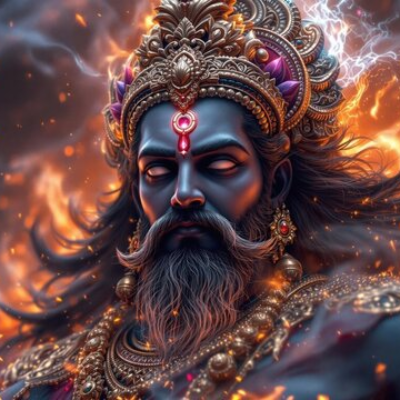
Dhritarashtra — Blind King of Hastinapura, Father of the Kauravas, and Tragic Patriarch of the Kuru House
Dhritarashtra · Ambikasuta · Vyasaputra · Gandharipati · Kauravapita · Kururajakumara · Dhritarashtraraja
Dhritarashtra is the eldest of the three sons born of the sage Vyasa's levirate union with the widows of Vichitravirya — the arrangement by which the Kuru royal line was continued after Vichitravirya's childless death. His biological mother is Ambika — the elder of the two Kashi princesses who were Vichitravirya's wives — who closed her eyes in terror during Vyasa's visit, and from this closure the child born was blind. He is the nominal eldest son of Vichitravirya in the dynastic succession and the most prominent patriarch of the Kuru house in the generation that immediately precedes the Kurukshetra war. Dhritarashtra is the father of the hundred Kauravas — led by Duryodhana — whose claim to the throne of Hastinapura against the Pandavas is the central political conflict of the Mahabharata. He is also the husband of Gandhari — the princess of Gandhara who bound her own eyes for the entirety of her marriage out of solidarity with her blind husband — and the figure in whose court and household the entire generation of the Mahabharata's protagonists grew to adulthood. Dhritarashtra's biography is one of the most psychologically complex in the entire epic: a man of great intelligence and learning who was repeatedly aware that his son Duryodhana's conduct was unjust and would lead to catastrophe, yet consistently unable or unwilling to restrain him, his paternal love — figured in the tradition as his most defining characteristic and his most catastrophic failing — overriding his dharmic judgment at every critical moment. He appears throughout the Mahabharata and is referenced in the Vishnu Purana, the Bhagavata Purana, and the Harivamsa.
✦ The Names
The name Dhritarashtra is a compound of dhrita — held, maintained, borne, sustained — and rashtra — kingdom, realm, or dominion — yielding the sense of "he who holds the kingdom," "the upholder of the realm," or "he by whom the dominion is sustained." The name is thus a royal name of aspiration and duty, carrying the implication of the obligation to maintain and preserve the kingdom entrusted to one. The irony embedded in the name — that the king whose duty was to hold the kingdom presided over its most catastrophic destruction — is one of the Mahabharata's characteristic forms of narrative and moral encoding. The patronymic Ambikasuta identifies him as the son of Ambika. Kauravapita means "father of the Kauravas." Gandharipati means "husband of Gandhari."
✦ Lineage
- Biological father: Vyasa — born Krishna Dvaipayana, son of Satyavati and the sage Parashara, composer of the Mahabharata. Vyasa came to Ambika as directed by Satyavati to continue the Kuru line through the levirate arrangement. Ambika shut her eyes during his visit — out of fear at his fearsome appearance — and the child born was blind as a consequence.
- Nominal father: Vichitravirya — the king of Hastinapura who died of consumption without fathering children, in whose name the levirate was conducted and in whose dynastic succession Dhritarashtra is counted.
- Mother: Ambika — the elder of the two Kashi princesses who were Vichitravirya's wives, whose closed eyes during Vyasa's visit were the cause of Dhritarashtra's congenital blindness. The Mahabharata presents this not as a fault of Ambika's character but as an instinctive response of terror to an overwhelming presence, with consequences she could not foresee.
- Younger brothers: Pandu — born of Ambalika, pale from his mother's terror — who became the active king of Hastinapura. And Vidura — born of a maidservant — who became the wisest counsellor of the Kuru court.
- Guardian: Bhishma — son of Shantanu and Ganga — who served as regent and protector of the household throughout Dhritarashtra's childhood and who remained the supreme moral authority of the Kuru household throughout Dhritarashtra's reign.
- Wife: Gandhari — the princess of Gandhara, daughter of Subala the king of Gandhara. Gandhari is one of the most remarkable and morally complex figures in the Mahabharata. Upon learning that the man she was to marry was blind, she resolved to bind her own eyes for the remainder of her marriage — to deprive herself of the sight her husband lacked, in an act of extraordinary solidarity and renunciation. Gandhari's blindfolded existence and her complicated relationship with her sons — particularly Duryodhana — and with the catastrophe of the war form one of the Mahabharata's most sustained meditations on maternal love, self-renunciation, and the limits of human power over fate. She is also the mother of the Kauravas and is credited in some passages with possessing accumulated spiritual power from her lifelong renunciation that she could have deployed to protect her sons but chose to direct otherwise.
- Sons — the hundred Kauravas: Dhritarashtra and Gandhari had one hundred sons — collectively the Kauravas — and one daughter Dushala. The hundred sons were born of an extraordinary process described in the Adi Parva: Gandhari's pregnancy lasted two years without issue; in frustration she struck her womb, and the resulting mass of flesh was divided by Vyasa into one hundred and one portions, each placed in a pot of ghee. From these pots, after another period of time, the children were born. The eldest and most prominent is Duryodhana — whose proper name is Suyodhana but who is most commonly called Duryodhana, meaning the difficult warrior — the primary antagonist of the Mahabharata and the figure whose pride, jealousy, and political ambition drove the dynasty toward war. Other notable sons include Dushasana — who dragged Draupadi into the assembly hall and attempted to disrobe her — Vikarna, who alone among the Kauravas spoke against Draupadi's humiliation, and Yuyutsu, who sided with the Pandavas in the war.
- Daughter: Dushala — the only daughter of Dhritarashtra and Gandhari, given in marriage to Jayadratha the king of Sindhu, whose death at Arjuna's hands during the war over Abhimanyu's killing was one of the most dramatically constructed episodes of the Drona Parva.
✦ Dhritarashtra's Blindness and the Question of Kingship
Dhritarashtra's congenital blindness was the formal reason given in the tradition for passing the active kingship to his younger brother Pandu rather than to him — the eldest son — as would have been conventional. The Mahabharata presents this with some complexity: Bhishma and the elders of the court determined that a blind king could not perform all the functions of royal governance, including the visual direction of battle and the visual conduct of certain rituals. Dhritarashtra himself is never presented as accepting this assessment with equanimity. His awareness that the kingship that should have been his by right of birth was given to his younger brother because of a physical condition he did not choose is a constant, barely submerged theme of the Mahabharata's presentation of his psychology, and it is given explicit voice in several passages where his bitterness at his situation breaks through his otherwise dignified bearing.
After Pandu's death in the forest, the question of who should rule arose again. Dhritarashtra was the eldest living son of the previous king's line and was appointed to govern as the regent king of Hastinapura — though the Mahabharata's language about the precise nature of his authority is not entirely consistent. He governed Hastinapura throughout the critical period in which the Kauravas and Pandavas grew to adulthood, trained, competed, and began their escalating conflict, and he continued to hold formal authority through the period of the Pandavas' exile and the lead-up to the war.
✦ Dhritarashtra's Partiality and the Failure of Restraint
The Mahabharata's most sustained psychological portrait of Dhritarashtra is of a man who knew repeatedly and explicitly that Duryodhana's conduct was wrong — who heard Bhishma's counsel, Vidura's warnings, Vyasa's prophecies, and the sages' admonitions — and who nonetheless, at every critical moment, sided with his son rather than with dharma. The primary text records numerous occasions on which Dhritarashtra privately agreed with the critics of Duryodhana and as many occasions on which he submitted to his son's pressure and authorised or failed to prevent acts of injustice: the conspiracy to burn the Pandavas alive at Varanavata, the dice game at which Shakuni cheated Yudhishthira of his kingdom and freedom, the humiliation of Draupadi in the assembly hall, and the refusal of a peaceful settlement that would have averted the war.
Vidura — the wisest of the three brothers and the most consistent voice of dharmic judgment in the Kuru court — repeatedly warned Dhritarashtra in private and public audiences that the path Duryodhana was following would lead to the annihilation of the dynasty. Dhritarashtra listened to these warnings with evident distress and repeatedly acknowledged their justice before proceeding to ignore them. The Mahabharata presents this pattern not as stupidity or wickedness but as the specific moral failure of excessive parental attachment — a form of moha or delusion in which the father's love for his son overrides his judgment about that son's conduct. Dhritarashtra is the Mahabharata's most extended and fully realised portrait of a good man destroyed by an excess of a natural and even admirable feeling.
✦ The Dice Game and Its Consequences
The Sabha Parva narrates the dice game in which Duryodhana — working through his maternal uncle Shakuni, a master of the dice — invited Yudhishthira to Hastinapura for a formal game. Shakuni played on Duryodhana's behalf and defeated Yudhishthira stake by stake — first his possessions, then his kingdom, then his brothers, then himself, then his wife Draupadi. Draupadi, summoned to the assembly hall as a slave, was dragged in by her hair by Dushasana and subjected to an attempted public disrobing before the entire court. The Mahabharata records that Dhritarashtra sat through most of this episode without effective intervention — though eventually, moved either by alarm at the cosmic portents that accompanied Draupadi's humiliation or by the distress of Gandhari and the court's elders, he called a halt and returned everything the Pandavas had lost. He then permitted a second game, whose outcome was the Pandavas' exile for twelve years plus a year of incognito. The dice game and Dhritarashtra's conduct during it represent his most catastrophic failure of restraint in the Mahabharata's narrative.
✦ The Sanjaya Narration and the Blind King's Grief
One of the Mahabharata's most distinctive structural features is the figure of Sanjaya — Dhritarashtra's charioteer and minister, who was granted by Vyasa the divine vision to see the entire Kurukshetra war as it occurred — narrating the progress of the battle to the blind king in Hastinapura as the war was fought. The Bhishma Parva opens with Dhritarashtra asking Sanjaya to describe the forces arrayed at Kurukshetra, and the entirety of the Bhishma Parva — including the Bhagavad Gita — is framed as Sanjaya's narration to the blind king. Dhritarashtra's anguished inquiries about the fate of his sons run through each day's narration; he receives the news of each son's death from Sanjaya with grief that the Mahabharata describes in detail. By the war's end, ninety-nine of his hundred sons — all but Yuyutsu, who had crossed to the Pandavas' side — were dead.
✦ Gandhari's Curse on Krishna
After the war, when Dhritarashtra and Gandhari performed the funerary rites for their sons, Gandhari — who had borne her grief and her blindfolded state with extraordinary fortitude throughout the war — finally allowed her rage to find expression. She told Krishna that he had possessed the power to prevent the war, that the destruction of the Kurus and the Pandavas was his responsibility, and she pronounced a curse upon him: that the Yadava clan — Krishna's own people — would destroy themselves in internecine conflict just as the Kurus had, and that Krishna himself would die an ignoble death in the wilderness. Krishna accepted the curse with composure, acknowledging that what she said was not untrue. The curse was eventually fulfilled in the Musala Parva with the destruction of the Yadavas at Prabhasa and Krishna's death from the hunter Jara's arrow. Dhritarashtra is present and witnesses this exchange without opposing his wife's grief-driven curse — a passive presence at one of the Mahabharata's most consequential moments.
✦ The Encounter with Bhima and Dhritarashtra's Iron Effigy
The Stri Parva — the Book of the Women — contains an episode in which Dhritarashtra, after the war and the cremation of the dead, met the victorious Pandavas. When Bhima — who had killed ninety-nine of the hundred Kauravas including Duryodhana — came to bow before Dhritarashtra, the blind king asked that Bhima be directed toward him so that he could embrace him. Krishna, perceiving Dhritarashtra's intent, substituted an iron effigy of Bhima in Bhima's place. Dhritarashtra embraced the iron effigy with the force of his accumulated grief and rage — and crushed it, breaking the iron image. When he discovered what had happened — that Krishna had substituted the effigy — he was both relieved that Bhima had not been killed and ashamed of his own action. This episode presents Dhritarashtra with psychological and narrative economy: the blind king who had refrained from acting against the Pandavas throughout the long years of their persecution finally allowed his suppressed fury to act, and Krishna's intervention prevented a murder even at the last moment.
✦ The Forest Retirement and Death
The Ashramavasika Parva narrates the final phase of Dhritarashtra's life. After living for fifteen years in Hastinapura under the care of the Pandavas following the war — years that the text describes as marked by Dhritarashtra's continued grief and Yudhishthira's filial care for him — Dhritarashtra, Gandhari, Kunti, and Vidura withdrew to the forest to spend their final years in ascetic retirement. The Mahabharata records that Vyasa visited Dhritarashtra in the forest and granted him the temporary gift of sight — allowing the blind king to see the shades of all his dead sons and kinsmen assembled one final time by the Ganga before they were released to their proper post-mortem destinations. Dhritarashtra died in a forest fire, together with Gandhari and Kunti, having attained a state of yogic equanimity in his final years that represents the Mahabharata's redemptive closure for his character — the man who had failed the dharmic test of kingship throughout his active life achieved in his final retirement the detachment and inner peace that had eluded him.
✦ Textual Variants and Inconsistencies
The birth of the hundred Kauravas: The account of the mass of flesh divided into pots and the children born from them is the standard Mahabharata account. Some regional and devotional traditions present the birth of the Kauravas somewhat differently — in certain versions they are born directly rather than through this extraordinary process. The Adi Parva's pot-birth account is the authoritative primary source version.
Yuyutsu's parentage: The Mahabharata records that Yuyutsu — the one Kaurava who survived the war by crossing to the Pandavas' side — was not born of Gandhari but of a Vaishya woman of Dhritarashtra's household. This detail, given in the Adi Parva's genealogical sections, makes Yuyutsu a half-brother of the Kauravas rather than a full brother, and his choice to side with the Pandavas in the war is presented as connected to this partial separation from the Kaurava family identity.
✦ Theological and Philosophical Significance
Dhritarashtra is the Mahabharata's most fully realised portrait of the dharmic danger of moha — the delusion arising from excessive personal attachment. The Bhagavad Gita — spoken by Krishna to Arjuna on the first day of the Kurukshetra war — opens with Arjuna experiencing exactly the same paralysis of moha that has characterised Dhritarashtra throughout the preceding narrative: an inability to act rightly because of overwhelming attachment to his kinsmen. Krishna's entire teaching in the Gita is a response to this paralysis, and Dhritarashtra — who sits blind in Hastinapura listening to Sanjaya describe the battle as it begins — is the silent anti-type against whom Arjuna's eventual overcoming of moha is measured. Arjuna, through Krishna's teaching, transcends the paralysis; Dhritarashtra, throughout his long life, never does. The Mahabharata thus frames its central philosophical teaching — the Bhagavad Gita — against the backdrop of the failure that makes that teaching necessary.
✦ Connection to the Wider Genealogy
Through his biological father Vyasa and the Satyavati-Uparichara Vasu line, Dhritarashtra connects to the Chedi dynasty and through it to the Chandravamsha. Through his nominal father Vichitravirya and the Kuru-Paurava line, he descends from Shantanu, Pratipa, Kuru, Puru, Yayati, and ultimately Chandra the moon god. Through his hundred sons — the Kauravas — he is the father of the antagonists of the Mahabharata; through his daughter Dushala he is the father-in-law of Jayadratha of Sindhu; through Gandhari he is connected to the Gandhara royal line. His brother Pandu's sons — the five Pandavas — are his nephews in the dynastic family, and their conflict with his sons constitutes the central action of the Mahabharata.
✦ References
Primary Sources
- Mahabharata, Adi Parva, sections 100–116: Birth of Dhritarashtra from Ambika and Vyasa; the blindness; the birth of the hundred Kauravas from the mass of flesh divided into pots; Dhritarashtra's installation as king after Pandu's death.
- Mahabharata, Sabha Parva (Book 2) in its entirety: The dice game, Draupadi's humiliation, Dhritarashtra's partial interventions and his final grant of freedom to the Pandavas, and the second dice game leading to exile. The primary source for Dhritarashtra's most catastrophic failure of restraint.
- Mahabharata, Udyoga Parva, sections 1–40 and 127–138: Dhritarashtra's conduct during the prewar diplomatic period; his private acknowledgements of the justice of the Pandavas' cause alongside his public support of Duryodhana; Vidura's repeated warnings.
- Mahabharata, Bhishma Parva, sections 1–5: Dhritarashtra's anguished questions to Sanjaya at the opening of the war; the structural frame within which the Bhagavad Gita is delivered.
- Mahabharata, Stri Parva (Book 11): Dhritarashtra's and Gandhari's grief at their sons' deaths; the iron effigy episode; Gandhari's curse on Krishna.
- Mahabharata, Ashramavasika Parva (Book 15): Dhritarashtra's retirement to the forest with Gandhari, Kunti, and Vidura; Vyasa's grant of temporary sight; Dhritarashtra's death in the forest fire.
- Vishnu Purana, Book 4, chapter 20: The Kuru genealogy confirming Dhritarashtra's position and the birth of the Kauravas.
- Bhagavata Purana, Book 1, chapters 13–15: Detailed account of Dhritarashtra's forest retirement, including Vidura's counsel to him to withdraw from the world, which directly led to the retirement narrated in the Ashramavasika Parva.
Modern Reference Works
- Vettam Mani, Puranic Encyclopaedia (1975): Entry on Dhritarashtra; comprehensive collation of all primary references across the Mahabharata, Puranas, and Harivamsa.
- J. A. B. van Buitenen (translator), The Mahabharata, Volumes 1–3 (1973–1978): Critical translations of the Adi, Sabha, and Vana Parvas with scholarly notes; authoritative primary source for Dhritarashtra's biography through the dice game and exile period.
- Bimal Krishna Matilal (editor), Moral Dilemmas in the Mahabharata (1989): Contains analysis of Dhritarashtra's moral failures and their philosophical grounding in the concept of moha.
- Irawati Karve, Yuganta: The End of an Epoch (1969): Contains a celebrated humanistic analysis of Dhritarashtra's character — his intelligence, his blindness (literal and moral), and the consequences of his partiality — that remains one of the most insightful modern discussions of this figure.
- Alf Hiltebeitel, The Ritual of Battle: Krishna in the Mahabharata (1990): Contains discussion of the structural relationship between Dhritarashtra's moha and Arjuna's moha as the context for the Bhagavad Gita's teaching.