
About
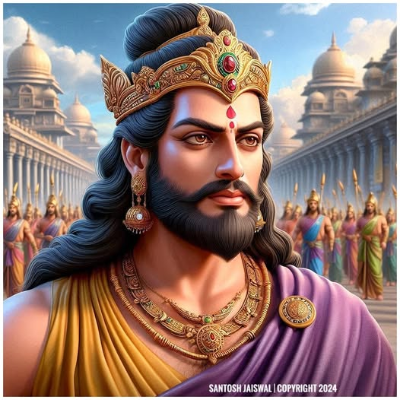
Vichitravirya — Son of Shantanu and Satyavati, King of Hastinapura, and Father of the Kuru Generation
Vichitravirya · Shantanuputra · Satyavatiputra · Kururajakumara · Ambikapati · Ambalikapat
Vichitravirya is the younger of the two sons born of Shantanu — the king of Hastinapura and a descendant of the Paurava-Kuru branch of the Lunar dynasty — and of Satyavati, the daughter of the fisherman king Dasharaja and the mother of the sage Vyasa from a prior union with the sage Parashara. Vichitravirya became the king of Hastinapura after the brief reign and premature death of his elder brother Chitrangada, and he is significant in the Mahabharata's genealogical architecture not for any personal achievements — his reign was short and he died of consumption without fathering any children by conventional biological means — but as the nominal father, through the extraordinary levirate arrangement arranged by his mother Satyavati, of Dhritarashtra and Pandu, the patriarchs of the Kauravas and Pandavas respectively. His wives Ambika and Ambalika — the princesses of Kashi won for him by Bhishma at their svayamvara — became the vessels through whom Vyasa, the sage and half-brother of Vichitravirya, fathered these children. Vichitravirya appears in the Mahabharata's Adi Parva, the Vishnu Purana, the Bhagavata Purana, and the Harivamsa.
✦ The Name
The name Vichitravirya is a Sanskrit compound of vichitra — wonderful, variegated, strange, or of many kinds — and virya — valour, heroic power, strength, or seed. The compound may be rendered as "he of wonderful valour," "he of diverse heroic power," or — given the significance of the seed-meaning of virya in the context of his biography — "he of remarkable generative power," an ironic resonance given that his own biological generativity was never exercised and that the generation attributed to his household was produced by another. The primary texts do not provide an internal etymology for the name. The patronymics Shantanuputra and Satyavatiputra identify him as the son of Shantanu and Satyavati respectively. Ambikapati and Ambalikapat mean "husband of Ambika" and "husband of Ambalika."
✦ Lineage
- Father: Shantanu — the king of Hastinapura, descendant of the Paurava-Kuru branch of the Chandravamsha, whose two marriages and the consequences flowing from them shaped the entire genealogical structure of the Mahabharata's world.
- Mother: Satyavati — the daughter of the fisherman king Dasharaja and biologically of the royal Uparichara Vasu and the Apsara Adrika; previously the mother of the sage Vyasa through the sage Parashara before her marriage to Shantanu; the queen mother of Hastinapura and the figure who authorised the levirate arrangement after Vichitravirya's death.
- Elder brother: Chitrangada — the elder son of Shantanu and Satyavati, who became the first king of Hastinapura after Shantanu's death but was killed in combat with a Gandharva of the same name before he could father heirs. Profiled separately in this series.
- Half-brother: Bhishma — born Devavrata, the son of Shantanu and the goddess Ganga, who renounced his claim to the throne of Hastinapura and vowed lifelong celibacy to enable Shantanu's marriage to Satyavati. Bhishma served as guardian and protector of Vichitravirya and of the Kuru throne throughout Vichitravirya's reign and beyond.
- Half-brother: Vyasa — born Krishna Dvaipayana, the son of Satyavati and the sage Parashara, the composer of the Mahabharata and the eighteen Puranas. Vyasa was called upon by Satyavati after Vichitravirya's death to father children on the widows in the niyoga arrangement.
- Wives: Ambika and Ambalika — the two elder princesses of Kashi (Varanasi), daughters of the king of Kashi. They were brought to Hastinapura by Bhishma, who abducted all three daughters of the Kashi king from their svayamvara. The third princess — Amba — refused to accept this arrangement as she had already given her heart to King Shalva; she was released by Bhishma to go to Shalva, who rejected her; she subsequently became one of the most important figures of vengeance in the Mahabharata tradition, eventually being reborn as Shikhandi to bring about Bhishma's fall. Ambika and Ambalika accepted Vichitravirya as their husband.
- Sons — through Vyasa's levirate fatherhood:
- Dhritarashtra — born of Ambika and Vyasa. Ambika, frightened by Vyasa's formidable appearance, closed her eyes during their union; the child born was blind from birth. Dhritarashtra became the king of Hastinapura and the father of the hundred Kauravas by his wife Gandhari.
- Pandu — born of Ambalika and Vyasa. Ambalika, terrified, went pale during their union; the child born was pale-complexioned. Pandu became the regent king of Hastinapura — since Dhritarashtra's blindness was considered a disqualification for sovereignty in the primary tradition — and the nominal father of the five Pandavas.
- Vidura — born of a maidservant of the household and Vyasa. The maidservant accepted Vyasa's presence without fear or aversion, and the child born was of complete intelligence and equanimity. Vidura became the wisest counsellor of the Kuru court and is identified in the Mahabharata as a partial manifestation of Dharma himself.
✦ The Svayamvara of Kashi and Bhishma's Abduction
The Mahabharata's Adi Parva narrates that when Vichitravirya came of marriageable age — he was still young, and Bhishma governed as regent and protector — Bhishma learned that the king of Kashi was holding a svayamvara at which his three daughters — Amba, Ambika, and Ambalika — would choose their husbands from among the assembled kings and princes. Bhishma, recognising that these princesses would make suitable wives for Vichitravirya and unwilling to allow the outcome to depend on the result of a competitive selection ceremony, went to the svayamvara uninvited and announced to the assembled kings that he was taking the three women for his brother. He then carried them away in his chariot by force, defeating all the kings who pursued him to prevent the abduction. This forcible seizure of brides was a recognised if contested form of marriage in the tradition — called Rakshasa vivaha — and Bhishma explicitly invoked it as a legitimate practice as he departed. Amba, who had already made her choice and wished to go to King Shalva, was subsequently released. Ambika and Ambalika were married to Vichitravirya.
✦ Vichitravirya's Death and the Levirate Arrangement
Vichitravirya's reign was brief. The Mahabharata's Adi Parva records that he was devoted to his wives but that he contracted a severe illness — described as consumption, the progressive wasting disease — and despite the best efforts of physicians and the care of the household, he died without having fathered any children. He is described as having been deeply absorbed in sensory pleasure during his short life and reign, a characterisation that the text offers without extended moral commentary but that is relevant to understanding why no children were produced despite the marriages.
After Vichitravirya's death, the Kuru royal line faced extinction. Bhishma could not father children on the widows because of his vow of celibacy. Satyavati then disclosed to Bhishma the existence of Vyasa and proposed the niyoga arrangement. The circumstances of Vyasa's visits to Ambika and Ambalika — including the women's fear responses that produced Dhritarashtra's blindness and Pandu's pallor — are narrated in full in the Adi Parva. Vichitravirya is thus the nominal father of Dhritarashtra and Pandu — the children are recorded as his sons in the dynastic succession — even though their biological father was Vyasa.
✦ Textual Variants and Inconsistencies
The primary texts are consistent in the broad account of Vichitravirya's reign, marriages, illness, and death. Minor variations exist in different recensions of the Mahabharata regarding the duration of his reign and the specific details of his illness. The Vishnu Purana and Bhagavata Purana confirm his position in the Kuru genealogy and the niyoga arrangement producing Dhritarashtra and Pandu without elaborating the biographical details at the same length as the Mahabharata's Adi Parva. The identification of Vichitravirya as the nominal father of Dhritarashtra and Pandu — with Vyasa as the biological father — is consistent across all major sources and is treated in the tradition as an unambiguous aspect of the genealogical record rather than as a contested point.
✦ Theological and Narrative Significance
Vichitravirya's significance is entirely structural within the Mahabharata's genealogical architecture. He is not a heroic figure, a philosopher-king, or a figure of personal spiritual achievement. He is the necessary link — the nominal father through whose position in the Kuru succession the next generation receives its royal legitimacy — without whose brief existence and childless death the extraordinary circumstances that produced Dhritarashtra, Pandu, and Vidura could not have arisen. The tradition's presentation of him as young, pleasure-loving, and short-lived functions to explain why the dynasty required the dramatic intervention of Vyasa's niyoga rather than a conventional succession. His death without heirs is the hinge on which the entire subsequent history of the Mahabharata turns.
✦ Connection to the Wider Genealogy
Through his father Shantanu and the Paurava-Kuru line, Vichitravirya is a descendant of the Chandravamsha tracing back through Kuru, Puru, Yayati, Nahusha, Ayu, Pururavas, Budha, Chandra, and Atri to Brahma. Through his nominal sons Dhritarashtra and Pandu — biologically fathered by Vyasa — the Kauravas and Pandavas respectively descend. The hundred sons of Dhritarashtra — the Kauravas, led by Duryodhana — and the five sons of Pandu — the Pandavas: Yudhishthira, Bhima, Arjuna, Nakula, and Sahadeva — are all, by the conventions of Puranic genealogy, the grandsons of Vichitravirya in the dynastic succession even though their biological ancestry runs through Vyasa on the paternal side and through the gods who fathered the Pandavas directly on the maternal side. Vichitravirya's position as the nominal progenitor of both the Kauravas and the Pandavas makes him, in the genealogical record, the common grandfather of the two sides of the conflict that constitutes the Mahabharata war.
✦ References
Primary Sources
- Mahabharata, Adi Parva, sections 96–106: The primary source for Vichitravirya's biography — Bhishma's abduction of the Kashi princesses, the marriages of Ambika and Ambalika to Vichitravirya, his illness and death without heirs, and the niyoga arrangement through Vyasa producing Dhritarashtra, Pandu, and Vidura.
- Vishnu Purana, Book 4, chapters 20–21: Confirms Vichitravirya's position in the Kuru genealogy and the production of Dhritarashtra and Pandu through Vyasa's niyoga.
- Bhagavata Purana, Book 9, chapters 22–23: The Kuru genealogy confirming Vichitravirya's place in the succession and the birth of Dhritarashtra and Pandu.
- Harivamsa, chapters 30–35: Additional genealogical and narrative material on Vichitravirya and the Kuru royal household.
Modern Reference Works
- Vettam Mani, Puranic Encyclopaedia (1975): Entry on Vichitravirya; collates primary references and summarises the key episodes of his brief biography.
- J. A. B. van Buitenen (translator), The Mahabharata, Volume 1 (1973): Critical translation of the Adi Parva with scholarly notes on the Vichitravirya episodes and the niyoga arrangement.