
About
Shrutakarma — The Third Flame, Son of the Peerless Archer
Shrutakarma · Shrutakirti · Arjuni · Draupadeya-tritiya · Partha-suta · Shakra-pautra · Upapandava-madhyama
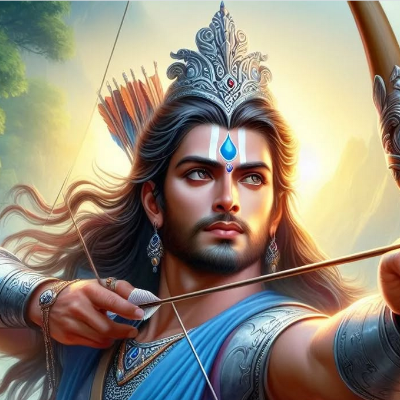
Among the five Upapandavas, Shrutakarma — also known as Shrutakirti, the two names denoting the same prince — is the third, the son of Arjuna and Draupadi. His very double-naming is itself a declaration of the richness of his inheritance: Shrutakarma, meaning he whose deeds are famous, and Shrutakirti, meaning he whose fame is heard about — two names circling the same truth from different directions, the fame of his actions and the hearing of his glory, each completing the other. He was born of the greatest archer who ever drew a bow — the man to whom the Bhagavad Gita was revealed on the battlefield of Kurukshetra — and of the most celebrated and most morally fierce woman of the epic. In him, Indra's celestial lightning and Panchala's sacred fire met in a single bloodline of extraordinary distinction. He trained at Drupada's court, fought with the recognition of Bhishma himself, rode horses the colour of kingfishers into battle, engaged Duhshasana and Ashvatthama on the field, and killed a king of the Kaurava side on the sixteenth day. He survived eighteen days of the most violent war in the age's memory — and was taken in the silence of the night that followed.
✦ The Two Names — Deeds Famous, Fame Heard
Shrutakarma (Sanskrit: Shrutakarmā) is composed of shruta — renowned, heard, celebrated — and karma — deed, action, the performance of one's sacred duty. Together: he whose deeds are famous. Shrutakirti, his alternate name, pairs the same shruta with kirti — glory, fame, renown — to declare: he whose fame is heard about. The two names are complementary facets of the same proclamation: that this prince's actions would generate glory, and that the glory of those actions would travel through the world as spoken fame. That Arjuna — a man whose own names included Vijaya (ever-victorious) and Kiriti (the crowned one) — chose names for his son centred on the relationship between deed and renown reflects a father encoding his deepest understanding of what constitutes a worthwhile life: not merely fame, but fame earned through action; not merely deeds, but deeds whose echo is heard.
✦ Born of the Arrow and the Flame
Shrutakarma was born at Indraprastha during Arjuna's year of exclusive companionship with Draupadi. From Arjuna — son of Indra, wielder of Gandiva, recipient of the Bhagavad Gita, master of every celestial weapon in existence, the mortal who had ascended to Svarga and studied under celestial masters — he inherited a paternal lineage of staggering martial and spiritual distinction. The divine blood of Indra — king of the gods, lord of thunder — ran in his veins. From Draupadi — fire-born, morally absolute, the woman whose cry had brought Krishna's miraculous protection in the Kuru court — he inherited the fierce, fire-tempered dignity that made her the most uncompromising figure of the epic.
He grew up in the presence — if not the household — of both his father's dearest friend Sri Krishna and his mother's divine protector. Through Arjuna he was the son of Krishna's most beloved mortal companion; through Draupadi he was the child of Krishna's most cherished sakhi. In no other Upapandava did the two most celebrated human-divine relationships of the entire epic converge so completely in a single parentage.
✦ Lineage — Where Indra's Lightning Meets Panchala's Fire
- Father: Arjuna (Dhananjaya, Vijaya, Partha, Kiriti) — third Pandava, son of Indra, wielder of Gandiva, recipient of the Bhagavad Gita
- Mother: Draupadi (Panchali, Krishnaa, Yajnaseni) — fire-born queen of the five Pandavas
- Paternal Divine Grandfather: Indra — king of the gods, lord of Svarga and the thunderbolt
- Maternal Grandfather: King Drupada (Yajnasena) of Panchala
- Maternal Uncle: Dhrishtadyumna — commander-in-chief of the Pandava forces
- Half-Brothers through Arjuna: Abhimanyu (by Subhadra, Krishna's sister), Iravan (by Ulupi), Babhruvahana (by Chitrangada of Manipura)
- Brothers among the Upapandavas: Prativindhya (son of Yudhishthira), Sutasoma (son of Bhima), Shatanika (son of Nakula), Shrutasena (son of Sahadeva)
- Divine Lineage: Lunar Dynasty (Chandravamsha) → Kuru → Shantanu → Pandu → Arjuna → Shrutakarma
✦ The Shadow of Abhimanyu — Brother and Comparison
Shrutakarma grew up as one of Arjuna's sons — but not the most celebrated one. That distinction belonged to Abhimanyu, born of Subhadra, Krishna's sister, who had absorbed the knowledge of the Chakravyuha formation in his mother's womb and who was widely regarded as the most gifted young warrior of his generation. Shrutakarma and Abhimanyu were half-brothers — sons of the same father, born of different mothers, roughly the same age. The relationship between them carried the particular complexity of two young men who both bore Arjuna's blood and Arjuna's expectations, each carrying a different dimension of their extraordinary father's legacy.
Abhimanyu fell on the thirteenth day — lured into the Chakravyuha and slaughtered by multiple maharathis in an act of collective adharma that shocked both armies. Shrutakarma fought the remaining five days of the war carrying the death of his half-brother alongside everything else, knowing that the prince the entire army had regarded as its brightest young hope was gone, knowing that his father Arjuna's grief had been so total it had produced the most electrifying vow of the war. And he continued to fight — because the Upapandavas always continued to fight.
✦ At Kurukshetra — Horses of Kingfisher Blue, A King Slain
The Mahabharata preserves specific and vivid details of Shrutakarma's presence at Kurukshetra that set him apart from his brothers among the Upapandavas in terms of recorded battle narrative. His chariot was drawn by horses the colour of kingfishers — a striking, distinctive detail that would have made him immediately recognisable on the field, his chariot blazing with the iridescent blue-green of those brilliant birds, moving through the dust and carnage of the battlefield like a flash of living colour.
He fought directly against Duhshasana — the man who had dragged his mother by her hair into the Kuru court and attempted her disrobing, the most personal enemy of the entire Pandava family after Duryodhana himself. He also engaged Ashvatthama in direct combat during the war — and thus faced in battle the very man who would later kill him in the night. On the sixteenth day of the war, Shrutakarma achieved his most significant recorded battlefield feat: he killed Chitrasena, a son of Dhritarashtra and one of the Kaurava princes — a kill that placed him in the small company of warriors who had personally slain members of the hundred Kaurava brothers.
On the eleventh and fourteenth days, all five Upapandavas were singlehandedly defeated by Vrishasena — Karna's son — speaking to Vrishasena's extraordinary quality and to the Upapandavas' courage in engaging even the most dangerous warriors on the field. Shrutakarma survived both encounters and fought on. He was classified as an Ekarathi by Bhishma — a single-chariot warrior of established battlefield competence — a recognition from the greatest military mind of the age that placed him firmly among the war's qualified combatants.
✦ The Sauptika Night — The Arrow Never Released
Shrutakarma survived all eighteen days of open battle. He was alive when the Pandavas celebrated their victory on the evening of the eighteenth day. Then came the night of the Sauptika Parva — and Ashvatthama moved through the sleeping camp and killed all five Upapandavas. Shrutakarma — the boy whose father had heard God speak on a battlefield, whose horses had blazed kingfisher-blue across eighteen days of war, who had killed a Kaurava king on the sixteenth day — was taken in his sleep. The deeds that were meant to be famous, the glory that was meant to be heard — were silenced before the half of them had been performed.
✦ Primary Scriptural References
- Mahabharata (Vyasa) — Adi Parva (birth of the Upapandavas), Bhishma Parva (Bhishma's enumeration of warriors), Drona Parva and Karna Parva (battle engagements, defeat by Vrishasena, combat against Duhshasana and Ashvatthama), Shalya Parva (killing of Chitrasena on the sixteenth day), Sauptika Parva (killing by Ashvatthama), Stri Parva (lamentations)
- Bhagavata Purana — genealogical passages listing Shrutakarma as the son of Arjuna and Draupadi within the Upapandava succession
- Vishnu Purana — dynastic records of the Kuru line and the passing of succession to Parikshit after the extinction of all five Upapandavas
- Regional Mahabharatas — Tamil, Telugu, and Kannada retellings giving expanded treatment to Shrutakarma's identity as Arjuna's son by Draupadi
- Draupadi Amman temple traditions — liturgical texts in which Shrutakarma is honoured as the third of the five sacred Upapandava princes, his Indra-descended paternal lineage noted as a mark of celestial distinction
"He rode horses the colour of kingfishers — iridescent, swift, unmistakable. His father had heard the voice of God. His deeds were meant to be famous, his fame was meant to be heard. The night that took him did not erase those things. It only prevented the rest of them."