
About
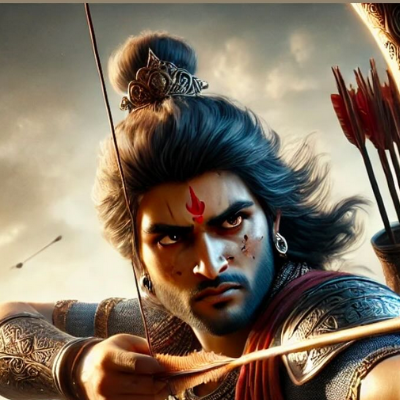
Shrutasena — The Fifth Flame, Youngest Son of the Silent Sage
Shrutasena · Sahadevaja · Draupadeya-kanishtha · Upapandava-antima · Madreya-anuja-suta · Ashvini-pautra
Among the five Upapandavas — those five brief flames raised to inherit the world their fathers had paid every possible price to reclaim — Shrutasena is the last. He is the fifth and youngest, the son of Sahadeva and Draupadi, the child born of the most inward and the most mysteriously gifted of all the Pandavas — the man who knew the movements of stars and the patterns of karma and the shape of futures not yet arrived, who carried the full weight of trikala jnana through the entire Mahabharata in a silence the divine condition imposed upon him. In Shrutasena, this silence and this knowing meet the fire and the fierce dignity of Draupadi — and the result is the youngest of five princes who carried the most complete and the most burdened of all the generation's spiritual inheritances. He trained at Panchala, fought with recognised competence at Kurukshetra, defeated a king of Bhurishrava's line on the fourteenth day, and was overcome by Shakuni in the course of the war — only to kill and survive and continue. He was the last of five lights. He was the last to be born. And in the night that took all five, he was the last light the darkness reached.
✦ The Name — Army of the Heard, Force That Is Known
The name Shrutasena pairs shruta — heard, renowned, celebrated through sacred hearing — with sena — army, military force, the organised power of warriors assembled with purpose and discipline. Together: one whose army is renowned, or one whose military force has been heard of and celebrated across the world. It is the name of a commander — a prince marked from birth for the kind of sovereign military authority that belongs to kings rather than merely to individual warriors. Where his brothers' names proclaimed personal glory (Shrutakarma), extracted divine essence (Sutasoma), or martial dominance against a hundred (Shatanika), Shrutasena's name proclaimed the capacity to lead forces — to direct the organised strength of others toward a defined and righteous end.
That Sahadeva — the most strategically perceptive of the Pandavas, the man whose foreknowledge included the movements of armies and the outcomes of campaigns, who had conducted the entire southern Digvijaya campaign with a combination of martial precision and diplomatic acuity — gave his son a name oriented toward military command rather than individual excellence speaks to a father naming a child for the domain where strategic intelligence most completely expresses itself. Sahadeva knew what it meant to read a military situation in its full complexity. He named his son for the kind of renowned force that such reading, when combined with the will to act, could produce.
✦ Born of Stars and Sacred Fire — The Last and the Most Fully Inherited
Shrutasena was born at Indraprastha during Sahadeva's year of exclusive companionship with Draupadi — the last of the five Upapandava births, the youngest child of the most celebrated woman of the age and the most inwardly gifted of her five husbands. From Sahadeva — son of the Ashvins, possessor of trikala jnana, master of cattle and jyotisha, killer of Shakuni — he inherited the Ashvin celestial heritage of healing, prophetic sight, and the deep intelligence that moves between the observable and the hidden. From Draupadi — fire-born, fierce, morally absolute — he inherited the flame that gave the Ashvin knowing a direction and a will. In Shrutasena the star-seer's inward depth and the sacred fire's outward force met in their final and most complete Upapandava expression.
✦ Lineage — The Fifth Thread, Where All Lines Complete
- Father: Sahadeva (Tantripala, Arishtanemi) — fifth Pandava, second of the Madri twins, son of the Ashvins, master of cattle and astrology, possessor of trikala jnana, slayer of Shakuni
- Mother: Draupadi (Panchali, Krishnaa, Yajnaseni) — fire-born queen of the five Pandavas, daughter of King Drupada of Panchala
- Paternal Divine Grandfathers: The Ashvins (Nasatya and Dasra) — twin gods of dawn, celestial medicine, and prophetic illumination
- Paternal Grandmother: Madri — princess of Madra, who died on Pandu's funeral pyre
- Paternal Twin-Uncle: Nakula — Sahadeva's inseparable twin, whose son Shatanika was Shrutasena's elder brother among the Upapandavas
- Paternal Step-Grandmother: Kunti — who raised Sahadeva as her own with genuine maternal love
- Maternal Grandfather: King Drupada (Yajnasena) of Panchala
- Maternal Uncle: Dhrishtadyumna — fire-born commander-in-chief of the Pandava forces
- Half-Brother through Sahadeva: Suhotra — son of Sahadeva by Vijaya, princess of Madra
- Brothers among the Upapandavas: Prativindhya (son of Yudhishthira), Sutasoma (son of Bhima), Shrutakarma (son of Arjuna), Shatanika (son of Nakula)
- Divine Lineage: Lunar Dynasty (Chandravamsha) → Kuru → Shantanu → Pandu → Sahadeva → Shrutasena
✦ The Bond with Shatanika — Sons of the Divine Twins
Among the particular resonances of Shrutasena's position within the Upapandava brotherhood, the most charged is his relationship with his elder brother Shatanika — son of Nakula, Sahadeva's inseparable twin. The two youngest Upapandavas were the sons of twin fathers — and that doubled twinning gave their relationship a mirroring quality unique among the five. Where Nakula was the outward twin — the horseman, the swordsman, the graceful active presence — and Sahadeva the inward twin — the star-gazer, the knowing silent seer — Shatanika and Shrutasena carried some version of this complementarity forward into their own relationship. They were the sons of an indivisible pair, the next generation of the Ashvin heritage made flesh, two young men who in some sense continued the twin bond of their fathers into a new life.
✦ At Kurukshetra — Defeated by Shakuni, Slayer of Shala
Shrutasena fought at Kurukshetra across all eighteen days as the youngest of the Upapandava cohort, classified by Bhishma as an Ekarathi — a single-chariot warrior of recognised competence. The Mahabharata preserves two specific and significant engagements for him.
At one point during the war, Shrutasena was defeated by Shakuni — the master schemer of the Kaurava side, the man whose loaded dice had set in motion the entire catastrophe of the Mahabharata, whose manipulation of Yudhishthira in the Sabha had cost the Pandavas their kingdom, their freedom, and their wife's dignity. That Shrutasena engaged Shakuni directly — the son of Sahadeva, whose father would ultimately kill Shakuni on the eighteenth day, facing the very man his father was destined to destroy — carries a deep narrative symmetry. The defeat was a temporary reversal; Shrutasena survived and continued fighting.
His most significant recorded battlefield achievement came on the fourteenth day of the war: Shrutasena killed Shala, the younger brother of Bhurishrava — a warrior of notable lineage and standing in the Kaurava forces. This kill placed Shrutasena among those Upapandavas who had personally slain significant Kaurava commanders, and demonstrated that the youngest of the five had fully earned the battlefield classification Bhishma had given him. He also shared with all his brothers the experience of being singlehandedly defeated by Vrishasena — Karna's son — on the eleventh and fourteenth days, a testament to Vrishasena's extraordinary ability and the Upapandavas' willingness to engage even the most dangerous opponents.
✦ His Father's Foreknowledge — What the Son May Have Carried
One of the most philosophically charged dimensions of Shrutasena's existence is his position as the son of Sahadeva — the man who knew the past, present, and future in complete detail, who was bound by divine condition from volunteering that knowledge, and who had watched the entire Mahabharata unfold with the anguished lucidity of a seer who cannot close his eyes. Whether Sahadeva knew that the night after the war's final day would take his youngest son — whether he had carried that knowledge through all eighteen days of fighting beside Shrutasena, watching him survive, knowing what the night would bring — is a question the tradition holds in silence, as it holds so many of the deepest questions about Sahadeva.
What is certain is that Sahadeva, on the eighteenth day, killed Shakuni — the man whose manipulations had started everything. The most profound act of retributive justice in the entire war was performed by the man who had known from the beginning what Shakuni's scheming would cost — and who had waited, through all the years and all the losses, for the moment when dharma permitted him to act. He killed Shakuni on the same day his son was still alive. He went to sleep that night having fulfilled the most important act of justice within his power. And then Ashvatthama came.
✦ The Sauptika Night — The Last Light
Shrutasena survived all eighteen days of open battle. He was alive after Duryodhana fell, after the conches announced the Pandava victory, after the long war his family had been moving toward his entire life reached its declared end. Then Ashvatthama entered the sleeping camp in the darkness and killed all five Upapandavas one by one. Shrutasena — the youngest, the last born, the son of the man who had known everything — was the final light extinguished in that terrible night. The army that his name had proclaimed would be renowned never had the chance to be assembled. The force whose fame was meant to travel across the world was ended before it could move.
The completeness of the five Upapandavas' destruction — all five, in a single night, every heir of every Pandava by Draupadi extinguished simultaneously — is the Mahabharata's most precise and most devastating accounting of the war's true cost. Shrutasena, youngest and last, is the final entry in that accounting. After him there was nothing left of Draupadi's motherhood but grief. After him there was no next generation from the Pandavas' direct line by their shared queen. After him there was only Parikshit — Abhimanyu's son, revived in the womb by Krishna, the sole remaining thread of the Kuru succession — and the long silence of everything that had been taken.
✦ Primary Scriptural References
- Mahabharata (Vyasa) — Adi Parva (birth of the Upapandavas), Bhishma Parva (Bhishma's enumeration of warriors), Drona Parva and Karna Parva (battle engagements including defeat by Shakuni and defeat by Vrishasena), Shalya Parva (killing of Shala, younger brother of Bhurishrava, on the fourteenth day), Sauptika Parva (killing by Ashvatthama as the last of the five Upapandavas), Stri Parva (lamentations of Draupadi and Sahadeva over the fallen)
- Bhagavata Purana — genealogical passages listing Shrutasena as the son of Sahadeva and Draupadi, the fifth and youngest Upapandava, within the broader Kuru dynastic succession narrative
- Vishnu Purana — dynastic records noting Shrutasena's position as the final member of the Upapandava generation, and the theological significance of the complete extinction of Draupadi's five sons as the karmic culmination of the war's consequences
- Regional Mahabharatas — Tamil, Telugu, and Kannada retellings in which the relationship between Shatanika and Shrutasena as sons of the divine twins Nakula and Sahadeva receives expanded narrative attention, and Shrutasena's position as youngest and last is treated with particular devotional significance
- Draupadi Amman temple traditions — liturgical and folk texts of the Draupadi cult in Tamil Nadu in which Shrutasena is honoured as the fifth and final of the five sacred Upapandava princes, his position as the last light of the Sauptika night treated as the culminating moment of the five brothers' collective sacred story
"His father killed Shakuni on the day his son was still alive — settling the oldest debt of the entire war. And then the night came and settled its own debt, the one no act of justice could prevent. Shrutasena, youngest and last, was the final proof that in the Mahabharata, victory and loss are not opposites. They are the same night, arriving together."