
About
Balandhara (Valandhara) — Princess of Kashi, Wife of Bhima, Mother of Sarvaga
Balandhara · Baladhara · Valandhara · Kali · Jalandharaa · Kashi-rajkumari · Bhima-patni · Sarvaga-mata
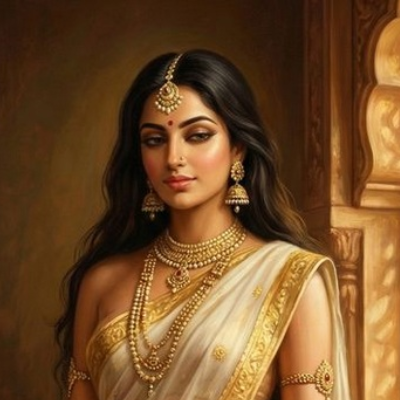
Balandhara — also written Valandhara and recorded in the Bhagavata Purana as Kali — is a princess of the ancient kingdom of Kashi (present-day Varanasi on the banks of the Ganga); the wife of Bhima, the second Pandava brother; and the mother of Sarvaga, who ruled Kashi after the Kurukshetra War and whose granddaughter Vapushtama married Janamejaya — the Kuru king who performed the Sarpa Satra. Her name in the Mahabharata's primary Sanskrit text (Adi Parva, Chapter 95, Verse 84) is given as Baladhara. She is described as beautiful — her face likened to a cluster of lovely blue lotuses — possessed of good qualities, gentle in manner, and deeply respectful toward Kunti and Draupadi. The precise circumstances of her marriage to Bhima vary across the sources and involve two incompatible accounts — a svayamvara won by Bhima's prowess in one tradition, and a flight from Duryodhana's unwanted courtship followed by Bhima finding her in another — both recorded below. She is one of the Pandavas' secondary wives who lived with her son in her father's kingdom rather than at Indraprastha, in accordance with Draupadi's condition that she alone among Bhima's wives would share his principal household. Her son Sarvaga did not participate in the Kurukshetra War. Her personal narrative is brief in the canonical sources — she appears principally as the mother of Sarvaga and as one of Bhima's recorded wives — but her genealogical consequence is significant: through Sarvaga's son Suvarnasena and Suvarnasena's daughter Vapushtama, she is the ancestral grandmother of the Kuru king Janamejaya's wife and thus of Janamejaya's sons Shatanika and Sahasranika.
✦ The Names — Variants and Their Sources
The name appears in four distinct forms across the primary and secondary sources. Baladhara is the form in the Mahabharata's Adi Parva Sanskrit text (1.95.84) — from bala (strength, force, the young) and dhara (bearing, holding, sustaining) — meaning she who bears strength or the strong-bearing one. Balandhara is the form used in the Wikipedia Bhima article and the Mahabharata characters list, adding a nasal consonant to the same root. Valandhara is the form used in popular devotional sources. The Bhagavata Purana records her under the name Kali — the dark one — with her son recorded as Sarvagata. The Glorious Hinduism source, drawing from a regional retelling, uses the form Jalandharaa — connecting her name with the city of Jalandhar in Punjab and suggesting a different regional tradition. This profile uses Balandhara as the primary form in accordance with the Wikipedia Bhima article, and notes all variants.
✦ Lineage
- Father: a king of Kashi — three different names are given across the sources: the Hindu Blog source names him Subahu; the HinduPad source names him Devesha; the Wikipedia characters list names him simply as the king of Kashi without a personal name; these three are inconsistent and cannot be reconciled from the available primary evidence; the Mahabharata's own text (Adi Parva 1.95.84) identifies her only as the daughter of the king of Kashi without naming the father
- Husband: Bhima — the second Pandava; son of Pandu and Kunti, who invoked the wind god Vayu to father him; of extraordinary physical strength; who defeated the kings at her svayamvara or found her after she fled Duryodhana's pursuit, depending on which account is followed
- Mother-in-law: Kunti — who was deeply pleased with Balandhara when she first met her and blessed the couple warmly
- Co-wives: Hidimbi — the Rakshasi princess, Bhima's first wife, mother of Ghatotkacha; and Draupadi — the common wife of all five Pandavas, mother of Sutasoma through Bhima
- Son: Sarvaga — who became king of Kashi after the Kurukshetra War; whose son was Suvarnasena; whose daughter Vapushtama married the Kuru king Janamejaya; whose sons by Janamejaya were Shatanika and Sahasranika
- Residence: Kashi — she lived with her son Sarvaga in her father's kingdom rather than at Indraprastha, in accordance with Draupadi's condition that she alone would share the primary Pandava household at Indraprastha with her husbands
✦ The Marriage — Two Accounts
Two distinct accounts of how Balandhara came to marry Bhima exist across the sources, and they are incompatible in their narrative details. The primary canonical account in the Mahabharata's Adi Parva presents a svayamvara — a self-choice ceremony — at which Bhima won her hand. The Jatland Wiki source quotes the precise Sanskrit verse: Bhima obtaining for a wife Baladhara the daughter of the king of Kasi offered his own prowess as dower and begat upon her a son named Sarvaga. The HinduPad source elaborates: Krishna advised Bhima to participate in her svayamvara, where Bhima defeated all the other assembled kings through his prowess, and both were married; Kunti was delighted with her daughter-in-law's beauty and good qualities; and Krishna blessed the couple. In the Hindu Blog source the same event is framed slightly differently — Bhima encountered Kashi during his eastern military campaigns for the Rajasuya, defeated its king, and the marriage followed from that context. A completely different account appears in the Glorious Hinduism source, drawing from an extended Kashi kingdom narrative. In this tradition, Balandhara (here called Jalandharaa) was originally intended for Duryodhana — she was offered to him as a political alliance. She wanted to marry Bhima rather than Duryodhana. When she learned the Pandavas were believed dead after the Lakshagriha fire, and Duryodhana began pressing his claim, Vidura — the wise minister of Hastinapura who alone knew the Pandavas had survived — quietly advised her to leave the Kuru kingdom. She did. Bhima eventually found her and married her. Their son Sarvaga was born from this union. This account makes Balandhara's marriage a story of personal choice and political flight — she refused the more powerful suitor and waited for the man she had chosen, with Vidura's assistance. The two accounts cannot be harmonised. The Mahabharata's Adi Parva verse is the primary canonical source and the svayamvara account has stronger textual authority.
✦ Character and Life in the Pandava Household
The tradition records Balandhara as a woman of beauty, virtue, and gentleness. She was respectful toward Kunti — her mother-in-law received her warmly on first meeting. She maintained a harmonious relationship with Draupadi — a relationship that many of the Pandavas' other wives found difficult to navigate given Draupadi's primacy in the household. She lived separately from Indraprastha with her son in Kashi, in accordance with the arrangement that governed the Pandavas' secondary marriages — Draupadi's condition that she would share her household with no other woman was observed strictly. Sarvaga grew up in Kashi, learned both Vedic learning from scholars and magical arts from his half-brother Ghatotkacha — the two sons of Bhima by different mothers in contact with each other. He did not go to Kurukshetra. Whether this was by choice, by the arrangement that kept him in Kashi as its future ruler, or by Bhima's direction that one of his sons should survive the war, the canonical text does not specify.
✦ References
- Mahabharata (Adi Parva, Chapter 95, Verse 84) — the primary canonical source: Baladhara named as the daughter of the king of Kashi; Bhima offering his own prowess as dower; the birth of Sarvaga; the primary Sanskrit verse confirming all three facts simultaneously
- Bhagavata Purana — Balandhara recorded under the name Kali; her son Sarvaga recorded as Sarvagata; the Puranic variant of her name and her son's name
- Wikipedia — Bhima — the svayamvara account; Balandhara as the daughter of the King of Kashi won at a svayamvara contest; the Bhagavata Purana's alternate names noted; the Ashramvasika Parva reference to another unnamed wife possibly equated with Balandhara by Wendy Doniger
- Wikipedia — List of characters in the Mahabharata — Balandhara as princess of Kashi, daughter of King Devesha, wife of Bhima; Sarvaga's granddaughter Vapushtama marrying Janamejaya and bearing Shatanika and Sahasranika
- Jatland Wiki — Bhima — the Sanskrit verse citation (Mahabharata 1.95.84) in transliteration and translation; the name Baladhara confirmed as the primary Mahabharata form; Sarvaga confirmed as her son
- HinduPad — Valandhara Wife of Bhima; Hindu Blog — Story of Valandhara Wife of Bhima; Glorious Hinduism — Kasi Kingdom; Devdutt Pattanaik — The Other Wives; Vedadhara — Wives of Bhima: modern summaries drawing from the above primary sources