
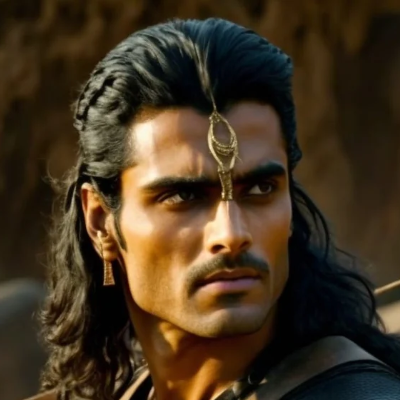
About
Sarvaga — Son of Bhima and Balandhara, King of Kashi after the Kurukshetra War, Ancestor of Janamejaya's Queen
Sarvaga · Savarga · Sarvagata · Bhimasena-putra · Balandhara-suta · Kashi-raja · Suvarnasena-pita · Vapushtama-pitamaha
Sarvaga — also written Savarga and recorded in the Bhagavata Purana as Sarvagata — is the son of Bhima, the second Pandava, and his wife Balandhara (Valandhara), princess of the ancient kingdom of Kashi (present-day Varanasi). He is the only son of Bhima to have survived the Kurukshetra War — his half-brothers Ghatotkacha (son of Hidimbi) and Sutasoma (son of Draupadi) both died in the war — and after its conclusion he ascended to the throne of Kashi, the kingdom of his maternal line. His genealogical significance extends well beyond his own reign: his son Suvarnasena became the next king of Kashi, and Suvarnasena's daughter Vapushtama married Janamejaya — the great Kuru king who performed the Sarpa Satra (the great snake sacrifice) to avenge his father Parikshit's death and who heard the entire Mahabharata narrated by Vaishampayana. Vapushtama bore Janamejaya two sons — Shatanika and Sahasranika. Through this genealogical chain Sarvaga is the maternal great-grandfather of two of the post-Kurukshetra War Kuru kings, connecting the Kashi royal line directly to the continuation of the Kuru dynasty in the generations after the war. He did not participate in the Kurukshetra War. He learned magical arts from his half-brother Ghatotkacha alongside Vedic learning from scholars.
✦ The Name
The Sanskrit name Sarvaga — written Sarvaga — is a compound of sarva (all, every, complete) and ga (going, moving — from the root gam, to go). The compound means he who goes everywhere, the all-pervading mover, one who traverses all directions. The Bhagavata Purana's variant Sarvagata — from sarva and gata (gone, reached, arrived everywhere) — carries the same essential meaning with a slight grammatical shift: he who has reached everywhere, the all-arrived one. His name in the Mahabharata's Adi Parva Sanskrit text is given as Sarvaga in the verse cited by the Jatland source (Mahabharata 1.95.84). The name's quality of universal movement or reach is consistent with his post-war role as king of a kingdom that, in the extended Glorious Hinduism account, also administered Mithila (Videha) and Kosala for a period after the war — an all-encompassing reach that reflects his name.
✦ Lineage
- Father: Bhima — the second Pandava; son of Pandu and Kunti, who invoked the wind god Vayu to father him; who defeated the Kashi king in military conquest or won Balandhara at her svayamvara; whose prowess was offered as the bride-price (viraShulka) for the marriage
- Mother: Balandhara (Valandhara) — princess of Kashi; daughter of the Kashi king; whose beauty was likened to a cluster of blue lotuses; who lived with her son in Kashi rather than at Indraprastha after the marriage
- Paternal grandfather: Pandu — the pale king of Hastinapura; who was cursed to die if he engaged in physical intimacy; the formal father of Bhima though Bhima's actual progenitor through Kunti's mantra was Vayu, the wind god
- Paternal grandmother: Kunti — who invoked Vayu to father Bhima; who blessed Sarvaga's parents warmly when she first met Balandhara
- Half-brothers: Ghatotkacha — son of Bhima and the Rakshasi Hidimbi; who taught Sarvaga magical arts; killed by Karna's Vasavi Shakti on the fourteenth night of the Kurukshetra War; Sutasoma — son of Bhima and Draupadi; killed by Ashvatthama in the nocturnal raid after the war's conclusion
- Maternal grandfather: the king of Kashi — named Subahu in one source and Devesha in another, with no primary canonical resolution
- Wife: not named in any primary canonical source consulted
- Son: Suvarnasena — king of Kashi after Sarvaga; no further personal details recorded in primary sources
- Granddaughter: Vapushtama — daughter of Suvarnasena; princess of Kashi; who married the Kuru king Janamejaya — who performed the Sarpa Satra and at whose sacrifice the entire Mahabharata was first narrated by Vaishampayana; who bore Janamejaya two sons: Shatanika and Sahasranika
- Great-grandsons: Shatanika — king of Hastinapura; son of Janamejaya and Vapushtama; whose son was Ashvamedhadatta; and Sahasranika — also son of Janamejaya and Vapushtama; a later king of the Vatsa dynasty in whose court the stories of the Kathasaritsagara are framed
✦ Upbringing — Between Two Worlds
Sarvaga grew up in Kashi in his mother's kingdom, separated from the turbulent world of Indraprastha and the Kuru-Pandava political conflict. His education was notably dual in character: he received full Vedic education from learned scholars at the Kashi court — Kashi being one of the foremost centres of Brahminic learning in ancient India — and he also learned magical arts from his half-brother Ghatotkacha, the half-Rakshasa warrior who visited the Pandava family during the years before the war. The combination of formal Brahminic scholarship and Rakshasa magical knowledge in a single prince is unusual in the Mahabharata tradition and reflects his dual heritage: the son of the mighty wind-god's descendant Bhima on one side, and of the ancient Kashi royal house on the other.
✦ The Kurukshetra War — Absence and Its Meaning
Sarvaga did not participate in the Kurukshetra War. Among Bhima's three sons, Sarvaga alone survived — Ghatotkacha and Sutasoma both died. Whether his absence from the battlefield was a deliberate arrangement to preserve the Kashi succession — ensuring that the kingdom his mother's family had governed for generations would have a Pandava-connected heir after the war — or whether it reflects a different political calculation, the canonical text does not explain. The Glorious Hinduism source records that the Kashi king Subahu died of old age a few days before the Kurukshetra War began, and that Subahu's sons Abhibhu and Jalandhar fought and died with the Pandava army. With Subahu's direct male line extinguished in the war, the throne of Kashi had no claimant except Sarvaga — Bhima's son and the grandson of Subahu's line through Balandhara. His survival and his ascension to the Kashi throne after the war was therefore not merely fortunate but structurally necessary for the continuity of both the Kashi kingdom and the Pandava family's connection to it.
✦ Post-War Reign — King of Kashi and Beyond
After the Kurukshetra War Sarvaga ascended the throne of Kashi. The Glorious Hinduism source, drawing from a detailed Kashi kingdom narrative, records that he also administered Mithila (the Videha kingdom) and Kosala for a period after the war — both kingdoms having lost their kings in the conflict and having no immediate successor. He eventually gave Mithila to the son of Prativindhya — the eldest of the Upapandavas, son of Yudhishthira and Draupadi. He gave Kosala to the husband of his sister Visala — identified as a Kosala prince. Both arrangements represent Sarvaga acting not merely as a king of Kashi but as a regional administrator distributing governance across the post-war power vacuum of the eastern kingdoms. His reign established Kashi's renewed independence and strength in the post-war settlement. His son Suvarnasena succeeded him. Through Suvarnasena's daughter Vapushtama and her marriage to Janamejaya, Sarvaga's lineage became permanently woven into the continuation of the main Kuru dynasty through the post-war generations.
✦ References
- Mahabharata (Adi Parva, Chapter 95, Verse 84) — the primary canonical source: Bhima obtaining Baladhara as wife and begetting upon her a son named Sarvaga; the Sanskrit verse in transliteration confirming Sarvaga's parentage
- Bhagavata Purana — Sarvaga recorded as Sarvagata; Balandhara recorded as Kali; the Puranic variant names for both mother and son
- Wikipedia — List of characters in the Mahabharata — Sarvaga becoming king of Kashi after the Kurukshetra War; Sarvaga's granddaughter Vapushtama marrying Janamejaya; Vapushtama bearing Janamejaya the two sons Shatanika and Sahasranika
- Glorious Hinduism — Kasi Kingdom — the most detailed account of Sarvaga's post-war career: Suvarnasena as his son; Vapushtama as Suvarnasena's daughter; Sarvaga's dual administration of Mithila and Kosala after the war; his distributing those kingdoms to Prativindhya's son and Visala's husband; Sarvaga's surviving when Subahu's direct sons died in the war
- HinduPad — Valandhara Wife of Bhima — Sarvaga learning magical arts from Ghatotkacha; Sarvaga's dual education in Vedic learning and magic; his becoming king of Kashi after the war
- Wikipedia — Bhima; Jatland Wiki — Bhima; myCBSEguide — Bhima's sons: confirmation that Sarvaga was the only son of Bhima who survived the Kurukshetra War and his lineage connection to Janamejaya's queen