
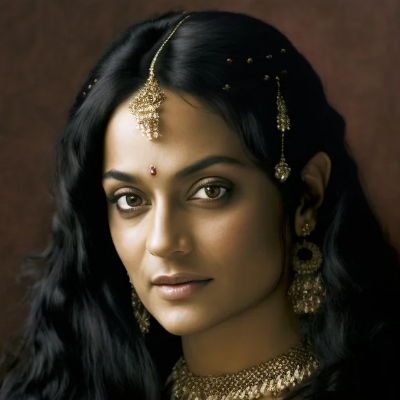
About
Ulupi — Naga Princess, Wife of Arjuna, Mother of Iravan
Ulupi · Uluochi · Uluchi · Kauravyaputri · Nagakanya
Ulupi is a Naga princess who appears in the Mahabharata as one of the four wives of Arjuna, the third of the five Pandava brothers and one of the central heroes of the epic. She is the daughter of Kauravya, a king among the Nagas — the divine serpent beings who inhabit the subterranean and aquatic realms of the cosmos. Ulupi encounters Arjuna during his twelve-year exile from Indraprastha, draws him into the Naga realm beneath the Ganga river, and becomes his wife. She bears him a son named Iravan, a warrior of mixed Naga and Kuru lineage. Beyond her role as wife and mother, Ulupi plays a significant independent narrative role in the later portions of the Mahabharata, most notably in the restoration of Arjuna following the Kurukshetra war. She appears in the Adi Parva, the Aranyaka Parva, and the Ashvamedhika Parva of the Mahabharata, and is among the more actively characterised of Arjuna's wives in the text.
✦ The Name
The name Ulupi does not carry a widely attested Sanskrit etymology in the primary sources. It appears as a proper name specific to this figure rather than as a descriptive epithet. The variant forms Uluochi and Uluchi appear in regional recensions and vernacular retellings of the Mahabharata. The patronymic Kauravyaputri, meaning daughter of Kauravya, is used to identify her through her father, Kauravya, the Naga king. The epithet Nagakanya, meaning maiden of the Nagas or daughter of the serpent race, is a descriptive designation marking her identity as a female being of the Naga order rather than a personal name. Some regional traditions render her name in forms that reflect local phonological conventions, but the core identity of the figure remains consistent across these variations.
✦ Lineage
- Father: Kauravya — a king among the Nagas, belonging to the lineage of serpent beings who descend cosmologically from Kashyapa, one of the seven primordial sages, and Kadru, a daughter of the progenitor Daksha, who is regarded across the tradition as the mother of all Nagas.
- First husband (prior to Arjuna): An unnamed Naga husband, mentioned in the Mahabharata as having died before her encounter with Arjuna. Ulupi is thus introduced as a widow at the time she meets Arjuna, a detail she herself discloses when she requests that he marry her.
- Husband: Arjuna — the third of the five Pandava brothers, son of Kunti and born through the grace of Indra, the king of the gods. Arjuna is a prince of the Kuru dynasty, a member of the lunar lineage, and one of the preeminent warriors of the Mahabharata. He is the wielder of the bow Gandiva and the recipient of the Bhagavad Gita's teachings from Krishna, his charioteer and divine companion.
- Son: Iravan — born of Ulupi and Arjuna, Iravan is a warrior of mixed Naga and Kuru heritage. He participates in the Kurukshetra war on the side of the Pandavas and dies in battle. He is the subject of significant veneration in Tamil Nadu and other regions, where he is worshipped as a deity under the name Aravan or Kuttantavar.
✦ The Meeting with Arjuna and the Marriage
The episode of Ulupi's union with Arjuna is narrated in the Adi Parva of the Mahabharata. Arjuna had been exiled from Indraprastha for twelve years as a consequence of having inadvertently intruded upon Yudhishthira, the eldest Pandava, and Draupadi — the wife shared among all five brothers — in a moment that violated the terms of a prior agreement among the brothers regarding privacy. During this period of wandering penance, Arjuna arrived at the Ganga river and bathed in its sacred waters. Ulupi, who was present in the Naga realm beneath the river and who had seen Arjuna, was seized with desire for him. She drew him down into the subterranean Naga world, to the abode of her father Kauravya.
There she declared her love openly and asked Arjuna to accept her as his wife. Arjuna expressed hesitation, explaining that he was bound by a vow of brahmacharya — a vow of restraint — for the duration of his exile, specifically in relation to Draupadi. Ulupi countered this objection with a reasoned argument: she pointed out that his vow pertained to Draupadi alone and not to all women, that dharma required him to relieve the distress of a supplicant, and that she as a widow was in need of his protection and companionship. She invoked the principle that turning away a woman who comes to a man in love and need constitutes a failure of duty. Arjuna accepted her reasoning and the legitimacy of her request, and the two were married that night in the Naga realm. The following day Arjuna was returned to the surface of the earth and continued his exile. The episode is narrated with Ulupi as its active agent — it is she who initiates, argues, and achieves the union, while Arjuna responds to her initiative.
✦ The Restoration of Arjuna — The Nagamani Episode
Ulupi's most consequential act in the Mahabharata occurs in the Ashvamedhika Parva, following the conclusion of the Kurukshetra war. During the war, Arjuna had killed Bhishma, the patriarch of the Kuru clan, who had fallen on the battlefield. Bhishma was a figure of immense sanctity — a celibate warrior of extraordinary virtue who bore a terrible oath of lifelong chastity. After the war, the Nagas, angered by Arjuna's role in the killing of certain beings during the conflict, and through the agency of a curse connected to these events, brought about Arjuna's death. Specifically, Arjuna was killed by Babruvahana, his own son born of Chitrangada, a princess of Manipura who was another of his wives. Babruvahana, unaware of Arjuna's identity at the moment of their encounter, struck him down in battle.
It is at this point that Ulupi intervenes decisively. She appeared on the battlefield, and by means of the Nagamani — a divine gem possessed by the Nagas with the power to restore life — she revived Arjuna. The text presents Ulupi as having orchestrated the entire sequence of events with foreknowledge: she had guided Babruvahana to fight Arjuna, understanding that the combat and Arjuna's death were necessary to fulfil and thereby dissolve a curse that had been laid upon him, and she possessed the means to restore him thereafter. Her use of the Nagamani demonstrates both her access to the supernatural resources of the Naga world and her abiding concern for Arjuna's welfare long after their brief period of cohabitation. This episode establishes Ulupi as a figure of active agency and strategic intelligence within the epic, not merely a passive wife from Arjuna's period of exile.
✦ Ulupi and the Curse of Bhishma
The Ashvamedhika Parva provides the background to the curse that Ulupi sought to resolve through the Babruvahana episode. During the Kurukshetra war, the Vasus — a group of eight divine beings — had been angered by Arjuna's conduct in bringing about the death of Bhishma, who was himself the reincarnation of one of the Vasus. The Vasus cursed Arjuna that he would be slain by his own son. Ulupi, aware of this curse through her Naga knowledge and connections, engineered the circumstances by which Arjuna would be killed by Babruvahana and then restored, thereby satisfying the terms of the curse and releasing Arjuna from its consequences. The Mahabharata presents Ulupi's intervention as both motivated and calculated, reflecting her role as a protector of Arjuna through means available to the Naga world but not to human agency.
✦ Ulupi's Final Journey
In the Mahaprasthanika Parva, the penultimate book of the Mahabharata, the five Pandava brothers and Draupadi undertake their final journey towards the Himalayas and the path to heaven, renouncing the world after Yudhishthira's coronation and the completion of the Ashvamedha sacrifice. At this point of departure, Ulupi is recorded as having returned to the waters of the Ganga, re-entering the Naga realm. This detail, though brief, closes her narrative arc within the epic and affirms her identity as a being of the aquatic and subterranean world whose temporary residence in the human sphere was bounded by her relationship with Arjuna.
✦ Textual Variants and Inconsistencies
The core narrative of Ulupi's marriage to Arjuna and her use of the Nagamani to restore him is consistent across the principal recensions of the Mahabharata. Regional and vernacular retellings, however, introduce variations. In Tamil tradition, the figure of Ulupi is sometimes conflated or confused with other Naga women in Arjuna's narrative, and the name Ulupi is rendered in forms that diverge from the Sanskrit. The role of Ulupi in orchestrating the Babruvahana episode is given greater or lesser emphasis depending on the recension; in some tellings her role as architect of the entire sequence is made more explicit, while in others she appears primarily as the agent of restoration rather than as the planner of the preceding events. The Jaimini Bharata, a regional Sanskrit retelling of the Mahabharata associated with the sage Jaimini, expands on several episodes involving Arjuna's wives and may present Ulupi's role in somewhat different terms from the Vyasa recension, though her fundamental identity and relationship to Arjuna remain constant.
✦ Theological and Narrative Significance
Ulupi is one of several figures in the Mahabharata who inhabit the boundary between the human and the non-human orders of being, and her narrative illustrates the epic's recurring interest in the relationships between the world of humans and the world of Nagas. Her marriage to Arjuna is one of a series of unions that the epic records between heroes of the Kuru lineage and women of non-human or semi-divine origin. Within the group of Arjuna's four wives — Draupadi, Ulupi, Chitrangada, and Subhadra — Ulupi is distinctive in being the only one whose intervention after the Kurukshetra war directly preserves Arjuna's life. Her characterisation in the text is notably active: she initiates her own marriage, argues her case before Arjuna using dharmic reasoning, possesses and deploys knowledge and resources unavailable to human figures, and acts with long-term strategic purpose in the Babruvahana episode. The Mahabharata does not treat her as a peripheral figure despite the brevity of her direct cohabitation with Arjuna.
✦ Connection to the Wider Genealogy
Through her father Kauravya, Ulupi belongs to the Naga lineages that trace their ultimate cosmological origin to Kashyapa and Kadru, the progenitor sage and the mother of all serpent beings. Through her marriage to Arjuna, she is connected to the Kuru dynasty of the lunar lineage, one of the two great royal lineages of the Mahabharata. Her son Iravan carries both inheritances, making him a figure of dual descent from the Naga world and the human royal world. Through Arjuna's other wives and children, Ulupi stands in a lateral relationship to Abhimanyu — Arjuna's son by Subhadra, a sister of Krishna — and to the Pandava lineage more broadly. The descendants of Iravan through regional and vernacular traditions extend Ulupi's genealogical significance well beyond the Sanskrit text of the Mahabharata into living ritual and devotional contexts, particularly in Tamil Nadu.
✦ References
- Primary Sources:
- Mahabharata, Adi Parva, Arjuna-vanavasa sub-parva — The principal source for Ulupi's introduction, her encounter with Arjuna at the Ganga, her self-identification as the daughter of Kauravya, her argument for the legitimacy of their union, and the birth of Iravan.
- Mahabharata, Ashvamedhika Parva — The source for Ulupi's role in the Babruvahana episode, her use of the Nagamani to restore Arjuna, and the account of the curse of the Vasus that she sought to resolve.
- Mahabharata, Mahaprasthanika Parva — Records Ulupi's departure into the Ganga at the conclusion of the Pandavas' worldly life.
- Mahabharata, Adi Parva, Astika sub-parva — Provides the foundational genealogical account of the Naga lineages from Kashyapa and Kadru, within which Ulupi's cosmological ancestry is situated.
- Secondary Sources:
- Puranic Encyclopaedia by Vettam Mani — Provides a consolidated entry for Ulupi covering her lineage, her marriage to Arjuna, the birth of Iravan, and her role in the Ashvamedhika Parva episodes.
- The Mahabharata, critical edition published by the Bhandarkar Oriental Research Institute — The authoritative critical text against which the narrative details of Ulupi's episodes have been verified.
- Women in the Mahabharata by Shakuntala Rao Shastri — Discusses Ulupi's characterisation within the broader context of female figures in the epic and notes the active agency she displays across her appearances in the text.