
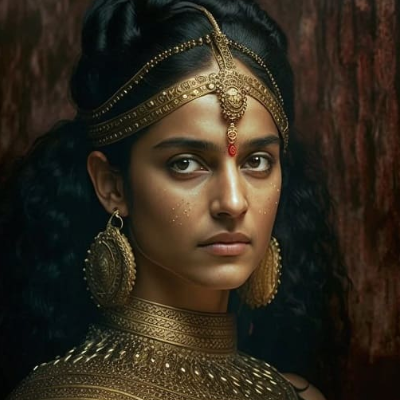
About
Chitrangada — Princess of Manipura and Wife of Arjuna
Chitrangada · Chitrangadaa · Princess of Manipura · Wife of Arjuna · Mother of Babhruvahana
Chitrangada was the princess of the Manipura kingdom and one of the wives of Arjuna, the third of the five Pandava brothers, son of the god Indra and the Pandava queen Kunti, and the foremost archer of his age. She was the daughter of Chitravahana, the king of Manipura, a kingdom situated in the northeastern regions of Bharatavarsha. Chitrangada became the mother of Babhruvahana, a prince who later became king of Manipura and who features in the Ashvamedha Parva of the Mahabharata in a remarkable episode in which he kills his own father Arjuna in combat before Arjuna is restored to life. Chitrangada appears in the Adi Parva of the Mahabharata in the account of Arjuna's pilgrimage to sacred tirthas during his period of voluntary exile from Indraprastha, and she is referenced again in the Ashvamedha Parva in connection with her son Babhruvahana. She is among the lesser-elaborated of Arjuna's wives in the primary sources, with the Mahabharata supplying only the essential facts of her origin, her marriage, and the condition under which she bore Arjuna's son.
✦ The Name
The name Chitrangada is a Sanskrit compound of chitra, meaning variegated, bright, wonderful, or distinguished, and angada, meaning armlet or bracelet, or alternatively a component meaning limbed or bodied. The compound thus carries the sense of one who is adorned with bright or wonderful ornaments, or one whose body or form is distinguished and remarkable. The name is shared in the Mahabharata with another figure entirely — Chitrangada, the elder son of King Shantanu and Satyavati, the half-brother of Bhishma and the brother of Vichitravirya, who was killed in combat with a Gandharva of the same name before he could produce an heir. The two figures bearing this name are entirely distinct and unrelated, and the shared name reflects the broader pattern of name recurrence across the epic tradition rather than any genealogical or narrative connection between them. In some texts the feminine form is distinguished by the lengthened final vowel as Chitrangadaa.
✦ Lineage
- Father: Chitravahana — king of Manipura, a kingdom in the northeastern regions of Bharatavarsha; his name means one whose vehicle or chariot is bright or distinguished; he is presented in the Mahabharata as a king without male heirs who had observed a vow that the sons born of his daughters would continue his own lineage rather than that of their fathers, a condition he imposed upon Arjuna as the price of the marriage
- Husband: Arjuna — the third of the five Pandava brothers; son of the god Indra, king of the heavens, and of Kunti, the first wife of King Pandu; the foremost archer of his age; bearer of the divine bow Gandiva; he encountered Chitrangada during his pilgrimage to the sacred tirthas of the eastern and southern regions while serving a period of voluntary exile from Indraprastha imposed as a consequence of having inadvertently violated an agreement among the five brothers regarding their shared access to Draupadi
- Son: Babhruvahana — prince and later king of Manipura; raised at his maternal grandfather Chitravahana's court in accordance with the condition of the marriage; killed Arjuna in single combat during the ashvamedha horse sacrifice performed by Yudhishthira after the Kurukshetra war, after which Arjuna was restored to life through the intervention of the serpent Ulupi, another of Arjuna's wives, who used a gem of divine power to revive him
✦ The Marriage to Arjuna
Arjuna encountered Chitrangada during a twelve-year pilgrimage to sacred tirthas that he undertook as a self-imposed penance after having inadvertently entered the chamber where his elder brother Yudhishthira was alone with Draupadi — a violation of the agreement the five Pandava brothers had made among themselves that whichever of them intruded upon another brother's private time with their shared wife would be required to undertake a pilgrimage of twelve years. The pilgrimage took Arjuna through many kingdoms and sacred sites, during which he contracted several unions, including his marriage to Chitrangada in Manipura.
When Arjuna arrived at Manipura and encountered Chitrangada, he was drawn to her and approached her father Chitravahana with a proposal of marriage. Chitravahana agreed to the marriage on a specific condition rooted in his own dynastic situation: having no sons of his own, he had maintained a custom by which daughters of his line would bear children who would be counted as belonging to the maternal grandfather's lineage rather than to the father's. He therefore required that the son born of Chitrangada and Arjuna would remain at Manipura as Chitravahana's heir rather than departing with Arjuna to the Pandava kingdom. Arjuna accepted this condition, and the marriage took place. He remained at Manipura for three years before continuing his pilgrimage.
The Mahabharata does not record the personal dimensions of the relationship between Arjuna and Chitrangada beyond the essential facts of its establishment. The narrative of the Adi Parva treats the marriage primarily as an episode within Arjuna's pilgrimage account and as the occasion for establishing Babhruvahana's origins and his position as heir of Manipura. Chitrangada's own voice, preferences, and experience of the marriage and of Arjuna's subsequent departure are not recorded in the text.
✦ The Condition of the Marriage and Its Consequences
The condition imposed by Chitravahana — that the son of Chitrangada and Arjuna would belong to the Manipura line rather than to the Pandava line — had lasting consequences for Babhruvahana's identity and his relationship to the broader Mahabharata narrative. Babhruvahana was raised as the prince of Manipura, inheriting the throne of his maternal grandfather, and his primary identity throughout the tradition is as king of Manipura rather than as a Pandava prince. This arrangement placed him in an unusual position during the ashvamedha sacrifice performed by Yudhishthira after the Kurukshetra war, when the sacrificial horse wandered into Manipura's territory and Babhruvahana, as king, was required to either submit to Yudhishthira's sovereignty or resist the horse's passage.
The Ashvamedha Parva records that when Arjuna arrived at Manipura following the horse, Babhruvahana engaged him in combat. The encounter resulted in Babhruvahana killing Arjuna with an arrow. The text records Chitrangada's extreme distress at this outcome — her son had killed her husband — and her presence in the scene of Arjuna's apparent death. Ulupi, the Naga princess who was another of Arjuna's wives and who had accompanied the ashvamedha expedition, produced a gem of divine power called the mritasanjivani and used it to restore Arjuna to life. The Mahabharata records that Ulupi revealed that the entire episode had been engineered to fulfil a curse laid upon Arjuna by the Vasus — divine beings who had been killed by Arjuna in a previous encounter — and that Babhruvahana's killing of his father had served as the means of discharging that curse. Chitrangada is present in this episode but her role is primarily that of a grief-stricken witness rather than an active participant.
✦ Textual Variants and Inconsistencies
The account of Chitrangada and her marriage to Arjuna is given in the Adi Parva with reasonable consistency across the main recensions of the Mahabharata, though the length and detail of the account varies between versions. The Ashvamedha Parva material concerning Babhruvahana's combat with Arjuna and the role of both Chitrangada and Ulupi in the aftermath also shows some variation in different recensions, particularly regarding the details of Ulupi's explanation of the curse and the specific mechanism of Arjuna's revival. Regional and vernacular retellings of the Mahabharata, particularly those of southern India, have elaborated the Babhruvahana episode considerably beyond what the Sanskrit text supplies, and in some of these traditions Chitrangada is given a more developed characterisation and a more active role in the events surrounding her son's combat with Arjuna. These elaborations are regional literary developments rather than reflections of the Sanskrit primary source and should be distinguished from the epic's own account.
✦ Theological and Narrative Significance
Chitrangada's significance in the Mahabharata tradition is primarily genealogical and structural rather than theological. As the mother of Babhruvahana, she is the means by which Arjuna's lineage extends into the northeastern kingdom of Manipura, a connection that becomes narratively important in the Ashvamedha Parva when the political geography of the post-war world requires the ashvamedha horse to pass through all the kingdoms of Bharatavarsha and encounter their kings. The episode in which Babhruvahana kills and then unwittingly revives his father through the chain of events involving Ulupi and the mritasanjivani gem serves in the tradition as a resolution of a specific karmic debt owed by Arjuna, and Chitrangada's role as the mother of the agent of that resolution places her at a structurally necessary point in the narrative even if her own characterisation remains limited.
✦ Connection to the Wider Genealogy
Chitrangada connects the Manipura royal line to the Pandava lineage through her son Babhruvahana. Arjuna, her husband, was the son of the god Indra and Kunti, and the brother of Yudhishthira, Bhima, Nakula, and Sahadeva. Through his other wife Subhadra — the sister of Krishna, the Yadava prince revered as an avatar of Vishnu — Arjuna fathered Abhimanyu, whose son Parikshit inherited the Kuru throne. Through Ulupi, a Naga princess and another of his wives, Arjuna fathered Iravan. Chitrangada's son Babhruvahana thus had as his half-brothers Abhimanyu and Iravan, two of the most significant of Arjuna's sons in the epic tradition, though Babhruvahana's own line continued through Manipura rather than through the Kuru kingdom. The Manipura kingdom's genealogical connection to the Pandavas established through Chitrangada's marriage is referenced in later Puranic dynastic lists, though the details of those lists vary between sources.
✦ References
- Mahabharata, Adi Parva (Book 1), chapters 206–208: Primary source for the account of Arjuna's arrival at Manipura, his meeting with Chitrangada, his negotiations with King Chitravahana, the condition of the marriage, and the birth of Babhruvahana; establishes all the essential genealogical and narrative facts concerning Chitrangada.
- Mahabharata, Ashvamedha Parva (Book 14), chapters 79–83: Records the arrival of the ashvamedha horse at Manipura, the combat between Babhruvahana and Arjuna, Arjuna's death and revival through Ulupi's intervention, and Chitrangada's presence as a witness and grieving figure in the episode; references Ulupi's explanation of the curse of the Vasus as the underlying cause of the encounter.
- Mahabharata, Adi Parva (Book 1), Sambhava Parva section: Lists Arjuna's wives and sons in the context of the broader Pandava genealogy; confirms Chitrangada as one of Arjuna's wives and Babhruvahana as her son.
- Vettam Mani, Puranic Encyclopaedia (1975): Entry on Chitrangada and associated entries on Babhruvahana and Chitravahana synthesise the Mahabharata material; identify her parentage, marriage, and role as mother of Babhruvahana without contributing independent primary source detail beyond what the epic supplies.
- V. S. Apte, The Student's Sanskrit-English Dictionary (1890): Supplies the etymology and standard meaning of the components of the name Chitrangada; contributes linguistic context for the name's interpretation.