
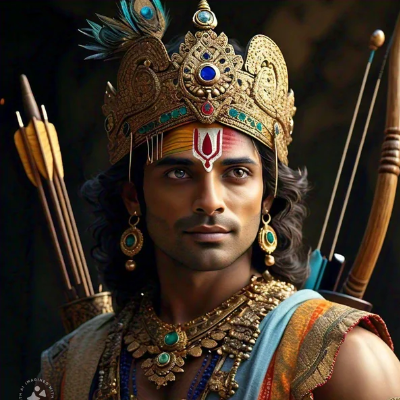
About
Abhimanyu — Son of Arjuna and Subhadra, Incarnation of Varchas, Hero of the Chakravyuha
Abhimanyu · Saubhadra · Arjuni · Arjunatmaja · Phalgu ni · Shakratmajaatmaja · Janmavira · Varchas-punarjanma · Chakravyuha-bhetta · Uttara-pati · Parikshit-pita
Abhimanyu is the son of Arjuna — the third Pandava, the greatest archer of the age, and the recipient of the Bhagavad Gita — and of Subhadra, the sister of Krishna and Balarama and the daughter of Vasudeva and Devaki. He is identified in the Mahabharata's Adi Parva as the mortal incarnation of Varchas — the son of Chandra the moon god and Rohini — born under the specific condition that he would live only sixteen years before returning to Chandra who could not bear separation from his beloved son for any longer. He is one of the most celebrated warriors of the Mahabharata's second generation — comparable to his father in individual martial capability despite his youth — and the central figure of the thirteenth day of the Kurukshetra war, the day of the Chakravyuha, whose events constitute one of the tradition's most emotionally devastating episodes of heroism, treachery, and consequence. He alone among the Pandava side's warriors knew the technique for entering the Chakravyuha — the wheel formation of interlocking concentric circles — but had not learned the technique for exiting it, because Subhadra had fallen asleep while Arjuna was explaining it in the womb. He entered the Chakravyuha alone, fought six of the greatest warriors of the age simultaneously, was stripped of his weapons and chariot, and was killed at sixteen after a combat the tradition explicitly describes as a violation of every rule of honourable warfare. His posthumous son Parikshit — preserved in Uttara's womb against Ashvatthama's Brahmastra by Vishnu's direct intervention — became the last king of the Kuru line and the figure at whose deathbed the Bhagavata Purana was recited by Shuka. He appears in the Mahabharata's Adi Parva, Bhishma Parva, Drona Parva, Sauptika Parva, Ashramavasika Parva, and Svargarohanika Parva, and in the Bhagavata Purana, Vishnu Purana, Harivamsha, and the Kathāsaritsāgara.
✦ The Names
The name Abhimanyu is derived from the Sanskrit abhi — toward, intensified, in front — and manyu — wrath, spirit, courage, fierce energy. The Wisdomlib source citing the Mahabharata gives the specific etymology: "he was called Abhimanyu because at his very birth he appeared to be heroic, long-armed and very fiery — abhivṛddhaḥ manyuryasya — he in whom fierce courage was intensified from the very beginning." The name thus means "he of intensified martial spirit," "the one in whom courage burns most fiercely," or "the wrathful one." The metronymic Saubhadra — "son of Subhadra" — is one of his most consistently used epithets throughout the Mahabharata, identifying him through his mother's name and through her Vrishni royal identity. Arjuni means "son of Arjuna." Phalgu ni means "son of Phalguna" — Arjuna's lunar calendar name. Shakratmajaatmaja means "son of Indra's son" — encoding both Arjuna's divine father Indra and Abhimanyu's relationship to that lineage. Janmavira means "one who was brave from birth." Chakravyuha-bhetta means "the one who broke through the Chakravyuha."
✦ Lineage
- Father: Arjuna — the third Pandava, son of Pandu and Kunti, divine son of Indra, the greatest archer of the age, the recipient of the Bhagavad Gita from Krishna. Arjuna's combination of divine paternal lineage through Indra and his own supreme martial training gave Abhimanyu an exceptional martial inheritance. Arjuna had obtained from Drona the complete knowledge of all weapons including the technique for entering and exiting the Chakravyuha — but Abhimanyu received only the entry technique before the transmission was interrupted in the womb.
- Mother: Subhadra — the daughter of Vasudeva and Devaki, the sister of Krishna and Balarama, and the Vrishni princess whom Arjuna abducted from Dvaraka at Krishna's suggestion during his twelve-month exile. Subhadra was Arjuna's third wife and her son Abhimanyu was his eldest son by any of the three. She fell asleep at the crucial moment when Arjuna was explaining the Chakravyuha's exit technique in the womb — the episode that defined Abhimanyu's fatal limitation at the war's most critical moment.
- Maternal uncles: Krishna and Balarama — the most important divine and martial figures of the Krishna tradition. Abhimanyu was raised in Dvaraka during the thirteen years of the Pandavas' exile and received additional martial training from Pradyumna — Krishna's son — alongside his father's teaching. His relationship with Krishna as his maternal uncle was the tradition's most intimate instance of the god's personal involvement in the formation of a warrior's capability.
- Paternal grandfather: Pandu — the king of Hastinapura. Paternal great-grandfather: Vichitravirya. Through the Kuru lineage Abhimanyu descends from the Chandravamsha — Chandra through Budha, Pururavas, Ayus, Nahusha, Yayati, Puru, and the full Kuru genealogical chain to Shantanu, Pandu, and Arjuna.
- Maternal grandfather: Vasudeva — the Yadava prince, the son of Shura, and the father of Krishna and Subhadra. Through the Yadava lineage Abhimanyu descends from the Chandravamsha's Yadu branch — Yadu, Yayati, and the Yadava genealogical chain.
- Divine previous birth: Varchas — the son of Chandra the moon god and Rohini. The Mahabharata's Adi Parva chapter 67 narrates the celestial conference at which the gods discussed their incarnations for the destruction of the wicked. Chandra, asked to send Varchas to earth, agreed on the specific condition that his son would live no longer than sixteen years — "I am unable to be separated from him for more than sixteen years." The gods accepted this condition. Abhimanyu's sixteen-year life and his death in the sixteenth year of his life were thus divinely pre-determined at the cosmic level before his birth.
- Wife: Uttara — the daughter of King Virata of the Matsya kingdom, in whose court the Pandavas spent their final year of incognito exile. The marriage was arranged by Yudhishthira as part of the alliance with Virata during the war's preparation. Uttara had initially been proposed as a wife for Arjuna himself — Virata offered her in gratitude for the Pandavas' service — but Arjuna declined on the grounds that he had taught her dance and music during the incognito year and she was therefore as a daughter to him, proposing instead that she marry his son Abhimanyu.
- Son: Parikshit — born posthumously, after Abhimanyu's death, preserved in Uttara's womb against Ashvatthama's Brahmastra by Vishnu's direct intervention. Parikshit became the last king of the Kuru line, ruled from Hastinapura with justice and fame, and was cursed to die within seven days by a brahmin boy. His seven-day preparation for death — during which Shuka recited the entire Bhagavata Purana to him — is the frame narrative of the tradition's most celebrated Purana. Kripacharya served as Parikshit's teacher, continuing the Kuru household's educational tradition into the next generation. Parikshit's son Janamejaya performed the great snake sacrifice that framed the Mahabharata's own outermost narrative recitation.
✦ Childhood and Formation
Abhimanyu was born in Indraprastha after Arjuna's return from the twelve-month exile during which he had abducted Subhadra. The Mahabharata records that at his birth Yudhishthira distributed ten thousand cows and gold coins to brahmins — a mark of the child's importance to the household. From his earliest years he was the favourite of Krishna who performed the childhood rites personally — an extraordinary marker of divine favour. He grew up in Indraprastha in the charged atmosphere of the Pandavas' capital, surrounded by his father, his four paternal uncles, Draupadi, and the full court of the most accomplished warriors and scholars of the age.
During the thirteen years of the Pandavas' exile — the twelve years in the forest and the year of incognito — Abhimanyu went with his mother Subhadra to Dvaraka and lived in Krishna's household. There he received training from Pradyumna — Krishna's son and himself one of the most accomplished warriors of the age — supplementing the training he had begun with his father. By the time the Pandavas' exile ended and the war's preparation began, Abhimanyu had developed into a warrior of capabilities that the Mahabharata describes as comparable to his father's own — the combination of his father's instruction, Krishna's household's influence, and Pradyumna's specific training producing a martial accomplishment extraordinary for one of his age.
✦ The Womb-Knowledge — Entry Without Exit
The most famous single biographical fact about Abhimanyu — the one around which all the consequences of his life and death turn — is his incomplete reception of the Chakravyuha knowledge in the womb. The Mahabharata's account narrates that Arjuna, during Subhadra's pregnancy, was explaining the complete technique of the Chakravyuha — a military formation arranged in interlocking concentric circles that creates a spiral trap from which escape is extremely difficult — to Subhadra. The unborn Abhimanyu in the womb was listening and absorbing the knowledge. Arjuna explained the complete technique for entering the formation. When he began the explanation of the exit technique, Subhadra fell asleep. In the Gayatri Heritage source's version, Krishna interrupted Arjuna at this moment and the subject was dropped — in either case the transmission was interrupted before the exit technique was fully delivered. Abhimanyu in the womb received the entry knowledge but not the exit knowledge.
The tradition uses this episode as one of its most sustained meditations on the relationship between incomplete knowledge and fate — the hero whose partial wisdom was adequate for extraordinary achievement but inadequate for survival, whose gap of knowledge was not a personal failing but a cosmically pre-determined limitation arising from the specific conditions of his formation. The Grokipedia source's analysis states this directly: "Taught only the method to enter the Chakravyuha formation in the womb by his father Arjuna, he lacked instruction on exiting it, a limitation that directly precipitated his demise. This partial wisdom symbolizes the fragility of human endeavors, where even exceptional talent and courage can be thwarted by unforeseen gaps."
✦ The War's First Twelve Days — Abhimanyu's Combat Record
Abhimanyu fought with extraordinary distinction from the war's very first day. The Vyasa Mahabharata source gives a detailed account of his combat across the war's first twelve days: on the first day he duelled with Brihadbala the king of Kosala; in the conflict with Bhishma he broke Bhishma's flagstaff and then assisted his father Arjuna against the Kuru patriarch; in the second day's battle he fought Lakshmana — Duryodhana's son — and defeated him. He fought fiercely against the Gandharas, attacked Shalya, killed Jayatsena the king of Magadha along with his elephant, defeated Vikarna and Chitrasena, assisted Bhimasena across multiple chapters of the Bhishma Parva, fought Bhagadatta, defeated Ambastha and Alambusa, and duelled Sudesna. The Mahabharata's Drona Parva chapter 10 verses 47-52 records Dhritarashtra's own description of Abhimanyu's heroism — a blind king lamenting to his minister Sanjaya about the power of the young warrior on the opposing side. Throughout these twelve days Abhimanyu was consistently described as fighting warriors far more experienced and more senior than himself to outcomes that equalled or exceeded those of his father's own engagements.
✦ The Thirteenth Day — the Chakravyuha
The thirteenth day of the Kurukshetra war is the day whose events define Abhimanyu's biography and the day the tradition regards as the war's single most concentrated episode of both extraordinary courage and extraordinary treachery simultaneously. After Bhishma's fall Drona was appointed supreme commander of the Kaurava forces. Embarrassed by a poor performance on the twelfth day and stung by Duryodhana's reproach, Drona promised to capture Yudhishthira — not kill him, because killing him would end the war and render the conflict pointless, but capture him and hold him. To accomplish this Drona designed the Chakravyuha — the wheel formation. Its specific purpose was to capture Yudhishthira while Arjuna was occupied elsewhere — the formation was one that only Arjuna and Krishna knew how to defeat, and Drona arranged for the Samsaptakas under Susarma to challenge Arjuna to a battle on the opposite side of the field, drawing him away from the Chakravyuha's location. Krishna, accompanying Arjuna, also departed. With both Arjuna and Krishna absent, the Pandava side had no one who knew the Chakravyuha's full entry-and-exit technique — except Abhimanyu, who knew the entry.
Yudhishthira turned to Abhimanyu and asked him to break through the formation. Abhimanyu agreed immediately — telling his uncles that he could enter the Chakravyuha and that they should follow him in single file through the gap he created, protecting his rear. The plan was that Abhimanyu would enter and the others would follow, so that once inside they could fight together. Jayadratha — the king of Sindhu, who had been granted the boon by Shiva of being able to hold back all the Pandavas except Arjuna in battle for one day — stationed himself at the entry point and prevented the four Pandava brothers from following Abhimanyu inside. Abhimanyu entered the Chakravyuha alone.
Inside the formation he fought alone against the combined Kaurava army's greatest warriors. The Mahabharata records his single combat with Drona, Karna, Shalya, Kripa, Ashvatthama, Duryodhana, and Dusshasana in successive or simultaneous engagements. He killed Lakshmana — Duryodhana's own son — a blow that drove Duryodhana to desperation. He killed Brihadbala the king of Kosala with whom he had duelled on the first day. He killed dozens of Kaurava commanders and thousands of soldiers. The Mahabharata's verse — "Surrounding Abhimanyu, the great archer, who stood like an enraged serpent, the mighty warriors attacked him together" — encodes the moment at which the formation's response to his extraordinary effectiveness shifted from individual combat to collective assault.
At Drona's direction — and this is the episode the tradition most explicitly condemns as adharma — multiple Kaurava maharathis attacked Abhimanyu simultaneously. Karna shot off his bowstring from behind. Drona destroyed his bow. Kripa killed his horses. Dusshasana's son destroyed his chariot. His chariot destroyed, his bow broken, his horses killed, Abhimanyu took up a chariot wheel and fought on foot. The chariot wheel was also broken. He took up a sword and shield. The sword was broken and the shield pierced. He finally stood with a mace. He was killed — surrounded by multiple simultaneous attackers using every means available — by a combination of missile attacks that no single opponent could have inflicted alone. He was sixteen years old. The Mahabharata does not spare the reader the moral weight of what happened — it records the event with explicit condemnation of its dharmic character and with the full weight of the grief it produced in the Pandava camp.
✦ Arjuna's Vow and Jayadratha's Death
When Arjuna returned to the Pandava camp that evening and learned what had happened, the Mahabharata records his grief and rage as the most extreme emotional state the epic attributes to him — deeper than any wound or defeat he had suffered personally. He vowed before the assembled Pandava warriors that he would kill Jayadratha — the king whose boon had prevented the Pandavas from following Abhimanyu into the Chakravyuha — before the next day's sunset, or enter fire himself. The vow was heard by all. On the fourteenth day Arjuna fought with singular focused purpose, driving through the entire Kaurava army to reach Jayadratha. At the moment of sunset, with Jayadratha still alive and the time running out, Krishna used his divine power to briefly obscure the sun — creating a false sunset — causing the Kauravas to celebrate Arjuna's failure. When Jayadratha emerged from his cover in relief, Krishna revealed the true sunset and Arjuna killed Jayadratha in the same moment. The vow was fulfilled. Abhimanyu's death thus produced the fourteenth day's most consequential battle — the single most determined individual combat mission of the entire war.
✦ Abhimanyu's Cosmic Return
The Mahabharata's Svargarohanika Parva and the Bhagavata Purana both record that after the Kurukshetra war Arjuna ascended to Svarga — the heaven of Indra his father — and there encountered Abhimanyu in his restored celestial form as Varchas, reunited with Chandra. The condition Chandra had set — that his beloved son would return to him after sixteen years — was fulfilled exactly. Abhimanyu the mortal warrior was simultaneously Varchas the son of the moon god, his earthly life complete and his celestial identity resumed. The tradition's closure of this narrative arc — the cosmic conference before Abhimanyu's birth, the sixteen-year condition, the death at sixteen, and the reunion with Chandra — gives Abhimanyu's tragedy a specifically pre-determined quality that removes from it any sense of arbitrary injustice without removing from it any of its emotional weight.
✦ Textual Variants and Inconsistencies
The Telugu folk tradition of Sasirekha Parinayam: The Wikipedia article notes that a Telugu folk tradition — the Sasirekha Parinayam — adds a narrative not in the Mahabharata's critical edition in which Abhimanyu was first betrothed to and married Sasirekha, the daughter of Balarama, before marrying Uttara. Ghatotkacha's disguise and the frustration of Lakshmana's intended marriage to Sasirekha are the key plot elements. The Wikipedia article notes explicitly: "No such has been attested in the Mahabharata." This is a regional folk tradition elaboration rather than a canonical primary source episode.
The Javanese wayang tradition: In Indonesian Javanese wayang culture Abhimanyu — called Abimanyu — is an important figure whose character has developed differently from the Indian tradition, with additional episodes and relationships specific to the Javanese performance tradition. These are noted as regional elaborations outside the Sanskrit canonical tradition.
Whether Subhadra fell asleep or Krishna interrupted: Different sources give slightly different accounts of why the Chakravyuha exit technique was not transmitted — Subhadra falling asleep in some accounts, Krishna's interruption of Arjuna in others. Both amount to the same result — the transmission was cut short — but the specific cause varies across manuscript traditions.
✦ Theological and Philosophical Significance
Abhimanyu's theological significance is concentrated in the specific quality of his tragedy — a tragedy that is simultaneously pre-determined at the cosmic level and genuinely grievous at the human level, simultaneously a dharmic necessity (the destruction of evil required such a sacrifice) and a dharmic violation (the manner of his killing was explicitly adharmic by the Mahabharata's own standards). The tradition uses Abhimanyu to demonstrate that the same event can be cosmically necessary and humanly wrong simultaneously — that the war's dharmic purpose did not make the specific manner of his death acceptable, and that the grief his death produced in Arjuna was not a failure of philosophical equanimity but the appropriate human response to genuine loss and genuine injustice. The Grokipedia source's analysis of the Chakravyuha episode as a "metaphor for truncated potential, embodying the theme of incomplete knowledge amid life's inherent unpredictability" captures the philosophical dimension without exhausting it — Abhimanyu is simultaneously the symbol of incomplete knowledge, of pre-determined sacrifice, of the tradition's most extreme portrait of kshatriya courage under impossible conditions, and of the adharma that even the nominally virtuous side was capable of when desperate.
✦ Connection to the Wider Genealogy
Through his father Arjuna and the Kuru genealogical chain, Abhimanyu descends from the Chandravamsha through Puru, Yayati, Nahusha, Ayus, Pururavas, Budha, and Chandra — the complete Lunar dynasty's central line. Through his mother Subhadra and the Yadava chain, he descends from the Chandravamsha's Yadu branch and therefore through the same Yayati-Yadu line that produced Krishna himself — making Abhimanyu the descendant of the Lunar dynasty through both his paternal and maternal lines simultaneously. Through his previous birth as Varchas he is the son of Chandra the moon god — making him both a descendant of the Chandravamsha and a son of the deity who founded it, giving his genealogical position a specifically circular quality: the moon god's son reborn into the dynasty that originated from the moon god's own earlier son. Through his son Parikshit he is the ancestor of Janamejaya whose great snake sacrifice framed the Mahabharata's outermost narrative layer — making Abhimanyu the ancestor of the very king at whose court the Mahabharata's first public recitation occurred and the grandfather of the context in which the tradition's most important epic was first told to the world.
✦ References
Primary Sources
- Mahabharata, Adi Parva, chapter 67: The celestial conference — Chandra's agreement to send Varchas as Abhimanyu on the condition of return after sixteen years; the birth narrative; childhood description; the womb-knowledge episode.
- Mahabharata, Bhishma Parva, chapters 55, 63, 64, 69, 94: Abhimanyu's combat across the first ten days — the duel with Lakshmana, assistance to Bhimasena, fight against Bhishma's flagstaff.
- Mahabharata, Drona Parva — Abhimanyu-badha Parva (chapters 30–48): The primary and most extensive source for the thirteenth day, the Chakravyuha, Abhimanyu's entry, his combat inside the formation against multiple warriors, the collective assault, and his death. The most detailed account of Abhimanyu's most significant biographical episode.
- Mahabharata, Drona Parva, chapter 10, verses 47–52: Dhritarashtra's description of Abhimanyu's heroism to Sanjaya.
- Mahabharata, Drona Parva — Jayadratha-vadha section: Arjuna's vow, the fourteenth day's battle, Krishna's obscuring of the sun, and Jayadratha's death in fulfilment of Arjuna's vow to avenge Abhimanyu.
- Mahabharata, Svargarohanika Parva: Arjuna's encounter with Abhimanyu-Varchas in Svarga after the war's conclusion.
- Bhagavata Purana, Book 1, chapters 7–8: Ashvatthama's Brahmastra against Parikshit in Uttara's womb and Vishnu's protection — the episode that preserved Abhimanyu's posthumous son.
- Vishnu Purana, Book 4, chapter 20: Genealogical confirmation of Abhimanyu as Arjuna's son and Parikshit's father.
- Harivamsha: Elaborates on Abhimanyu's birth within the broader genealogy of the Yadava and Kuru lineages.
Modern Reference Works
- Vettam Mani, Puranic Encyclopaedia (1975): Entry on Abhimanyu — the most comprehensive single-volume collation of all primary references including the Purvajanma narrative, the womb-knowledge episode, the full combat record, and the Svargarohanika reunion.
- J. A. B. van Buitenen (translator), The Mahabharata, Volume 3 (1978): Critical translation of the Drona Parva with scholarly notes on the Chakravyuha episode and Abhimanyu's death.
- Irawati Karve, Yuganta: The End of an Epoch (1969): Contains the most sustained literary-critical analysis of Abhimanyu's death and its moral implications for the Pandava side's claim to dharmic superiority over the Kauravas.