
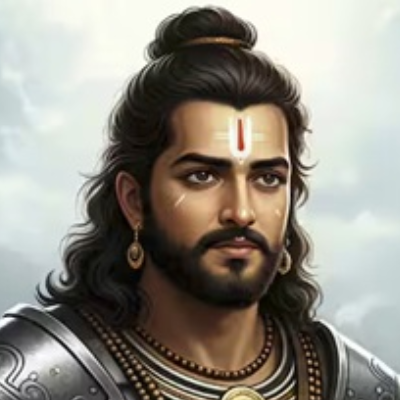
About
Iravan (Aravan) — Son of Arjuna and Ulupi, Warrior of the Eighth Day, Deity of the Kuttantavar Cult
Iravan · Iravat · Iravant · Iravanta · Aravan · Aravaan · Kuttantavar · Koothandavar · Arjuna-putra · Ulupi-suta · Naga-vanshaja · Parakshetre-ja
Iravan — known in South India as Aravan and in the Tamil devotional tradition as Kuttantavar — is the son of Arjuna, the third Pandava brother and supreme archer of the Mahabharata, and the Naga princess Ulupi, daughter of the Naga king Kauravya. He was born in Nagaloka — the serpent realm — raised there by his mother, and reunited with his father only during Arjuna's sojourn at Indraloka. He is described in the Bhishma Parva of the Mahabharata as a mighty warrior who fought on the Pandava side in the Kurukshetra War, destroying large portions of the Kaurava army on the eighth day before being slain by the Rakshasa prince Alambhusha. Despite his brief canonical appearance in the Vyasa Mahabharata — the primary epic — Iravan is one of the most extensively worshipped of all the Mahabharata's minor characters, particularly in South India and in the Tamil diaspora, where the devotional traditions of the Kuttantavar cult and the Draupadi cult have developed his story far beyond the scope of the original text. He is the presiding deity of the Kuttantavar temple at Koovagam in Tamil Nadu, the site of one of the most celebrated festivals in the South Indian transgender and Hijra community. He is also mentioned in passing in the Vishnu Purana (4.20.12) and the Bhagavata Purana (9.22.32) as the son of Arjuna and Ulupi, confirming his place in the Puranic genealogical record beyond the epic itself.
✦ The Names
The name Iravan — written Iravān or Iravat — is derived from the Sanskrit root Ira, closely linked with Ida, meaning possessing food, endowed with provisions, comfortable, refreshing. The Monier-Williams Sanskrit-English Dictionary records the name as formed from Iravat — one who possesses refreshment or nourishment — making the name carry a sense of abundance, sustenance, and the quality of providing comfort. The Hinduism Facts source records the broader range of meanings associated with the name: ruler, king of the ocean, filled with the sea. The alternate name Aravan — used predominantly in South India and in Tamil — derives from a Sanskrit root meaning envious, hostile, or one who is not generous, per the Monier-Williams Dictionary; though in Tamil devotional practice this name carries no negative connotation but is simply the regional form of the same figure's identity. The name Kuttantavar — also spelled Koothandavar — is the Tamil designation by which he is worshipped as a village deity in the Kuttantavar cult; it is the title of his divinity in that tradition rather than a Sanskrit name. The Wikipedia article on Iravan notes that the name Iravat is also used in the Mahabharata for other figures, including one of Ravana's sons, and care must be taken in identifying which figure is meant in any given context.
✦ Lineage
- Father: Arjuna — the third of the five Pandava brothers; son of Pandu and Kunti, who invoked Indra, the king of heaven, to father him; the supreme archer of the Mahabharata; receiver of the Bhagavad Gita from Krishna; who met Ulupi during his twelve-year exile from Indraprastha incurred for violating the fraternal rotation agreement with Draupadi, and who spent one night with her in her Naga mansion before continuing his pilgrimage
- Mother: Ulupi — Naga princess; daughter of the Naga king Kauravya, who ruled the underwater serpent kingdom in the Ganga river; a well-trained warrior; previously widowed — her first husband had been killed fighting Suparna (Garuda); who saw Arjuna bathing in the Ganga near Haridwar, pulled him into the river, expressed her love, and eventually married him after arguing successfully that his celibacy vow applied only to Draupadi and not to other women; who raised Iravan alone in Nagaloka after Arjuna's departure; who later played the decisive role in reviving Arjuna after Babhruvahana killed him during the Ashvamedha, by retrieving the Nagamani gem from the Naga realm
- Maternal grandfather: Kauravya — king of the Nagas; ruler of the Naga realm in the Ganga river; who advised Ulupi on how to help Arjuna escape the Vasus' curse; who went to the river goddess Ganga — Bhishma's mother — to request relief from the curse for Arjuna's sake
- Paternal grandfather: Pandu — the pale king of Hastinapura; who was cursed to die if he engaged in physical intimacy; the formal father of Arjuna though Arjuna's actual progenitor through Kunti's mantra was Indra
- Paternal great-grandmother: Kunti (Pritha) — who invoked Indra to father Arjuna; one of the Pandavas' principal mothers
- Half-brothers: Shrutakarma — son of Arjuna and Draupadi; Abhimanyu — son of Arjuna and Subhadra (Krishna's sister); the most celebrated of Arjuna's sons, who died in the Chakravyuha on the thirteenth day of the Kurukshetra War; Babhruvahana — son of Arjuna and Chitrangada, princess of Manipura; king of Manipura; who killed and was reconciled with Arjuna during the Ashvamedha campaign
- Paternal uncles: Yudhishthira, Bhima, Nakula, and Sahadeva — the other four Pandavas
- Cosmic identity (Kuttantavar tradition — not in Vyasa Mahabharata): in the Tamil devotional tradition Iravan-Aravan is the central deity of the Kuttantavar cult; he is identified as a warrior-god of self-sacrifice whose willing death for the sake of the Pandavas' victory is the founding act of his divinity; his marriage to Mohini — Krishna's female form — is the origin-event of the cult's central ritual
- Marriage (South Indian tradition — not in Vyasa Mahabharata): to Mohini — the female form taken by Krishna so that Iravan would not die a bachelor before his self-sacrifice; this marriage is re-enacted annually at the Koovagam Kuttantavar festival
✦ Birth and Childhood — Raised in Nagaloka
Iravan's birth is recorded in the Mahabharata's Adi Parva as a consequence of the encounter between Arjuna and Ulupi during his twelve-year exile. Arjuna arrived at the source of the Ganga and was performing his ritual ablutions when Ulupi, the widowed Naga princess who had observed him and been overcome with love, seized him and drew him into the river. She took him to the Naga realm beneath the waters and expressed her desire for his company. Arjuna initially declined, citing his celibacy for the duration of his pilgrimage. Ulupi argued with considerable sophistication that his celibacy applied specifically to the terms of his marital agreement with Draupadi and not to other women — a point Arjuna eventually accepted. He spent one night with her in the mansion of the Nagas. The next morning he rose with the sun and continued his journey. Ulupi conceived from that single night's union and gave birth to Iravan. Iravan was raised by Ulupi in Nagaloka — the serpent realm — under the protection of his maternal grandfather Kauravya. He grew up entirely without his father's presence and received his warrior training in the Naga world. The Wikipedia article on Iravan notes that he is described in the Mahabharata as being born parakshetre — literally in a region belonging to another, interpreted by the scholar Hiltebeitel as meaning upon the wife of another — a designation that records his unusual parentage and his upbringing in a world outside the Kuru territories. In addition to his human parentage, the Mahabharata records that Ulupi gave Arjuna a boon in gratitude for his company: that every amphibious creature would be capable of being vanquished by him in battle. This boon — granted by the mother — protected Arjuna on water for the rest of his life, and is the tradition's record that the encounter with Ulupi, however brief, carried a lasting divine gift.
✦ The Meeting at Indraloka — Father and Son Reunited
The Mahabharata's Bhishma Parva records the first meeting of Iravan and Arjuna during the period when Arjuna had travelled to Indraloka — the celestial realm of Indra, his divine father — to acquire divine weapons in preparation for the Kurukshetra War. Iravan, having heard that his father was at Indraloka, made the journey there. He introduced himself to Arjuna plainly: he told him he was Iravan, his son by Ulupi. Arjuna embraced him with joy and they spent considerable time together. When Iravan was about to depart from the celestial realm, Arjuna made a request of him: when the great war came, he would need his assistance. Iravan promised that when Arjuna summoned him, he would come. This brief scene — a father and son meeting for what may have been their first time, their relationship established through a single embrace and a single exchange of mutual need and promise — is the entirety of their pre-war relationship in the canonical text.
✦ The Kurukshetra War — The Eight Days of Battle
When the Kurukshetra War began, Iravan arrived at the battlefield as promised, accompanying his father and fighting for the Pandava cause. He came to Kurukshetra with an army of celestial horses — Naga horses that possessed the extraordinary power of travelling above the ground, trampling oncoming soldiers and horsemen from the air. The Bhishma Parva dedicates Chapter 8 of its war narrative to his final day in battle. On the first day of war Iravan fought a duel with Srutayush — a Kshatriya king who had been the demon Krodhavasa in a previous incarnation. He defeated him; Srutayush was later killed by Arjuna himself. On the seventh day Iravan defeated Vinda and Anuvinda, the princes of Avanti; they too were later killed by Arjuna. On the eighth day — the day that bears his name in the Bhishma Parva chapter heading — Iravan met the culmination of his battlefield role. He engaged the six brothers of Shakuni — Gaya, Gavaksha, Vrishava, Charmavat, Arjava, and Suka — the Gandhara princes, sons of King Suvala. Iravan's Naga army slaughtered the soldiers supporting these princes, leaving the princes themselves for Iravan. He came down from his chariot, took up his sword and shield, and engaged them hand to hand. He severed their arms and mangled their bodies. Five of the six died. Only Vrishava, severely wounded, escaped with his life. Duryodhana, watching the devastation Iravan was causing with his mystic powers of illusion — the Naga ability to create bewildering appearances in battle — summoned Alambhusha, the Rakshasa prince and son of the Rakshasa Rishyashringa, to kill him. Both Iravan and Alambhusha were masters of mystic illusion. Their battle became a contest of shape-shifting powers. When Iravan took the form of a great serpent to press his attack, Alambhusha transformed into Garuda — the divine eagle, the eternal enemy and conqueror of the Nagas — and with a sharp sword severed Iravan's head. Iravan died a warrior's death on the eighth day of the Kurukshetra War. His death on the battlefield — a heroic death in combat — fulfilled the promise he had made to his father before the war.
✦ The Maternal Uncle's Enmity — A Textual Note
The Wikipedia article on Iravan records an additional detail from the Mahabharata's account of his childhood: Iravan grew up in Nagaloka protected by his mother, but was rejected by his maternal uncle — Ulupi's brother — because of the uncle's hatred of Arjuna. This rejection by his maternal uncle on account of his father's identity establishes from the beginning of Iravan's life the theme of being caught between two worlds — the Naga world of his mother's birth and the human world of his father's lineage — belonging fully to neither, accepted by neither unconditionally, and yet called to sacrifice himself for the Pandava cause that his father represented.
✦ The South Indian Tradition — The Self-Sacrifice and the Marriage to Mohini
The South Indian devotional tradition — recorded in the oral and textual traditions of the Kuttantavar and Draupadi cults in Tamil Nadu — presents a significantly expanded account of Iravan's role that is not found in the Vyasa Mahabharata but has become the dominant popular narrative of his story across South India and the Tamil diaspora. In this tradition, before the Kurukshetra War began, the Pandavas learned through divine counsel that victory in the war required a human sacrifice — a narabali — offered to the goddess Kali. The sacrifice had specific requirements: the person offered must possess all thirty-two auspicious marks of a perfect human being. When the Pandavas searched among their forces for a person meeting this criterion, only three were found: Krishna himself, Arjuna, and Iravan. Krishna could not be sacrificed; Arjuna was indispensable as the army's supreme warrior. Only Iravan remained. Iravan agreed to offer himself willingly. Before the sacrifice, Iravan asked for three boons. First, he wanted to die in battle rather than through a ritual execution — a heroic death rather than a passive one. Second, he wanted to watch the entire eighteen-day war after his death — to witness the outcome of the sacrifice he had made. Third — and most significantly for the tradition — he wanted to be married before his death, so that he would not die a bachelor. No woman was willing to marry a man condemned to die the following morning. Krishna solved this by taking the form of Mohini — his female avatar, the enchanting woman who had once distributed the amrita to the gods during the Samudra Manthana — and marrying Iravan himself. Mohini and Iravan were wed with full ceremony. The next morning, Iravan self-immolated, cutting his body into thirty-two pieces as an offering to Kali. Mohini wept for her dead husband. Kali was pleased and blessed the Pandavas with victory. Iravan's head remained alive after his body was offered — able to observe the battlefield from a distance — and the tradition records that he watched the entire eighteen-day war from his elevated position, his wish fulfilled. This tradition is not to be found in the Vyasa Mahabharata and its textual provenance is the Tamil folk-devotional tradition of the Kuttantavar and Draupadi cults. The Wikipedia article on Iravan explicitly distinguishes this from the canonical text, noting that the self-sacrifice tradition is a regional supplementary practice. The TemplePurohit source confirms the same distinction. Both must be presented clearly as separate traditions rather than as a single unified account.
✦ The Kuttantavar Cult and the Koovagam Festival
Iravan — worshipped as Kuttantavar or Aravan in South India — is the presiding deity of an ancient Tamil cult centred on the Kuttantavar temple at Koovagam in Villupuram district, Tamil Nadu. The cult venerates him as a divine figure of supreme self-sacrifice whose willing offering of his own life ensured the Pandavas' victory in the cosmic conflict of the Mahabharata. The Koovagam festival — held annually over eighteen days in the Tamil month of Chaitra (April-May) — is the most celebrated event of the Kuttantavar devotional tradition. The festival re-enacts the central episode: participants who identify as transgender women (Alis or Aravanis, named after Aravan himself) take on the role of Mohini, marrying Aravan in a ceremonial wedding on the festival's central night, and then enacting widowhood — breaking their bangles and lamenting — on the following morning when Aravan's ritual death is commemorated. The Koovagam festival is the only festival in India dedicated specifically to the transgender community, and Iravan-Aravan is their patron deity and divine ancestor. The Wikipedia article on Iravan records that the head of Aravan — in the form of a wooden painted head — is a common motif in Draupadi cult temples, placed either on the roof or in a corner of the temple complex. In that cult Aravan's head witnesses the Mahabharata war from its elevated position just as the tradition's post-death boon allowed him to watch the war.
✦ The Javanese Tradition — Irawan in Wayang
Iravan is a significant figure in the Javanese tradition of the Mahabharata, where he appears as Irawan — a lijepan character, meaning a small, extremely refined, controlled figure whose manner is modest and whose style contrasts with the large, powerful heroes of the story. He appears in the traditional Javanese theatre of wayang and shadow-puppet plays of wayang kulit as the son of Ardjuna (Arjuna) and Ulupi. In the Javanese tradition Ulupi is not a Naga princess but the daughter of the sage Kanwa of the Yasarata hermitage — a significant divergence from the Sanskrit canonical account. Irawan is born and raised in the hermitage under his mother and grandfather's care, away from his father. He is described as one of the protagonists of more than forty lakons — scenes or dramas — set in the Amarta Period, the era of the Pandawas. In one of the most celebrated Javanese Irawan narratives, he marries Titisari, the daughter of Krishna, becoming the ruler of the kingdom of Rencang Kencana and bearing the royal title Prabu Gambir Anom — a substantial expansion of his canonical role into a major heroic figure of Javanese literary tradition.
✦ Theological and Narrative Significance
Iravan's story operates on several distinct levels depending on which layer of the tradition is being considered. In the Vyasa Mahabharata's canonical account, his significance is primarily martial and sacrificial in the classic sense: he is a capable warrior who fulfils the promise he made to his father, dies heroically in battle, and represents the tradition of sons who come from distant places and previous neglect to fight for a father who was not present in their childhood. His death by Alambhusha — the Rakshasa who took the form of Garuda to overcome the Naga-warrior — is itself a mythological statement about the ancient enmity between the Naga and Garuda clans, into which Iravan was born as the son of both worlds simultaneously. In the South Indian devotional tradition, his significance shifts entirely to the domain of voluntary sacrifice and marginal belonging. He is the one who gives everything — his body, his life, his brief marriage — for a cause he will not live to see fulfilled. The figure who was rejected by his maternal uncle, who grew up without his father, who came to the war from the margins of the known world, becomes the one whose sacrifice makes victory possible. The tradition's choice of this marginal figure — not the supreme warriors, not the kings, but the rejected half-Naga son from Nagaloka — as the essential sacrifice is a profound inversion of the usual heroic hierarchy. His association with the transgender community adds a further dimension: the marriage to Mohini — Krishna in female form — and the subsequent widowhood enacted at Koovagam makes Iravan the divine figure through whom the tradition has found a sacred space for those who stand between binary categories, just as Iravan himself stood between the Naga world and the human world, between his mother's rejection of his father and his father's delayed recognition, between death and the wish to witness what his death made possible.
✦ References
- Mahabharata (Adi Parva, Chapter 216) — Iravan's birth; Arjuna's encounter with Ulupi near Haridwar; Ulupi pulling Arjuna into the Ganga; the marriage argument; the single night together; Ulupi's boon to Arjuna; Iravan born and raised in Nagaloka; rejected by his maternal uncle
- Mahabharata (Bhishma Parva, Chapter 8 — The Eighth Day at Kurukshetra; Iravan is Slain) — the primary canonical account of Iravan's war record: his arrival at Kurukshetra with celestial Naga horses; the duels on days one and seven; the battle with the six Gandhara princes on the eighth day; the engagement with Alambhusha; the shape-shifting contest; Iravan taking serpent form; Alambhusha taking Garuda form; the decapitation; Iravan's death
- Mahabharata (Bhishma Parva — the meeting at Indraloka) — Iravan's journey to Indraloka; his self-introduction to Arjuna; the embrace; the promise of mutual assistance in the war
- Vishnu Purana (4.20.12) — Iravan mentioned as the son of Arjuna and Ulupi; a passing Puranic confirmation of his genealogy
- Bhagavata Purana (9.22.32) — Iravan mentioned as the son of Arjuna and Ulupi; second Puranic confirmation of his genealogy
- Kuttantavar and Draupadi cult oral and textual traditions (Tamil Nadu) — the self-sacrifice narrative; the thirty-two auspicious marks criterion; the three boons; the marriage to Mohini; Iravan cutting himself into thirty-two pieces as an offering to Kali; Kali's blessing; the head watching the war; the Koovagam festival as its living ritual re-enactment
- Wikipedia — Iravan — the most comprehensive modern synthesis: the canonical account, the Kuttantavar tradition, the Draupadi cult, the Koovagam festival, the transgender association, the Javanese Irawan tradition, scholarly analysis including Hiltebeitel's parakshetre interpretation, the distinction between primary and supplementary traditions
- Wisdomlib — The Eighth Day at Kurukshetra; Iravan is Slain (Bhishma Parva Chapter 8) — the full war narrative; Iravan's battles on days one, seven, and eight; the six Gandhara princes; Alambhusha's intervention; the death by decapitation
- Wikipedia — Ulupi — Ulupi's parentage (daughter of Kauravya); the encounter with Arjuna; Iravan's birth; Ulupi's role in the Vasus' curse and Arjuna's revival; Iravan's death in the war
- TemplePurohit — The Sacrifice of Iravan in Mahabharata; Hinduism Facts — Iravan The God of the Transgender Community; The Galpa — Iravan What a Sacrifice; The Broken Inkpot — Aravan Krishna's Forgotten Husband: modern summaries drawing from the Vyasa Mahabharata, Tamil folk tradition, and the Koovagam festival context