
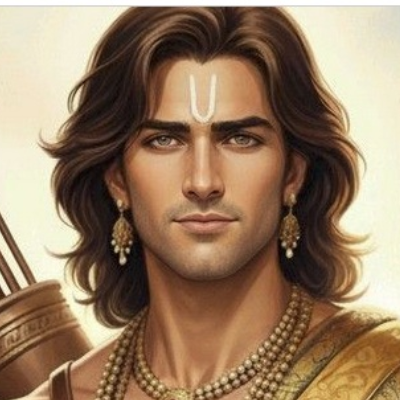
About
Babhruvahana — King of Manipura, Son of Arjuna and Chitrangada, the Son Who Slew and Revived His Father
Babhruvahana · Babhruvāhana · Babruvahana · Manipura-naresh · Chitrangada-suta · Arjuna-putra · Prabhasa-avatara
Babhruvahana is the son of Arjuna — the third of the five Pandava brothers, the supreme archer of the Mahabharata, the receiver of the Bhagavad Gita's teaching from Krishna — and Chitrangada, the princess-warrior of Manipura (also called Manalura), a kingdom in the north-eastern region. He was raised in Manipura as heir to his maternal grandfather King Chitravahana's throne under a pre-nuptial agreement stipulating that the son born of the union would remain in Manipura and not follow his father to the Kuru territories. He is accordingly the king of Manipura, not a prince of Hastinapura. He did not participate in the Kurukshetra War. His central role in the Mahabharata is as the unwilling protagonist of one of the tradition's most emotionally charged father-son confrontations: during the Pandavas' post-war Ashvamedha sacrifice, the ritual horse wandered into Manipura, and Babhruvahana — as the territorial king whose duty it was to challenge or submit — was compelled by the warrior code and by the urging of his stepmother Ulupi (the Naga princess, Arjuna's second wife) to fight the army following the horse. The battle culminated in Babhruvahana killing Arjuna with an arrow. Ulupi subsequently revealed that the encounter had been deliberately engineered to fulfil a divine curse on Arjuna, and used the Nagamani — a gem of the Naga realm — to revive him. The episode is narrated in the Vyasa Mahabharata's Ashvamedhika Parva (Chapters 78–82) and expanded considerably in the 12th-century Jaiminiya Ashvamedhaparva. The mythology source notes a tradition — not present in the Vyasa Mahabharata but recorded in a popular retelling — that Babhruvahana was an avatar of Prabhasa, one of the eight Vasus, adding a cosmic dimension to his role as the instrument of the curse the Vasus had placed on Arjuna.
✦ The Name
The Sanskrit name Babhruvahana — written Babhruvāhana — is a compound of babhru (reddish-brown, tawny, the colour of a mongoose or a reddish-brown horse) and vahana (vehicle, bearer, one who carries). The compound means he who bears or rides the tawny one — interpreted as one whose vehicle or mount is a reddish-brown horse, or one who bears the tawny (colour of royalty and martial distinction). The name is consistent with his identity as a king and warrior. The Indian Blog source notes that his name is interpreted as bearing the characteristic of bravery and power, matching his role in the Mahabharata as a warrior who defeated even Arjuna in single combat.
✦ Lineage
- Father: Arjuna — the third Pandava; son of Pandu and Kunti (Kunti invoked Indra, the king of heaven, to father him); the supreme archer of the Mahabharata; receiver of the Bhagavad Gita from Krishna on the Kurukshetra battlefield; who visited Manipura during his year-long exile from Indraprastha following a breach of the fraternal rotation agreement with Draupadi; who married Chitrangada there under the Asura-type marriage convention that surrendered paternal claim over any son born
- Mother: Chitrangada — princess of Manipura (Manalura); daughter of King Chitravahana; who was raised as a putrika — a daughter designated to carry forward the royal line through her own offspring — because Chitravahana had no sons despite the boon from Shiva that each descendant of his lineage would have a son to continue it; a warrior princess skilled in martial arts and administration; who raised Babhruvahana alone in Manipura after Arjuna's departure; who came to the battlefield during the Ashvamedha confrontation and revealed Arjuna's identity to her son
- Stepmother: Ulupi — a princess of the Naga (serpent) clan; Arjuna's second wife, married before Chitrangada during the same period of exile; who played the decisive role in the Ashvamedha confrontation by urging Babhruvahana to fight and by subsequently providing the Nagamani gem to revive Arjuna; who revealed that the entire episode had been engineered to fulfil the Vasus' curse on Arjuna for his killing of Bhishma
- Paternal grandfather: Pandu — the pale king of Hastinapura; second son of Vichitravirya and Ambalika; who was cursed to die if he engaged in physical intimacy and who therefore invoked divine beings through Kunti's mantra to father the five Pandavas; the formal father of Arjuna though Arjuna's actual progenitor through the mantra was Indra
- Paternal great-grandmother: Kunti (Pritha) — who invoked Indra to father Arjuna; whose mantra gave all five Pandavas their divine parentage
- Maternal grandfather: Chitravahana — king of Manipura; whose lineage traced back to the ancestor Prabhanjana, who through intense penance to Shiva had secured a boon ensuring each descendant would have a son to continue the royal line; the boon paradoxically resulted in Chitravahana having only a daughter — Chitrangada — whom he raised as his heir under the putrika convention; who stipulated the pre-nuptial condition of Arjuna's marriage with Chitrangada that surrendered the son born to the couple to Manipura's succession
- Half-brothers: Shrutakarma — son of Arjuna and Draupadi; Iravan — son of Arjuna and the Naga princess Ulupi (Babhruvahana's stepmother, making Iravan simultaneously his half-brother and the son of his stepmother); Abhimanyu — son of Arjuna and Subhadra (Krishna's sister); the most celebrated of Arjuna's sons, who died in the Chakravyuha on the thirteenth day of the Kurukshetra War
- Cosmic identity (popular tradition, not in Vyasa Mahabharata): the mythology blogspot source records the tradition that Babhruvahana was an avatar of Prabhasa — one of the eight Vasus, the elemental attendant deities of Indra — who had been cursed by the sage Vasishtha to take mortal birth; the same Prabhasa who was the eighth and most senior of the Vasus, reborn as Bhishma through Ganga; if accepted, this identification makes Babhruvahana a sibling-avatar of Bhishma, and his killing of Arjuna the fulfilment of a cosmic pattern in which the Vasus (through their Prabhasa-avatar) directly enacted the curse they had placed on Arjuna for killing Bhishma (their own Vasu-avatar); this identification is not in the primary Vyasa Mahabharata and must be treated as a variant tradition
✦ Birth and Early Life — The Putrika Arrangement
Babhruvahana's birth is recorded in the Mahabharata's Adi Parva (Chapter 218) as a consequence of the pre-nuptial agreement between Arjuna and King Chitravahana. During the twelve-year period of exile from Indraprastha — which Arjuna had incurred by entering Draupadi and Yudhishthira's chamber while they were alone together, in breach of the fraternal rotation agreement — he undertook a pilgrimage through the sacred sites and kingdoms of India. When he arrived in Manipura he was struck by the beauty and quality of Chitrangada and sought her hand from her father. Chitravahana agreed to the marriage with the stipulation that any son born of the union would remain in Manipura as Chitravahana's heir — the son would be raised as a putrika's offspring, belonging to the mother's kingdom rather than the father's. Arjuna accepted. He resided in Manipura for three months before continuing his journey, or for three years in some manuscript traditions of the twelve-year exile narrative. When he departed, Chitrangada was pregnant. Babhruvahana was born after his father's departure, raised by his mother in Manipura, trained in warfare and administration, and eventually inherited the throne of Manipura from his maternal grandfather Chitravahana as stipulated. He grew into a king of considerable accomplishment — described across the sources as just, skilled in statecraft, and a warrior of exceptional archery. He knew of his father's identity. When Arjuna once returned to Manipura during his travels — before the Kurukshetra War — he was reunited with Chitrangada and met Babhruvahana but made no attempt to take either of them back to the Kuru territories.
✦ The Vasus' Curse — The Background to the Confrontation
The theological and narrative foundation of the Babhruvahana-Arjuna confrontation is the curse of the eight Vasus upon Arjuna for the manner in which he had killed Bhishma on the tenth day of the Kurukshetra War. Bhishma — born as Devavrata, son of King Shantanu and the river goddess Ganga — was himself the eighth Vasu reborn in mortal form, the Vasu Prabhasa who had been the most senior of the group cursed by Vasishtha to take human birth. When Arjuna, at the direction of Krishna, used the presence of Shikhandi — who had been a woman in a previous birth and whose previous-birth identity prevented Bhishma from shooting arrows at him — as a shield behind which to loose the arrows that felled Bhishma, the eight Vasus were enraged. In their understanding Arjuna had used a stratagem that was technically within the rules of war but violated the spirit of the warrior code — he had sent forth his arrows from behind someone whom Bhishma would not target. The Vasus pronounced their curse: Arjuna would be killed by his own son. Ulupi, the Naga princess who was Arjuna's second wife and who was deeply devoted to him, knew of this curse and knew also that the killing and revival was the mechanism through which the curse would be satisfied and Arjuna simultaneously released from it. She was therefore the one who arranged the entire confrontation when the Ashvamedha horse wandered into Manipura.
✦ The Ashvamedha Confrontation — The Battle and the Killing
After the Kurukshetra War, the Pandavas performed the Ashvamedha sacrifice to establish Yudhishthira's universal sovereignty and to neutralise the accumulated sin of the war's enormous death toll. The sacrificial horse was released to wander freely across the earth; any kingdom that allowed it free passage acknowledged Yudhishthira's suzerainty; any kingdom that challenged or captured the horse would have to fight Arjuna, who marched behind the horse as its military escort. The horse wandered through many kingdoms, most of which submitted or were subdued with minimal conflict. When it entered the territory of Manipura it came into the domain of Babhruvahana, Arjuna's own son. The Vyasa Mahabharata's Ashvamedhika Parva (Chapters 78–82) records the confrontation in full. When Arjuna arrived in Manipura following the horse, Babhruvahana — surrounded by scholars and ministers — came forward and greeted his father with respect and affection. Arjuna was immediately displeased. He upbraided his son for the manner of his welcome, which he characterised as soft and unworthy of a king who should by dharma have seized the horse and forced the fight. He told Babhruvahana that his conduct was that of a woman rather than a warrior, and that he was failing in his kshatriya-dharma — the duty of a king to fight when a ritual challenge enters his territory. The accusation was designed to provoke a battle rather than a peaceful submission. Ulupi, who had come to Manipura ahead of the Ashvamedha army, appeared and directly urged Babhruvahana to seize the horse and fight. She told him that fighting Arjuna was not merely permitted but required — both by the rules of the Ashvamedha ceremony and by a higher necessity that she did not yet reveal. Babhruvahana, caught between his natural reluctance to fight his own father and the dual pressure of Arjuna's taunts and Ulupi's command, resolved to fight. The battle was fierce. Babhruvahana proved himself a warrior of extraordinary quality — the sources note that his arrows cut through Arjuna's responses with a skill that amazed even his father. The Ashvamedhika Parva records that Arjuna himself praised his son in the middle of the battle — calling him excellent and mighty-armed. Babhruvahana pierced Arjuna's shoulder with an arrow that entered the earth beneath him. Arjuna, supported on his bow, appeared to have lost his life force. Babhruvahana then released an arrow that pierced Arjuna's chest, entering deep within his body. The supreme archer of the Mahabharata — the receiver of the Bhagavad Gita, the conqueror of divine weapons, the warrior who had fought gods and demons — fell to the earth without life. Babhruvahana, pierced himself by Arjuna's arrows in the course of the battle, fell unconscious from the shock of what he had done.
✦ The Aftermath — Chitrangada, Ulupi, and the Revival
Chitrangada arrived at the battlefield to find both her husband and her son lying on the ground — Arjuna dead and Babhruvahana unconscious from the dual shock of his wounds and his inadvertent parricide. She took Arjuna's feet in her lap and lamented. She directed her grief at Ulupi — blaming her, correctly as it turned out, for having urged Babhruvahana into the fight and thus being the proximate cause of Arjuna's death. She vowed to fast to death unless Arjuna was revived. When Babhruvahana regained consciousness and saw his dead father and his weeping mother, his remorse was absolute. He declared himself wretched and sinful and expressed his intention to kill himself in atonement. He addressed the assembled Brahmins asking what penance could expiate the sin of killing one's own father. Ulupi then revealed the full truth: the killing had not been an act of sin but the fulfilment of a cosmic necessity. Arjuna had been under the Vasus' curse since the moment he killed Bhishma using Shikhandi as a shield. The curse required that he be slain by his own son. Ulupi had arranged the confrontation precisely so that the curse could be satisfied and Arjuna simultaneously released from its consequences — for the tradition holds that a curse, once fulfilled, loses its power over its object. She had come prepared with the means of revival. She produced the Nagamani — the divine gem of the Naga realm, kept by the Nagas as their most sacred possession of healing and restoration — placed it on Arjuna's chest, and Arjuna revived, rising as one waking from sleep. The heavens responded: Indra showered flowers, celestial musicians sounded their instruments, and divine voices proclaimed well done from all directions. Arjuna, revived, embraced Babhruvahana. He turned to Ulupi and asked her to explain the full scene — the mixture of joy, sorrow, and wonder he observed around him. Babhruvahana directed his father's question to Ulupi, who explained the entire sequence of the curse, its fulfilment, and its resolution. Arjuna then invited his son to return with him to Hastinapura for the completion of the Ashvamedha ceremonies.
✦ After the Revival — The Journey to Hastinapura
After Arjuna's revival and the reconciliation, Babhruvahana invited his father to remain in Manipura. Arjuna, bound by the Ashvamedha's requirements to follow the horse to its conclusion, declined and continued his journey. Later, after the completion of the sacrifice, Babhruvahana, Chitrangada, and Ulupi all travelled to Hastinapura for the great festival marking the sacrifice's conclusion. At Hastinapura, Krishna presented Babhruvahana with a chariot drawn by divine horses — a royal gift honouring both his status as a king and his extraordinary prowess in battle. After the festivities, Babhruvahana returned to Manipura to continue his rule. Chitrangada and Ulupi remained at Hastinapura, joining the Pandavas' household. They returned to their natal families only when the Pandavas, having renounced the world after hearing of Krishna's departure from the earth, embarked on their final journey to the Himalayas decades later.
✦ The Jaiminiya Ashvamedhaparva — The Expanded Version
The 12th-century Jaiminiya Ashvamedhaparva — part of the Jaiminibharata, a Sanskrit retelling of the Mahabharata by the sage Jaimini — presents a significantly expanded version of Babhruvahana's story with elements not found in the Vyasa Mahabharata. The Wikipedia article on Babhruvahana identifies this text as a popular retelling known for its entertainment focus over philosophical depth. In the Jaiminiya version: Babhruvahana is raised by Ulupi after his mother Chitrangada (here the daughter of a Gandharva king rather than a human king) leaves for Yudhishthira's court. After the battle in which Babhruvahana kills Arjuna, he does not merely receive the Nagamani from Ulupi but must go himself to war against the Nagas in the underworld to retrieve both a divine elixir and the gem needed to revive his father. In some versions of this retelling Arjuna is beheaded rather than merely killed by a chest wound, requiring the retrieval of the head as well. The expansion of Babhruvahana's role in this version — from a relatively passive recipient of Ulupi's solution to an active hero who fights the underworld for his father's revival — reflects the 12th century's regional literary tradition of developing peripheral Mahabharata characters into full heroic figures. The Vyasa Mahabharata's Ashvamedhika Parva (Chapters 78–82) remains the primary canonical account.
✦ Theological and Narrative Significance
Babhruvahana's story operates on several simultaneous levels. At the level of dharmic duty it is the Mahabharata's most precise illustration of the conflict between kshatriya-dharma (the warrior's duty to fight when challenged or challenging) and pitra-dharma (the son's duty of reverence to his father). When Arjuna taunts his son for behaving like a woman and failing in his warrior duty, and Ulupi simultaneously urges him to fight, Babhruvahana is placed in a situation where both his warrior identity and his filial devotion appear to pull in opposite directions. The resolution — that fighting is in fact the expression of both duties simultaneously, because the fight fulfils the curse that releases Arjuna — is the episode's central theological statement: genuine duty to a parent sometimes requires actions that appear to violate that duty. At the level of karma and consequence it is the tradition's demonstration that a divine curse placed by legitimate divine authority cannot be evaded but can be fulfilled in a manner that transforms rather than destroys its object. Arjuna's killing by his son was inevitable; Ulupi's genius was to arrange that the fulfilment would also include the mechanism of revival, converting the curse from a terminal punishment into a transformative ordeal. The son kills the father; the father is revived; the curse is satisfied; the relationship is restored and deepened; both parties emerge transformed by the encounter. The episode also stands as a structural parallel to the Ramayana's account of Luv and Kusha — the twin sons of Rama and Sita — stopping the Ashvamedha horse and defeating the entire Kosala army before being revealed as Rama's own sons. Both episodes present the same narrative pattern: the universal sovereign's ritual horse captured by his own son, leading to a confrontation in which the son's true identity is revealed; in the Ramayana this leads to Sita's departure from the world rather than to a reunion, making Babhruvahana's episode the more benign resolution of the same archetypal situation.
✦ In the Regional and Folk Tradition
Babhruvahana's story has been especially popular in the regional literary traditions of Karnataka, Kerala, and Manipur. The Wikipedia article notes that numerous literary works, plays, and films have been based on his story. The Yakshagana and Kathakali traditions of South India include the Babhruvahana episode among their most performed narrative cycles. In Manipur, Babhruvahana is considered a founding royal ancestor — the king who established the royal lineage of that region — and his story is woven into the cultural identity of the state. The parallel between his story and that of Luv-Kusha stopping Rama's Ashvamedha horse made it a structurally resonant theme across the tradition's different regional expressions.
✦ References
- Mahabharata (Adi Parva, Chapter 218) — the birth narrative: Arjuna's exile journey to Manipura; the marriage to Chitrangada under the Putrikadharma condition; Babhruvahana born after Arjuna's departure; raised in Manipura as Chitravahana's heir; the founding episode of his existence
- Mahabharata (Ashvamedhika Parva, Chapters 78–82) — the primary canonical account of the central episode: the Ashvamedha horse entering Manipura; Arjuna's arrival and his taunt of Babhruvahana for lacking warrior spirit; Ulupi's urging of the fight; the battle; Arjuna's death from the chest-wound arrow; Babhruvahana's unconsciousness and remorse; Chitrangada's lament and accusation of Ulupi; Ulupi's revelation of the Vasus' curse and its fulfilment; the Nagamani placed on Arjuna's chest; Arjuna's revival; the embrace; Krishna's gift of a divine chariot to Babhruvahana; the journey to Hastinapura
- Jaiminiya Ashvamedhaparva (Jaiminibharata, 12th century CE) — the expanded retelling: Babhruvahana raised by Ulupi; Chitrangada as a Gandharva king's daughter; Babhruvahana's active quest to the underworld to retrieve elixir and divine gem for Arjuna's revival; the beheading variant; the significantly expanded role relative to the Vyasa Mahabharata version
- Wikipedia — Babhruvahana — the most comprehensive modern summary: the Vyasa and Jaiminiya versions distinguished; the Putrikadharma marriage structure; the curse of the Vasus; the Ashvamedha confrontation; the aftermath; the regional literary tradition; the parallel with Luv-Kusha
- HinduPad — Babruvahana Katha — the story retold with emphasis on the Vasus' curse and its fulfilment through Babhruvahana; Ashvamedhika Parva chapters 78–80 identified as the primary Sanskrit reference
- Wisdomlib — Ashvamedha Parva (Mahabharata summary) — direct paraphrase of the Ashvamedhika Parva passage: the arrow to the shoulder, the arrow to the chest, Arjuna's fall, Babhruvahana's unconsciousness, Chitrangada's lament, Ulupi's gem, the revival, Arjuna's praise of his son
- The Indian Blog — Babhruvahana The Heroic Son of Arjuna and Chitrangada — the most detailed modern essay on Babhruvahana's character, martial training, dharmic qualities, and the narrative structure of the episode
- MahabharataOnline.com — Story of Babhruvahana; Ritsin.com — Arjuna Mahabharata Babruvahana Story; Powercutonline.com — Yudhisthira Ashvamedha Yagna; Jayarama.wordpress.com — The Death of Arjuna at the Hands of Babhruvahana; Shrivastavapulkit.blogspot.com — Who Killed Arjuna Before His Final Death: modern summaries drawing from the Vyasa Mahabharata and Jaiminiya traditions