
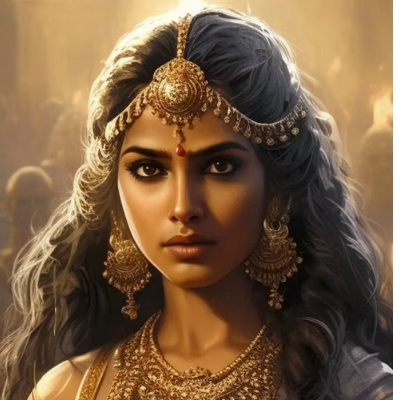
About
Uttaraa — Princess of Matsya, Wife of Abhimanyu, and Mother of Parikshit
Uttaraa · Uttara · Matsyakumari · Daughter of Virata · Wife of Abhimanyu · Mother of Parikshit
Uttaraa was the princess of the Matsya kingdom, the daughter of King Virata, ruler of Matsya, and his chief queen Sudeshna, who was herself the daughter of Kekaya, a Suta chieftain of the Kekaya country of northwestern Bharatavarsha, and of Malavi, a woman associated with the Malava country of central Bharatavarsha. Uttaraa became the wife of Abhimanyu, the son of the Pandava Arjuna and his wife Subhadra, who was the sister of Krishna, the Yadava prince revered as an avatar of the god Vishnu. She is principally significant in the Mahabharata as the mother of Parikshit, the child who survived an attempt on his life in the womb by the weapon of Ashvatthama, was subsequently born safely through the intervention of Krishna, and inherited the Kuru throne as the last king of the Pandava line recorded in the epic. Uttaraa appears in the Virata Parva, the Udyoga Parva, the Sauptika Parva, and the Ashramavasika Parva of the Mahabharata, and she is also referenced in the Bhagavata Purana in connection with the birth of Parikshit and the departure of Krishna from the world.
✦ The Name
The name Uttaraa is the feminine form of Uttara, a Sanskrit word meaning northern, upper, higher, or subsequent. In the context of the Mahabharata, the name is shared between the princess and her brother, the prince Uttara, son of Virata, creating a paired naming convention based on a common root. The distinction between the two is maintained in Sanskrit by grammatical gender — the masculine Uttara for the prince and the feminine Uttaraa for the princess — though in transliteration this distinction is sometimes rendered through the lengthened final vowel of the feminine form. The name Matsyakumari, meaning princess of the Matsyas, is a descriptive epithet applied to her by virtue of her origin. Some later texts and regional traditions refer to her simply as Uttara without the gender distinction, and readers of vernacular retellings should be aware that the brother and sister share the root name.
✦ Lineage
- Father: Virata — king of the Matsya kingdom, a ruler of the lunar dynasty; the Pandavas and Draupadi chose his court as their place of concealment during the thirteenth and final year of their exile; he fought on the side of the Pandavas in the Kurukshetra war and was killed during the conflict
- Mother: Sudeshna — daughter of Kekaya the Suta chieftain and of Malavi; chief queen of Virata; sister of Kichaka, the commander-in-chief of the Matsya armies who was killed by Bhima during the Pandavas' year of concealment at Virata's court
- Brother: Uttara — prince of Matsya; served as Arjuna's charioteer during the Kaurava cattle raid on Matsya; participated in the Kurukshetra war and was killed during the conflict
- Husband: Abhimanyu — son of the Pandava Arjuna and his wife Subhadra, who was the sister of Krishna; regarded as one of the most gifted warriors of his generation; killed during the Kurukshetra war on the thirteenth day of battle when he was trapped inside the Chakravyuha formation and slain by multiple Kaurava warriors simultaneously after his means of exit from the formation had been destroyed
- Son: Parikshit — born after Abhimanyu's death; survived an attempt on his life in the womb by the Brahmastra weapon discharged by Ashvatthama, son of the teacher Drona, through the intervention of Krishna; inherited the Kuru throne after the Kurukshetra war as the sole surviving heir of the Pandava lineage; his reign and the circumstances of his death by snakebite form the framing narrative of the Bhagavata Purana
- Maternal uncle: Kichaka — the powerful commander-in-chief of Virata's armies, whose assault on Draupadi during the Pandavas' year of incognito exile and subsequent killing by Bhima form the central episode of the Virata Parva
✦ During the Pandavas' Year of Concealment
During the thirteenth year of the Pandavas' exile, Arjuna — the third of the five Pandava brothers, son of the god Indra and the Pandava queen Kunti, and the foremost archer of his age — entered Virata's court in the disguise of a eunuch dance teacher named Brihannala. This disguise had a specific basis: Arjuna had spent a year in the heavens in the court of his divine father Indra, and during that time had incurred a curse from the celestial nymph Urvashi, who had approached him romantically and been refused; her curse transformed his appearance and manner in a way that made the eunuch disguise credible. In this guise, Arjuna served as the instructor of Uttaraa in music and the performing arts within the women's quarters of Virata's palace.
The relationship between Arjuna in his disguise as Brihannala and Uttaraa is presented in the Mahabharata as one of teacher and pupil, with Arjuna regarding Uttaraa in the manner appropriate to a daughter or student. This characterisation becomes narratively significant at the close of the year of concealment, when Virata proposed the marriage of Uttaraa to Arjuna in recognition of the debt he owed the Pandavas. Arjuna's refusal of that proposal on grounds of the intimacy of the teacher-pupil relationship, and his counter-proposal that Uttaraa instead marry his son Abhimanyu, is one of the key transitional episodes of the Virata Parva.
✦ The Marriage to Abhimanyu
The marriage of Uttaraa to Abhimanyu was celebrated at Viratanagara, the capital of the Matsya kingdom, with considerable ceremony. The occasion brought together a remarkable assembly of figures: Krishna, the Yadava prince who served as Arjuna's charioteer and closest ally, attended with other leading members of the Yadava clan; representatives of kingdoms allied with the Pandavas were present; and the celebration served simultaneously as a formal political occasion at which the alliances being assembled against the Kauravas were consolidated and made visible. Abhimanyu, the son of Arjuna and Subhadra, was at the time of the marriage a young warrior of exceptional talent, already recognised as one of the most capable fighters of the younger generation of the Kuru period.
The Mahabharata does not record the personal dimensions of the marriage between Uttaraa and Abhimanyu in any detail — their individual relationship, conversations, or domestic life are not described. The marriage is presented primarily as a political and genealogical event of great consequence rather than as a personal narrative. Uttaraa is depicted as accepting the match proposed by her father and endorsed by the assembled dignitaries without recorded objection or independent expression of preference.
✦ The Death of Abhimanyu and the Attack on the Unborn Child
Abhimanyu was killed on the thirteenth day of the Kurukshetra war. He had entered the Chakravyuha — a complex rotating wheel-formation of troops — alone, having been the only warrior present who knew how to penetrate it, since his knowledge of how to exit it had not been fully transmitted to him before birth. Once inside, the means of exit available to him was destroyed by Jayadratha, king of Sindhu, who was able on that day by virtue of a boon from the god Shiva to hold back all the Pandavas except Arjuna. Abhimanyu was then surrounded and attacked simultaneously by multiple senior Kaurava warriors, including Karna, Drona, Ashvatthama, Kripacharya, and Duryodhana's brother Dushasana's son, and was slain. His death is described in the Mahabharata as one of the most lamented of the war, and it provoked Arjuna to his vow to kill Jayadratha before the following sunset.
Uttaraa was pregnant with Abhimanyu's child at the time of his death. On the night following the conclusion of the war, Ashvatthama — the son of the teacher Drona, consumed by grief and rage over his father's death and by his own dishonour — crept into the Pandava camp and killed the five sons of Draupadi and other warriors as they slept. He then discharged the Brahmastra, a weapon of devastating supernatural power, targeting Uttaraa's womb with the specific intention of destroying the last surviving heir of the Pandava line before it could be born.
The Mahabharata and the Bhagavata Purana both record that Uttaraa experienced the weapon entering her body and felt the child within her being destroyed by its heat. She ran to Krishna in terror and despair, crying out for protection for the child. Krishna intervened directly, using his divine power to enter the womb and shield the unborn child from the Brahmastra's force. The child survived, though some versions of the account describe him as having been partially affected — born dead or near death and then revived by Krishna, or born alive but marked by the encounter. The Bhagavata Purana gives particular attention to this episode, presenting it as a demonstration of Krishna's protective power over his devotees and their descendants.
✦ The Birth of Parikshit
The child born to Uttaraa was named Parikshit. The name is derived from the Sanskrit root meaning to examine or to test, and is explained in the tradition by the account that as a child Parikshit went about examining all people he encountered, searching for the form of the divine being he had perceived within the womb during Krishna's protection — thus he was one who examines or tests. Parikshit became the king of the Kurus after the Pandavas, having installed him on the throne, retired from the world and undertook their final journey. His reign is not narrated in detail within the Mahabharata itself but becomes the framing occasion for the Bhagavata Purana, in which the circumstances of his impending death by the bite of the serpent Takshaka prompt the recitation of the entire Purana to him by the sage Shuka, the son of the sage Vyasa.
✦ Uttaraa After the War
The Mahabharata's Stri Parva records Uttaraa among the women who came to the battlefield after the war to mourn their dead. She is depicted lamenting over Abhimanyu's body with intense grief. The Ashramavasika Parva, which records the later years of the Pandavas' reign, references Uttaraa in connection with the Kuru royal household during the period of Parikshit's childhood. The Mahabharata does not narrate the circumstances of Uttaraa's own death, and no primary source records the length of her life or the manner of its end. Her presence in the tradition after the war is defined primarily by her identity as the mother of Parikshit and as the widow of Abhimanyu rather than by any independent narrative.
✦ Textual Variants and Inconsistencies
The account of the Brahmastra attack on Uttaraa's womb and Krishna's protection of the unborn Parikshit is told in both the Mahabharata's Ashvamedha Parva and the Bhagavata Purana, but with differences in emphasis and some variation in detail. The Mahabharata account focuses on the military and political dimension of the event — the destruction of Ashvatthama's power, the neutralisation of the weapon, and the survival of the Pandava line. The Bhagavata Purana's account, found in its first and second skandhas, gives considerably more devotional weight to the episode, presenting Uttaraa's appeal to Krishna and his response as a paradigmatic instance of divine protection of the surrendered devotee, and elaborating the theological significance of the moment at greater length than the epic does. The two accounts are broadly consistent in their main outline but differ in the degree of detail given to Uttaraa's experience and appeal, and in the emphasis placed on Krishna's interior act of protection within the womb.
✦ Connection to the Wider Genealogy
Uttaraa stands at a critical juncture in the genealogical record of the Kuru dynasty as it is preserved in the Mahabharata and the Puranas. Through her father Virata she brought the Matsya royal line into direct genealogical connection with the Pandava-Kuru succession. Through her husband Abhimanyu she was connected to three of the most significant figures of the epic period simultaneously: to Arjuna, the Pandava hero and son of Indra; to Subhadra, the Yadava princess and sister of Krishna; and through Subhadra to Krishna himself. Her son Parikshit carried forward the Kuru dynastic line into the post-war era and became, through his own son Janamejaya — who performed the great serpent sacrifice that serves as the occasion for the recitation of the Mahabharata itself — the ancestor of the kings in whose reign the epic tradition was consolidated and transmitted. Uttaraa is thus genealogically positioned as the woman through whom the Kuru line survived its near-extinction at the close of the Kurukshetra war.
✦ References
- Mahabharata, Virata Parva (Book 4), chapters 62–72: Records Uttaraa's role during the Pandavas' year of concealment as Arjuna's pupil in dance and music, Virata's proposal to marry her to Arjuna, Arjuna's counter-proposal, and the celebration of her marriage to Abhimanyu at Viratanagara.
- Mahabharata, Drona Parva (Book 7): Narrates the death of Abhimanyu in the Chakravyuha on the thirteenth day of the Kurukshetra war.
- Mahabharata, Stri Parva (Book 11): Records Uttaraa's lamentation over Abhimanyu's body among the women mourning their dead after the war.
- Mahabharata, Sauptika Parva (Book 10): Narrates Ashvatthama's night raid on the Pandava camp and his discharge of the Brahmastra targeting Uttaraa's womb.
- Mahabharata, Ashvamedha Parva (Book 14): Records Krishna's protection of the unborn Parikshit from the Brahmastra and the birth of Parikshit.
- Mahabharata, Ashramavasika Parva (Book 15): References Uttaraa and Parikshit in the context of the Pandavas' later reign and eventual retirement from the world.
- Bhagavata Purana, Skandha 1, chapters 7–8 and Skandha 2: Gives a detailed devotional account of Ashvatthama's Brahmastra attack on Uttaraa's womb, Uttaraa's appeal to Krishna, and Krishna's protection of Parikshit; also establishes Parikshit's reign and the circumstances of his death as the framing narrative of the entire Purana.
- Vishnu Purana, Book 4: References Parikshit's birth and succession within the Kuru dynastic genealogy; confirms Uttaraa's identity as his mother within the broader Puranic tradition.
- Vettam Mani, Puranic Encyclopaedia (1975): Entry on Uttaraa synthesises the Mahabharata and Bhagavata Purana material; identifies her parentage, marriage, and role as mother of Parikshit without contributing independent primary source detail beyond what the texts themselves supply.
- Alf Hiltebeitel, The Cult of Draupadi, Vol. 1 (1988): Discusses the Virata Parva material including the circumstances of Uttaraa's marriage to Abhimanyu and the structural significance of that union within the Mahabharata's narrative architecture.