
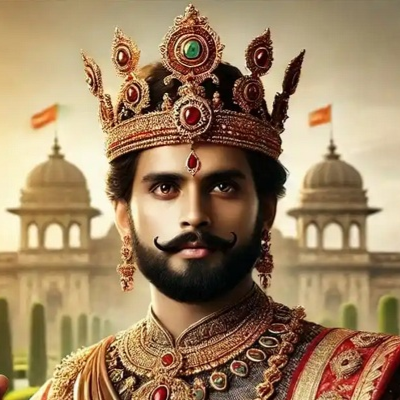
About
Parikshit — Son of Abhimanyu and Uttara, Last King of the Kuru Line, Recipient of the Bhagavata Purana, and Figure of the Cursed Seven Days
Parikshit · Parīkṣit · Abhimanyuputra · Uttarasuta · Vishnu-rakshita · Takshaka-dagdha · Shuka-shishya · Kuru-vamsha-antima · Hastinapura-adhipati · Vishnurata
Parikshit is the son of Abhimanyu — the hero of the Chakravyuha who was killed at sixteen on the thirteenth day of the Kurukshetra war — and of Uttara, the daughter of King Virata of the Matsya kingdom. He is the last king of the Kuru line, the figure whose seven-day preparation for death from a serpent's bite frames the entire recitation of the Bhagavata Purana, and the being whose survival in the womb against Ashvatthama's Brahmastra was secured by Vishnu's direct personal intervention — giving him the epithet Vishnurata, "he who was protected by Vishnu." He was born after his father Abhimanyu's death — a posthumous child — and was the sole male survivor of the Kuru dynasty's main line after the war's catastrophic destruction of the family. The Mahabharata's Ashramavasika Parva records that he was officially crowned king of Hastinapura by Yudhishthira before the five Pandavas departed for the Himalayas on their final journey. His reign is described as just, prosperous, and dharmic — a golden period of Kuru rule — until the serpent Takshaka, sent by the brahmin boy Shringin in fulfilment of a curse, bit him and he died. His death marks the tradition's reckoning of the beginning of the full Kali Yuga's dark period. He appears in the Mahabharata's Adi Parva, Ashvamedha Parva, Ashramavasika Parva, and Svargarohanika Parva, and most prominently in the Bhagavata Purana's first and twelfth books, the Vishnu Purana, the Devi Bhagavata Purana, and the Matsya Purana.
✦ The Names
The name Parikshit derives from the Sanskrit pari — around, all around, completely — and kshit — the earth, the inhabited world, the settled land — or alternatively from pariksha — examination, testing, inquiry — yielding two possible meanings: "the one who rules over all the earth" or "the examined one," "the one who was tested." The Bhagavata Purana gives a third etymology specific to his birth narrative: he was called Parikshit because he was born examining — looking around — for the being who had protected him in the womb, recognising instinctively the divine presence of Vishnu who had saved him from Ashvatthama's Brahmastra. The Puranic tradition generally prefers this birth-narrative etymology — he was looking for the one who had saved him, examining all faces he saw, and this searching examination became his name. The epithet Vishnurata means "he protected by Vishnu" — the most specific encoding of the womb-rescue episode. Abhimanyuputra means "son of Abhimanyu." Takshaka-dagdha means "he who was burned by Takshaka." Shuka-shishya means "student of Shuka." Kuru-vamsha-antima means "the last of the Kuru lineage."
✦ Lineage
- Father: Abhimanyu — son of Arjuna and Subhadra, killed at sixteen on the thirteenth day of the Kurukshetra war in the Chakravyuha. His profile is given separately in this series. Parikshit never knew his father — he was born after Abhimanyu's death and his entire sense of his father was derived from what others told him and from the traditions maintained at Hastinapura.
- Mother: Uttara — the daughter of King Virata of the Matsya kingdom, who bore the Brahmastra's attack in her womb and from whose womb Vishnu rescued Parikshit. After Abhimanyu's death Uttara was the only living connection to the Pandava line's next generation. Her later life — the Ashvamedha Parva and Ashramavasika Parva — records her grief, her widowhood, and her raising of Parikshit in Hastinapura under the Pandavas' protection.
- Paternal grandfather: Arjuna — the greatest archer of the age, the third Pandava.
- Paternal grandmother: Subhadra — sister of Krishna and Balarama.
- Divine protector: Vishnu — who appeared within Uttara's womb as a being of four arms holding the Sudarshana Chakra and other weapons, spinning the Sudarshana Chakra to consume Ashvatthama's Brahmastra and protect the foetus. The Bhagavata Purana's first book narrates this episode in detail — Uttara feeling the burning heat of the Brahmastra within her womb, crying out in terror, and then experiencing the cooling protective divine presence that neutralised the weapon.
- Teacher: Kripacharya — the first teacher of the Kuru princes, the Chiranjivi, who served as Parikshit's acharya and continued the Kuru household's educational tradition into the next generation. The Bhagavata Purana confirms this teaching relationship.
- Teacher during the seven days: Shuka — the son of Vyasa, born of Ghritachi's presence at the arani sticks, the narrator of the Bhagavata Purana. His profile is referenced in the Ghritachi entry in this series. The entire Bhagavata Purana's eighteen thousand verses were recited by Shuka to Parikshit in the seven days between the serpent curse and Parikshit's death.
- Wife: Madravati — the daughter of King Madra in the most widely attested account. The Bhagavata Purana's ninth book confirms their union.
- Son: Janamejaya — profiled separately in this series, the king who performed the great snake sacrifice (Sarpa Satra) to avenge his father's death at Takshaka's bite and at whose court the Mahabharata's outermost recitation frame was set.
✦ The Womb Rescue — Vishnu's Intervention Against the Brahmastra
The most cosmically significant event of Parikshit's biography occurred before his birth. After the night attack on the Pandava camp in the Sauptika Parva, Ashvatthama — cornered by Arjuna and unable to withdraw his Brahmastra — redirected it specifically against Uttara's womb, intending to extinguish the Pandava line at its last surviving root. The Brahmastra entered Uttara's womb as an irresistible burning force. Uttara, terrified, ran to Krishna and the Pandavas for protection — begging for the life of the child within her. Krishna assured her that the Pandava lineage would not be extinguished and personally intervened. The Bhagavata Purana's first book chapter 8 gives the most vivid account: Parikshit as a foetus experienced within the womb a burning heat followed by the appearance of a divine being — Vishnu in his small cosmic form, as large as a thumb, spinning the Sudarshana Chakra and emitting a cooling light that consumed and neutralised the Brahmastra. The foetus turned in all directions seeking the source of this protection — this turning and searching gave him his name Parikshit.
The Bhagavata Purana presents this episode as one of the most direct instances of Vishnu's personal protection of a devotee's dependent — Arjuna's devotion and service to Vishnu-Krishna extended across the boundary of his own body to the body of his unborn grandson. The child who had not yet been born, who had done nothing to earn divine protection, received it because his grandfather had served Vishnu with complete dedication. This principle — that the devotee's family inherits a portion of the devotee's divine grace — is one of the Bhagavata Purana's most central theological propositions, and Parikshit is its most dramatic example.
✦ Birth, Coronation, and the Ashvamedha
Parikshit was born in the immediate aftermath of the Kurukshetra war, after Yudhishthira's coronation at Hastinapura. The Ashvamedha Parva records that Yudhishthira performed the Ashvamedha sacrifice to purify the Kuru dynasty of the war's sins — and that the sacrificial horse was accompanied by Arjuna who fought successfully to protect it across many kingdoms. When Parikshit was born, Yudhishthira performed his birth ceremonies with great joy. The child grew up in Hastinapura under the joint protection of all five Pandavas and of Draupadi — the five uncles and their common wife collectively serving as the family of the posthumous child.
When the Pandavas decided to renounce their kingdom and undertake the final journey to the Himalayas — the Mahaprasthanika Parva — Yudhishthira formally crowned Parikshit king of Hastinapura and appointed him ruler of the entire Kuru kingdom before their departure. Yudhishthira also installed Yuyutsu — the one Kaurava son who had fought on the Pandava side — as Parikshit's adviser and guide. The coronation gave Parikshit both the symbolic and the practical authority over the entire Kuru domain. He was at this point still a child — the specific age is not given with complete consistency across all primary sources — and his reign began under the tutelage of the court's experienced advisers.
✦ The Reign — Justice and the Kali Yuga's Beginning
The Bhagavata Purana's twelfth book and the Mahabharata's concluding sections both record that Parikshit's reign was characterised by justice, prosperity, and dharmic order — a period of good governance that extended the Pandava tradition of righteous kingship into the post-war generation. He is specifically described as a valiant and dharmic king who protected his subjects with the same quality of care that the Pandavas had maintained. One episode specifically associated with his reign is the encounter with Kali — the personification of the Kali Yuga, the dark age — which the Bhagavata Purana narrates in detail. Parikshit was travelling through his kingdom when he found a bull with three broken legs being kicked by a man in ordinary dress. The bull was Dharma — the principle of righteous order — reduced to standing on one leg (truth alone) by the Kali Yuga's onset. The kicking man was Kali itself in disguise. Parikshit confronted Kali and raised his sword to kill him. Kali pleaded for his life and for a place to dwell. Parikshit, rather than destroying Kali — knowing that the Kali Yuga's arrival was cosmically inevitable — assigned him specific places where he could dwell: gambling, women (in the sense of illicit relations), intoxication, the slaughter of animals, and gold. This episode gives Parikshit a cosmic regulatory function — he did not prevent the Kali Yuga but he bounded and contained its most destructive expressions, establishing the specific domains in which the dark age's qualities would be concentrated rather than allowed to pervade all of life.
✦ The Curse of Shringin and the Seven Days
The episode that defines Parikshit's final biography — the curse that condemned him to die within seven days from a serpent's bite — is narrated in the Bhagavata Purana's first book. Parikshit was on a hunting expedition and became extremely thirsty. He came to the ashrama of the sage Shamika, who was deep in meditation and did not respond to the king's request for water. Parikshit — whether from exhaustion, thirst, or momentary anger — took a dead snake lying nearby and placed it around the meditating sage's neck. This act was immediately regretted by Parikshit as he left. Shamika's son Shringin — a young brahmin boy of extraordinary ascetic power but also of extreme irascibility — learned from a companion what the king had done to his father. In his rage he pronounced a curse: within seven days Takshaka the serpent king would bite Parikshit and he would die.
The sage Shamika himself, upon coming out of meditation, regretted his son's precipitate curse — the king's act had been wrong but the curse was disproportionate for a momentary lapse, and a great dharmic king was being condemned by the hot-headed reaction of a young brahmin boy. Shamika sent a messenger to warn Parikshit of the curse's terms so that the king could make whatever preparations he wished. When Parikshit received the warning he made a decision that the tradition presents as one of the most spiritually significant acts of his life — he accepted the curse, recognised it as the appropriate moment for renunciation of the world, gave up his kingdom, and went to the bank of the Ganga to fast until death. He sat on a grass mat on the Ganga's bank and declared that he was prepared to die and wished only to hear about Vishnu-Krishna until the moment of death.
✦ The Seven Days — Shuka's Recitation of the Bhagavata Purana
Sages, rishis, and divine beings gathered on the Ganga's bank to witness the extraordinary spectacle of a great king accepting death with complete equanimity and using his final days for spiritual reception rather than for desperate rescue attempts. Among those who came was Shuka — the son of Vyasa, born of Ghritachi's presence at the arani sticks, the being who had been enlightened from birth and who had never attached himself to any human relationship or institutional role. Parikshit asked Shuka what a man facing death should do and what he should hear. Shuka's answer was the Bhagavata Purana — all eighteen thousand verses, all twelve books, the entire account of Vishnu's avatars, the creation of the cosmos, the genealogies of the kings, the philosophical teachings, the devotional narratives, the stories of the great devotees, the account of Krishna's life and deeds and teachings — recited over seven days to the king sitting on the Ganga's bank waiting to die. The Bhagavata Purana is thus framed by this specific audience — a condemned man fasting until death, whose question about how to face the end received the tradition's most comprehensive answer — and every recitation of the Bhagavata Purana replicates this original seven-day context.
On the seventh day Takshaka came — despite Kashyapa's attempt to intercept him and counteract his venom — and bit Parikshit. The bite killed Parikshit. The Bhagavata Purana records that because Parikshit had spent his final seven days in complete absorption in Vishnu's stories and Shuka's recitation, his death was a liberation rather than a condemnation — the serpent's bite killed the body but the consciousness that met death had been completely saturated with divine awareness and was therefore freed rather than bound. Parikshit's death is thus simultaneously a tragedy — the just king dying from a disproportionate curse — and a liberation — the spiritual preparation transforming the curse's apparent punishment into a vehicle for the ultimate release.
✦ Textual Variants and Inconsistencies
The reason for Parikshit's act toward Shamika: Different manuscript traditions of the Bhagavata Purana vary slightly in the characterisation of Parikshit's mental state when he placed the dead snake on Shamika — some emphasising hunger and thirst without anger, others suggesting a momentary irritation. The tradition consistently presents the act as a lapse rather than a deliberate insult, and Parikshit's immediate regret as genuine.
Whether Kashyapa's attempt to intercede was sincere or compromised: The Bhagavata Purana narrates that the sage Kashyapa was travelling to Parikshit with the knowledge to counteract Takshaka's venom, motivated by the prospect of reward from the king. Takshaka intercepted Kashyapa on the road, demonstrated his venom's power by burning a tree, then revived it, and persuaded Kashyapa to return home by giving him gifts equivalent to what Parikshit would have given. The tradition presents Kashyapa's turning back as the mechanism by which Parikshit's death became inevitable — but the moral status of Kashyapa's willingness to be bought off is left ambiguous.
✦ Theological Significance
Parikshit's theological significance is inseparable from his role as the receiver of the Bhagavata Purana — he is the audience whose specific question generated the tradition's most celebrated and most comprehensive devotional text. The question he asked — "What should a man who is about to die do?" — is simultaneously the most personally urgent question imaginable and the most universally applicable one, since every human being is, in the tradition's philosophical understanding, always in Parikshit's position: always facing death, always needing to know how to prepare. His seven-day preparation — the fasting, the sitting on the Ganga's bank, the complete absorption in divine narratives — is presented as the model for the ideal death: not a desperate clinging to life but a conscious turning of the entire remaining consciousness toward the divine. The Bhagavata Purana's framing thus presents its own recitation as the answer to the question every human being ultimately faces.
✦ References
- Mahabharata, Adi Parva, chapter 57: The genealogical placement of Parikshit in the Kuru dynasty's succession.
- Mahabharata, Ashvamedha Parva: Parikshit's birth ceremonies after the war and his early years.
- Mahabharata, Ashramavasika Parva: Yudhishthira's formal coronation of Parikshit before the Pandavas' final departure.
- Bhagavata Purana, Book 1, chapters 7–8 (womb rescue); chapters 16–19 (the curse, the seven days, Shuka's arrival); Book 2, chapter 1 (Shuka's first teaching to Parikshit): The primary Bhagavata Purana sources for Parikshit's biography — the womb rescue by Vishnu, the entire seven-day frame narrative, and the inauguration of the Bhagavata Purana's recitation.
- Bhagavata Purana, Book 12, chapter 6: Takshaka's bite and Parikshit's death after the seven-day recitation is complete.
- Vishnu Purana, Book 4, chapter 20: Genealogical confirmation of Parikshit as Abhimanyu's son and Janamejaya's father.