
About
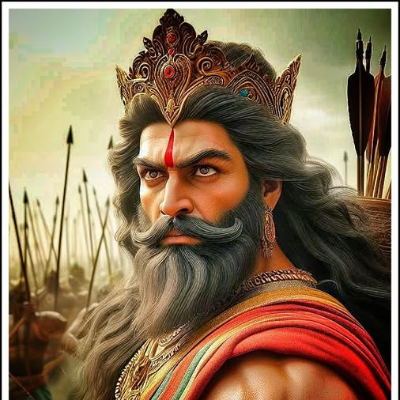
Drupada — King of Southern Panchala, Father of Draupadi and Dhrishtadyumna
Drupada · Yajnasena · Prishatasuta · Panchalaraja · Sovereign of the Somakas
Drupada was the king of the Panchala realm in the generation immediately preceding the Kurukshetra War, the son of King Prishata — himself the youngest of the hundred sons of the Panchala king Somaka — and the father of three figures who played pivotal roles in the war: Dhrishtadyumna, the commander-in-chief of the Pandava forces and the slayer of Drona; Shikhandi, the instrument of Bhishma's fall; and Draupadi, who became the common wife of the five Pandava brothers and one of the most significant female figures in the Mahabharata. His birth name, preserved in the Mahabharata, was Yajnasena. He is known throughout the epic under the name Drupada and by the patronymic Prishatasuta. His capital was Kampilya in Southern Panchala. His narrative — one of the most extensively developed stories in the Adi Parva — centres on his childhood friendship with the brahmin sage Drona, the rupture of that friendship after Drupada's ascension to the throne, his military defeat and humiliation at Drona's hands, his commissioning of a sacrificial yajna of vengeance, and his eventual death at Drona's hands on the fifteenth day of the Kurukshetra War. He appears principally in the Adi Parva, the Udyoga Parva, and the Drona Parva of the Mahabharata.
✦ The Names
The name Drupada is a Sanskrit compound of dru (wood, tree, or firm) and pada (foot or step), conventionally glossed as "firm-footed" or "wooden pillar." The name is attested in this meaning across multiple secondary sources and the spoken Sanskrit dictionary tradition, and it is consistent with the Mahabharata's usage of the name as a personal designation rather than an epithet. The Wikipedia and Hindupedia entries confirm the gloss "firm footed or pillar" as the standard modern interpretation.
The birth name Yajnasena is a compound of yajna (sacrifice) and sena (army or forces), meaning "he whose army is the sacrifice" or "he whose forces are sacrificial in nature." Wikipedia confirms this etymology directly. This birth name is less commonly used in the epic's narrative passages but is preserved in the tradition as his personal name before he became king. The patronymic Prishatasuta — son of Prishata — appears in the Mahabharata as a standard form of address referencing his father's royal identity.
✦ Lineage
- Father: Prishata — king of Panchala, youngest of the hundred sons of Somaka, close friend of the sage Bharadwaja, and the king through whose friendship Drupada was sent to study at Bharadwaja's hermitage where he first met Drona.
- Paternal grandfather: Somaka — king of Panchala, who obtained his hundred sons through a sacrificial ritual in which his only earlier son Jantu was offered as the victim, with Jantu being the eldest of the hundred sons born thereafter and Prishata the youngest.
- Wife: Referred to throughout the Mahabharata by the relational title Prishati — meaning "the daughter-in-law of Prishata" — rather than by a personal name. This title is the consistent form of address for Drupada's chief queen in the primary text. One source (cited in the regional tradition) refers to her as Kokila Devi, but this name does not appear in the canonical Mahabharata text and should be treated as a regional variant without confirmed primary source authority.
- Son (born from the yajna fire): Dhrishtadyumna — the twin of Draupadi, born as an ayonija (not born from a woman's womb) from the sacrificial fire of the Putrakameshti yajna Drupada commissioned for vengeance against Drona. He emerged fully grown and armed, destined by divine prophecy to slay Drona, and served as the commander-in-chief of the Pandava forces throughout the Kurukshetra War.
- Son (born earlier, before the yajna): Shikhandi — born female as Shikhandini after Drupada's prayer to Shiva for a child who would bring about Bhishma's death. On Shiva's direction, Drupada raised Shikhandini as a male. After a complex episode involving a Yaksha's exchange of gender, Shikhandini became the male Shikhandi and served as the instrument of Bhishma's fall on the tenth day of the Kurukshetra War.
- Son: Satyajit — named in the Mahabharata as a son of Drupada of significant warrior standing; rated by Bhishma in the Udyoga Parva as the equal of eight rathas and comparable to Dhrishtadyumna himself. He was slain by Drona on the twelfth day of the war.
- Sons: Yudhamanyu and Uttamaujas — two Panchala princes identified in multiple sources as sons of Drupada, both rated among the Maharathis of the Pandava army and specifically named in the Bhagavad Gita's opening verses among the distinguished warriors. During the Kurukshetra War they served as the dedicated protectors of Arjuna's chariot on the left and right flanks respectively.
- Sons (Critical Edition): The Critical Edition of the Mahabharata names a total of eleven sons for Drupada beyond Dhrishtadyumna — Satyajit, Shikhandi, Uttamaujas, Yudhamanyu, Kumar, Vrika, Panchalya, Suratha, Shatrunjaya, and Janamejaya. The names Priyadarsana and Vasudana, cited in some secondary retellings, do not appear in this primary enumeration and are not included here.
- Daughter: Draupadi — also called Krishna (on account of her dark complexion), Panchali (daughter of Panchala), Yajnaseni (born of the yajna), and Parshati (granddaughter of Prishata). Born together with Dhrishtadyumna from the sacrificial fire, she became the common wife of the five Pandava sons of Pandu: Yudhishthira, Bhima, Arjuna, Nakula, and Sahadeva. She is one of the central figures of the Mahabharata. Krishnaa listed separately as a daughter in some secondary summaries is not a separate individual but an alternate name for Draupadi herself.
✦ The Childhood Friendship and Its Rupture
The Adi Parva (Sambhava Parva, Sections 130–131 in the Ganguli edition) narrates that Drupada, as the son of the reigning king Prishata, was sent to study at the hermitage of the sage Bharadwaja — a brahmin teacher of great learning and the father of Drona. Drupada and Drona grew up together at Bharadwaja's ashrama, studying the Vedas and the martial arts side by side. The two boys formed a close friendship, and Drupada at some point promised Drona that when he became king he would share half his kingdom and all his wealth with his friend.
After Prishata's death Drupada ascended the throne. Drona, meanwhile, had descended into poverty severe enough that he could not provide milk for his young son Ashvatthama. He approached the court of Panchala to call upon their childhood bond and seek relief. Drupada's response, narrated in the Adi Parva, is one of the most philosophically constructed acts of cruelty in the epic: he lectured Drona that friendship can only exist between social equals, that kings cannot maintain the same bonds with impoverished brahmins that may have existed between children, and that whatever promise he may have made in youth carried no weight in the present. He dismissed Drona from his court, publicly shaming him. The Mahabharata records a portion of Drupada's speech to Drona in the text at Adi Parva Section 131, establishing this rejection as the initiating act of one of the epic's defining feuds.
✦ The Defeat and Division of Panchala
Drona subsequently became the preceptor of the Kuru princes — both the Pandavas and the Kauravas — at Hastinapura, under the arrangement of the Kuru patriarch Bhishma. Upon the conclusion of the princes' education, Drona demanded as his gurudakshina (teacher's fee) the capture of Drupada. The Kauravas attempted first and failed; Drupada's army repelled their attack. The Pandavas, led by Arjuna, then attacked Panchala. The Mahabharata narrates (Adi Parva, Sambhava Parva, Section 138) that Arjuna defeated Drupada in battle, bound him in ropes, and brought him before Drona.
Drona took precisely half of Drupada's kingdom — the northern portion, with its capital at Ahichhatra — and returned the remaining southern half to Drupada with Kampilya as its capital. He did so with a cutting remark: that kings can only be friends with kings, and since they were now equal rulers of equal halves, Drupada might consider him a friend. This second humiliation — mirroring in structure the philosophical argument Drupada himself had used to reject Drona — deepened Drupada's rage immeasurably. He retired to Kampilya consumed by a desire for vengeance that ordinary military means could not satisfy, since he recognised that he could not match Drona's martial power directly.
✦ The Putrakameshti Yajna
Drupada understood that defeating Drona required a brahmin-born warrior of supernatural power — a champion who could counter celestial weapons with celestial weapons. He set out to find brahmin sacrificial experts capable of performing a yajna that would produce such a son. The Adi Parva (Chaitraratha Parva, Sections 166–167) narrates his search and his eventual engagement of two extraordinary brahmin ritualists: Upayaja, whose personal austerities were of the highest order, and his elder brother Yaja, whom Upayaja directed Drupada to approach after some persuasion. It was Yaja who finally agreed to conduct the sacrifice, with Upayaja assisting. Their combined ritual expertise made them capable of generating results that ordinary priests could not.
At the conclusion of the yajna, the priests called upon Drupada's queen — addressed in the text as Prishati — to consume the sacrificial oblation so that she would bear the desired son. She declined, stating she was unprepared in her current state. The priests then poured the oblation directly into the fire. From the fire emerged Dhrishtadyumna — fully grown, armed with bow and wearing armour and a crown — and then Draupadi. A disembodied voice announced at Dhrishtadyumna's birth that he had come into the world specifically to slay Drona, and at Draupadi's birth that she would be the cause of the destruction of the Kshatriyas. Both children are therefore described in the text as ayonija — not born from a woman's womb.
✦ The Swayamvara of Draupadi and the Pandava Alliance
Drupada arranged a swayamvara for Draupadi, the contest for which was the stringing of an exceptionally powerful bow and the shooting of five arrows through a revolving ring to strike a target in the form of a fish's eye. The Mahabharata narrates that the Pandavas — who were at this time believed by the world to have perished in the fire at Varanavata — attended the swayamvara disguised as brahmins. Arjuna succeeded in the contest and won Draupadi's hand. Dhrishtadyumna had shadowed the disguised Pandavas during the event and, through his observation, recognised them for who they were. He reported this to Drupada.
When the Pandavas revealed themselves, Drupada was overjoyed: he had long desired an alliance with the Pandavas, understanding that such a union would give him powerful sons-in-law capable of helping him recover his lost northern kingdom and ultimately challenge Drona. The marriage of Draupadi to all five Pandavas — initially controversial and requiring the sanction of the sage Vyasa — cemented the Panchala-Pandava alliance that would define the political configuration of the Pandava side in the Kurukshetra War.
✦ Role in the Kurukshetra War
When the Kurukshetra War broke out between the Pandavas and the Kauravas under Duryodhana, Drupada brought one akshauhini division of troops to fight on the Pandava side. In the Udyoga Parva's enumeration of warriors (Rathatiratha-sankhyana Parva, Section 171), Bhishma — while cataloguing the Pandava army's command structure for Duryodhana — rated Drupada explicitly as a Maharathi, a classification denoting a warrior of the highest tier of skill and capability, and noted his deep knowledge of ancient military formations.
Drupada participated actively across multiple days of the war. On the eleventh day he killed Shakuni's relatives Keturaja and Ketusena of Kosala. He engaged in combat on several other days, fighting Jayadratha on the first day and suffering defeat and unconsciousness at the hands of Vrishasena on the night of the fourteenth day before being taken from the field. He fought until the fifteenth day.
✦ Death at the Hands of Drona
The Drona Parva (Chapter 186, as cited in the Puranic Encyclopaedia) narrates the circumstances of Drupada's death on the fifteenth day of the war. Drona, now the supreme commander of the Kaurava forces following Bhishma's incapacitation, was fighting with devastating effect, cutting through the Pandava ranks with celestial weapons. Drupada and King Virata of Matsya — both senior kings and Pandava allies — launched a combined chariot assault against Drona in an attempt to halt his advance. The Wisdomlib summary of the Drona Parva records the encounter in detail: Drona cut off the bows of both kings, Virata hurled ten lances and Drupada released a powerful dart, and Drona countered all of these before piercing both kings through the chest with broad-headed arrows, killing them.
Witnessing his father's death, Dhrishtadyumna was consumed with grief and rage and renewed his vow to kill Drona. The same day, through the stratagem devised by Krishna — the false report of Ashvatthama's death causing Drona to lay down his arms in despair — Dhrishtadyumna killed Drona, fulfilling the purpose for which he had been born from the sacrificial fire. The circle of vengeance that had begun with Drupada's rejection of Drona at the Panchala court was thus completed on the fifteenth day of the war, with both the originator of the feud and its appointed avenger present in the final sequence.
✦ Textual Variants
A variant genealogical tradition is noted in the Wikiwand article on Drupada: certain Puranic scriptures present a contradictory account in which Drupada is the direct son of Somaka, with Prishata placed several generations earlier as Somaka's great-grandfather rather than father. This reading is inconsistent with the Vishnu Purana, the Bhagavata Purana, and the Mahabharata's own consistent identification of Drupada as son of Prishata, and is not adopted in this lineage-tree system. It is recorded here as a genuine textual variant in the Puranic record.
The number and names of Drupada's sons also vary across versions of the Mahabharata. The Critical Edition names eleven sons in addition to Dhrishtadyumna; popular retellings and regional traditions supply additional names. Only those names attested in the Critical Edition or in clearly identified primary passages are used in this profile.
✦ Theological and Narrative Significance
Drupada's narrative functions in the Mahabharata as one of the most fully realised illustrations of how personal pride and the abuse of power generate karmic consequences that outlast the individual's own life. His rejection of Drona — philosophically argued, publicly delivered, and politically calculated — set in motion a chain of events whose final consequences fell not only on himself but on his children, his kingdom, his army, and ultimately on the generation of the Kurukshetra War as a whole. The yajna he commissioned as an act of personal vengeance produced not merely a champion against Drona but also Draupadi, whose marriage to the Pandavas drew the entire subcontinent into the conflict. In this sense Drupada's act of vengeance became one of the structural causes of the war.
His death at Drona's hands on the same day his son fulfilled the prophecy and killed Drona gives the narrative a concentrated tragic symmetry: the instigator of the feud and its appointed resolver are both present at its conclusion, and neither survives beyond that day. The Mahabharata preserves a detail, cited in several summaries, that after killing Drupada, Drona honoured his body — an act reflecting the complexity of their relationship as former companions whose enmity was in origin a matter of wounded friendship rather than innate hostility.
✦ Connection to the Wider Genealogy
Drupada stands at the generational node in the Panchala dynastic line at which the dynasty's ancient royal heritage — running from Ajamidha through Mudgala, Divodasa, Sudas, Sahadeva, Somaka, and Prishata — connects directly to the Mahabharata's central narrative. Through his daughter Draupadi's marriage to the five Pandavas, he became the father-in-law of the principal heroes of the epic and through them is connected to the entire Kuru dynastic tree. Through Dhrishtadyumna he is the grandfather of Kshatradharman, Kshatranjaya, and other sons named in the tradition. Through Shikhandi he is connected to the episode of Amba's rebirth and to Bhishma's fall, one of the pivotal events of the war. The Drona-Drupada feud, originating in his father Prishata's friendship with Bharadwaja and the consequent childhood companionship of Drupada and Drona, is the single event most directly responsible for the chain of circumstances leading to the birth of Draupadi — and thereby to the political and military configuration of the Kurukshetra War.
✦ References
Primary Sources
- Mahabharata, Adi Parva, Sambhava Parva, Sections 130–131 (Ganguli edition): Narrates Drona's arrival at the Panchala court, Drupada's philosophical rejection and public humiliation of him, and establishes the feud that drives the remainder of both their narratives.
- Mahabharata, Adi Parva, Sambhava Parva, Section 138: Narrates the defeat of Drupada by Arjuna as gurudakshina, the binding of Drupada, his presentation to Drona, and the division of the Panchala kingdom into northern (Ahichhatra, given to Drona) and southern (Kampilya, returned to Drupada) halves.
- Mahabharata, Adi Parva, Chaitraratha Parva, Sections 166–167: Narrates Drupada's search for ritual specialists, his engagement of Yaja and Upayaja, the conduct of the Putrakameshti yajna, and the births of Dhrishtadyumna and Draupadi from the sacrificial fire.
- Mahabharata, Udyoga Parva, Rathatiratha-sankhyana Parva, Section 171: Bhishma's enumeration of the commanders on both sides; names Drupada as a Maharathi and notes his knowledge of military formations.
- Mahabharata, Drona Parva, Chapter 186, Verse 33 (Puranic Encyclopaedia citation): Narrates Drona's killing of Drupada and Virata on the fifteenth day of the war in their combined chariot assault.
- Bhagavad Gita, Chapter 1, Verse 6 (Srimad Bhagavatam, Mahabharata, Bhishma Parva): Names Yudhamanyu and Uttamaujas among the distinguished Maharathis of the Pandava army in the opening enumeration of warriors before the war.
Secondary and Reference Sources
- Mani, Vettam. Puranic Encyclopaedia. Motilal Banarsidass, 1975: Provides a comprehensive entry on Drupada covering his principal narrative episodes, his sons, and the specific chapter and verse references for his death in the Drona Parva.
- Wikipedia, "Drupada": Confirms the name etymologies, the Critical Edition enumeration of eleven sons, Drupada's Maharathi classification, his death on the fifteenth day alongside Virata, and the variant Puranic genealogy placing him as son of Somaka.
- Wisdomlib.org, Mahabharata summary, Drona Parva, Chapter on Dronavadha: Provides the narrative detail of the encounter between Drupada, Virata, and Drona on the fifteenth day including the weapons used and the manner of death.
- Vyasaonline.com, "Drupada": Provides a consolidated summary of Drupada's major narrative appearances across the Adi Parva and Drona Parva drawn from primary text references.
- Bharatpedia, "Drupada": Confirms the Bharatpedia entry on Drupada including his killing of Keturaja and Ketusena on the eleventh day, citing the Ganguli translation of the Mahabharata.
- Sacred-texts.com, Mahabharata Adi Parva, Sections 130–131 and 138 (Ganguli translation): The canonical English translation of the Drona-rejection and Panchala-division episodes, used for factual verification of episode details.