
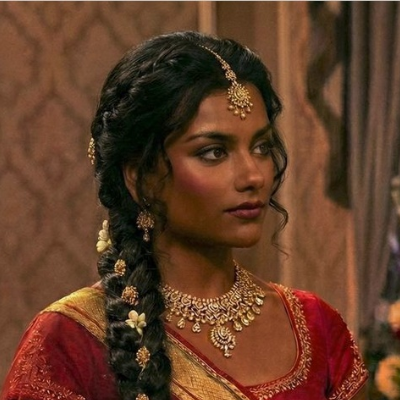
About
Prishati — Chief Queen of King Drupada of Panchala
Prishati · Parsati
Prishati is the chief queen consort of King Drupada — also known as Yajnasena — the king of the southern Panchala kingdom, son of King Prishata, and a central figure in the Mahabharata. Her name is a relational designation derived from the name of her father-in-law: Prishati in this usage means the daughter-in-law of Prishata. She is the mother of Shikhandini — who later became the male warrior Shikhandi — and through a singular episode connected to Drupada's fire sacrifice, she became the formally recognised mother of the fire-born twins Dhrishtadyumna and Draupadi. Through Draupadi, who became the shared wife of the five Pandavas, Prishati stands as a matrilineal link between the Panchala royal house and the Pandava lineage. Her story is told primarily in the Adi Parva and the Udyoga Parva of the Mahabharata.
✦ The Name
The name Prishati is not a birth name but a relational title derived from Prishata, the name of Drupada's father and the preceding king of Panchala. Prishata itself derives from the Sanskrit root meaning spotted, dappled, or sprinkled — associated in older Vedic usage with the dappled deer. As a queen-designation, Prishati thus identifies Drupada's chief wife by her position within the Panchala royal family rather than by her personal birth-name. The same root also gives rise to the name Parshati — meaning the granddaughter of Prishata — which is applied to Draupadi, the fire-born daughter raised by Prishati, connecting Prishati and her daughter through a shared derivation from the same ancestral name. The Mahabharata at Adi Parva 1.129.41 states explicitly that Draupadi received the name Parshati from Prishata's lineage.
✦ Lineage
- Husband: Drupada, also known as Yajnasena, king of southern Panchala, son of Prishata the king of Panchala, former student of the sage Bharadvaja where he studied alongside Drona the son of Bharadvaja; the central Panchala figure of the Mahabharata, whose enmity with Drona over a betrayed promise of friendship drives the events leading to the great sacrifice and the birth of Dhrishtadyumna.
- Child — Shikhandini / Shikhandi: Prishati's first child, born female as Shikhandini as a result of the boon Shiva granted to Drupada; raised from birth as a male under royal edict; later exchanged her female nature with the yaksha Sthunakarna and became permanently male as Shikhandi; fought on the Pandava side at Kurukshetra and was instrumental in the fall of Bhishma; had a son named Kshatradeva.
- Child — Dhrishtadyumna: fire-born son who emerged from the sacrificial altar at Drupada's yajna fully formed and armed; accepted by Prishati as her son; appointed supreme commander of the Pandava forces at Kurukshetra and fulfilled his destined purpose by slaying Drona on the fifteenth day of battle; had sons Kshatradharman, Kshatravarman, Kshatranjaya, and Dhrishtaketu.
- Child — Draupadi (also known as Krishnaa): fire-born daughter who emerged from the same sacrificial altar as Dhrishtadyumna; accepted by Prishati as her daughter; became the shared wife of the five Pandava brothers — Yudhishthira, Bhima, Arjuna, Nakula, and Sahadeva — and bore one son by each; known by many epithets including Panchali, Yajnaseni, Parshati, and Krishnaa.
- Other sons: Drupada had further sons including Satyajit, Uttamaujas, and Yudhamanyu; the Mahabharata records that Drupada had nine sons in addition to Dhrishtadyumna and Shikhandi, though not all are consistently attributed to Prishati specifically in the primary text.
✦ Shikhandini and the Boon of Shiva
The Udyoga Parva of the Mahabharata records that Drupada remained childless for a prolonged period and undertook severe austerities to propitiate Shiva. Shiva granted him a boon: a child would be born to him who would begin life as a female but in due course become male. Prishati accordingly gave birth to a daughter, Shikhandini. Under Drupada's instruction — and with Prishati's cooperation in concealing the truth — the child was raised entirely as a prince, educated in weapons and statecraft, and eventually given in marriage to the daughter of Hiranyavarman, the king of Dasharna. When Shikhandi's wife discovered that her husband was not male, Hiranyavarman prepared for war against Drupada. In distress, Shikhandini fled into the forest where she encountered the yaksha Sthunakarna and exchanged her female nature for his male form, thereafter becoming fully and permanently male as Shikhandi. It was in this male form that Shikhandi went on to fulfil the cosmic purpose of his birth — standing before Bhishma on the Kurukshetra battlefield, causing the great patriarch to lower his bow, as Bhishma would not fight one born female.
✦ The Yajna and the Fire-Born Children
The birth of Dhrishtadyumna and Draupadi is narrated in the Adi Parva of the Mahabharata. After the humiliation of Drupada by Drona — who had his former friend stripped of half his kingdom as the fee paid to him by his students the Pandavas for military instruction — Drupada sought a son capable of killing Drona in battle. Unable to obtain such a child by conventional means, he approached the sage brothers Yaja and Upayaja and, after a year of devoted service to them, persuaded them to perform a great fire sacrifice on his behalf. The sages Yaja and Upayaja conducted the yajna. At its conclusion, the priests directed Prishati to consume the sacrificial offering so that the child might be born through her — the conventional means by which a queen participates in a putrakameshti yajna. However, Prishati had saffron paste in her mouth and asked the sages to wait until she had washed. Unable or unwilling to delay, Yaja poured the offering directly into the sacrificial fire. From the altar emerged Dhrishtadyumna, a fully grown and armed young man, accompanied by a divine voice declaring that he was born to slay Drona; and then Draupadi, described as a radiant woman of extraordinary beauty with dark skin and the fragrance of blue lotuses. The Puranic Encyclopaedia, citing Mahabharata Adi Parva Chapter 166, records that Prishati then approached the officiating priest and requested that the two children born of the fire should recognise her as their mother. Her request was granted and the children accepted Drupada and Prishati as their parents; they were raised in the Panchala palace as royal children.
✦ Textual Variants and Inconsistencies
The primary genealogical texts present a minor inconsistency regarding Drupada's own lineage which indirectly bears on Prishati's dynastic position. The Mahabharata identifies Drupada as the son of Prishata, who is treated as an independent Panchala king. The Bhagavata Purana (9.22.1) and the Wisdomlib Puranic Encyclopaedia record that Prishata was the youngest son of Somaka, making Drupada Somaka's great-great-grandson; other Puranic texts treat Somaka as a much more distant ancestor. This variant in Drupada's genealogy does not affect Prishati's own position as his chief queen but determines how far back the Panchala dynastic line is traced. No variant texts give Prishati a personal birth-name distinct from her relational title, and no primary source identifies her natal family or kingdom.
✦ Connection to the Wider Genealogy
Prishati's household is central to the events of the Mahabharata war. Through her natural-born child Shikhandini — who became Shikhandi — she is the mother of the figure whose presence caused the fall of Bhishma, the most formidable warrior of the Kaurava side and the patriarch of the Kuru dynasty. Through the fire-born Dhrishtadyumna, whom she adopted as her son, she became the nominal mother of the supreme commander of the Pandava forces, who slew Drona. Through the fire-born Draupadi, raised as her daughter, she became the mother-in-law of the five Pandava brothers — Yudhishthira, eldest son of Dharma; Bhima, son of Vayu; Arjuna, son of Indra; and the twin sons of the Ashvins, Nakula and Sahadeva — making her a maternal figure to the entire Pandava alliance. Draupadi's five sons, the Draupadeyas — Prativindhya, Sutasoma, Shrutakarma, Shatanika, and Shrutasena — are Prishati's grandchildren by adoption through this line.
✦ References
- Mahabharata, Adi Parva, Chapter 166 (Ganguli numbering; also cited as Chapter 169 in some editions): Primary source. Narrates the yajna of Drupada, the birth of Dhrishtadyumna and Draupadi from the sacrificial fire, the episode of Prishati's refusal to consume the offering due to saffron in her mouth, and her subsequent request to be recognised as the children's mother.
- Mahabharata, Adi Parva, Chapter 129, verse 41: Primary source. Records that Draupadi received the name Parshati from Prishata's lineage, establishing the etymological connection between Prishati and her adopted daughter's epithet.
- Mahabharata, Udyoga Parva, Ambaopakhyana episode: Primary source. Narrates Drupada's childlessness, his austerities to propitiate Shiva, the boon granting a female-born child who would become male, and the birth and raising of Shikhandini, with Prishati's role in maintaining the deception of her child's assigned male identity.
- Bhagavata Purana, Skandha 9, Chapter 22, verse 1: Primary source. Places Prishata as the youngest son of Somaka, providing the Puranic genealogy of Drupada's paternal line.
- Wisdomlib — Story of Dhrishtadyumna (Puranic Encyclopaedia): Modern secondary resource. Cites Mahabharata Adi Parva Chapter 166 for the episode of Prishati's request and the children's acceptance of her as mother; confirms the sequence of events at the yajna.
- Wikipedia — Drupada, Prishati, Draupadi, and Shikhandi articles: Modern secondary resources. Confirm the primary attestation of Prishati as chief queen, the relational meaning of her name, the episodes of Shikhandini's birth and the yajna, and the etymological relationship between Prishati and Parshati.
- Isvara.org — Draupadi (Vedic Library): Modern secondary resource. Documents Draupadi's multiple names and epithets including Parshati, with reference to the relationship between Prishata, Prishati, and Parshati as a family of derived names.