
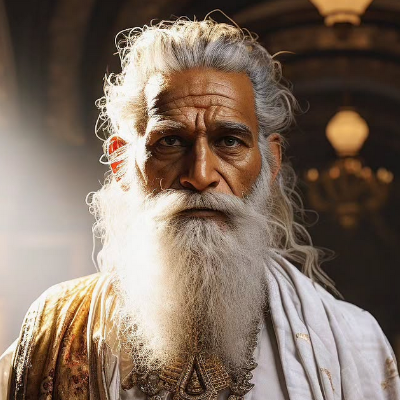
About
Prishata — King of Panchala and Father of Drupada
Prishata · Prishat · Prishata of Panchala · Prsata
Prishata was a king of the Panchala realm in ancient northern India, most prominently known as the father of King Drupada and as the paternal grandfather of three figures central to the Kurukshetra War: Dhrishtadyumna, Shikhandi, and Draupadi. He belongs to the Somaka lineage within the broader Puru-Bharata dynastic stream and is principally attested in the Mahabharata, especially its Adi Parva, and in the genealogical chapters of several major Puranas including the Vishnu Purana, the Bhagavata Purana, and the Agni Purana. His narrative importance in the Mahabharata is largely indirect: it is through his friendship with the sage Bharadwaja and through the throne he bequeathed to Drupada that the chain of events culminating in the Drona-Drupada feud, the yajna-birth of Dhrishtadyumna and Draupadi, and the Pandava alliance with Panchala are all set in motion.
✦ The Name
The name Prishata is a Sanskrit masculine noun. In common usage across the Puranas and the epic, it functions purely as a proper name without a separate epithet tradition attached to it. The name does, however, generate significant derivative terminology in the Mahabharata: his daughter-in-law, Drupada's chief queen, is addressed throughout the epic as Prishati, a feminine form meaning "the daughter-in-law of Prishata," and the patronymic Parshata or Parshati, applied to Prishata's grandchildren Dhrishtadyumna and Draupadi, derives from the same root and carries the sense of "descendant of Prishata." The frequency with which Dhrishtadyumna is addressed as Parshata or "son of Prishata" in the war books of the Mahabharata demonstrates that Prishata's name was considered prestigious enough to serve as a dynastic marker across two generations.
✦ Lineage
- Father (Vishnu Purana and Bhagavata Purana account): Somaka — a king of Panchala, son of Saudasa (also called Sahadeva), who is described in the Vana Parva of the Mahabharata as performing a great sacrifice on the banks of the Yamuna. Both the Vishnu Purana (Book IV, Chapter XIX) and the Bhagavata Purana (Skandha IX, Chapter 22) state that Somaka fathered one hundred sons, of whom Jantu was the eldest and Prishata the youngest, making Somaka the direct father of Prishata in this account.
- Father (Agni Purana account): Jantu — in the Agni Purana (Chapter 278), the genealogical line is presented as a single unbroken sequence: Somaka — Jantu — Prishata — Drupada. In this version Jantu, who is the eldest son of Somaka in the Vishnu and Bhagavata Purana accounts, is instead placed as Prishata's immediate father, making Somaka Prishata's paternal grandfather rather than his father. This is the principal genealogical inconsistency regarding Prishata across the primary sources.
- Son: Drupada (also known by his birth name Yajnasena) — king of Panchala, childhood companion of Drona at Bharadwaja's hermitage, and father of Dhrishtadyumna, Draupadi, Shikhandi, and several other sons. Drupada is the central figure of the Panchala strand of the Mahabharata narrative.
- Daughter-in-law: Prishati — the chief queen of Drupada, addressed in the Mahabharata by this relational name rather than a personal name. She is the mother who was instructed by the sacrificial priests Yaja and Upayaja to consume the sacred oblation at the conclusion of Drupada's vengeance-yajna, and who declined on grounds of ritual uncleanliness, after which the priests poured the offering into the fire, producing Dhrishtadyumna and Draupadi without her physical participation.
- Grandson: Dhrishtadyumna — born from Drupada's fire-sacrifice, destined by divine prophecy to slay Drona, and addressed throughout the war books of the Mahabharata by the patronymic Parshata, meaning "descendant of Prishata."
- Grandson: Shikhandi — born female as Shikhandini but later transformed into a male, who served as the proximate cause of Bhishma's fall on the tenth day of the Kurukshetra War.
- Granddaughter: Draupadi (also called Krishna, Panchali, Yajnaseni, and Parshati) — born together with Dhrishtadyumna from the sacrificial fire, she became the common wife of the five Pandava brothers and is one of the central figures of the Mahabharata. The epithet Parshati, meaning "granddaughter of Prishata," is one of her recognised names in the epic.
✦ Textual Variants in the Genealogy
Two distinct genealogical traditions concerning Prishata's parentage appear across the primary sources, and they must be stated separately.
The Vishnu Purana (Book IV, Chapter XIX) and the Bhagavata Purana (Skandha IX, Chapter 22) are in agreement that Somaka fathered one hundred sons, of whom Jantu was the eldest and Prishata the youngest. In this account, Prishata is the direct son of Somaka. The line in both texts runs: Divodasa — Mitreyu — (Chyavana) — Sudasa — Saudasa (Sahadeva) — Somaka — Jantu (eldest) ... Prishata (youngest) — Drupada — Dhrishtadyumna.
The Agni Purana (Chapter 278), however, presents a single unbroken line in which Jantu is not a brother of Prishata but his father: Somaka — Jantu — Prishata — Drupada — Dhrishtadyumna. In this version, Prishata is a grandson of Somaka through Jantu. The Wisdomlib reference corpus notes this variant explicitly.
A third complication arises from the Mahabharata itself, which is internally consistent in identifying Drupada as the son of Prishata but which some Puranas interpret differently at the macro-dynastic level. The Wikipedia article on Drupada notes that certain Puranic passages treat Drupada as the son of Somaka directly and place Prishata several generations earlier as Somaka's great-grandfather rather than father, though this reading is at odds with the Vishnu Purana and Bhagavata Purana passages cited above. The Mahabharata itself does not engage in this dispute; it refers to Drupada consistently as "the son of Prishata" and to Dhrishtadyumna as "Prishata's son" without elaborating on Prishata's own parentage in detail.
✦ The Friendship with Bharadwaja
The most consequential act attributed to Prishata in the Mahabharata is not a military campaign or a political manoeuvre but a personal friendship. The Adi Parva records that Prishata, king of Panchala, maintained a close friendship with the great sage Bharadwaja, who was himself a celebrated Vedic teacher and the father of Drona. The two men — one a ruling king, the other a Brahmin sage of great learning — are described as being companions of equivalent standing in their respective domains. Because of this bond, the young Drupada was permitted to attend Bharadwaja's hermitage regularly. Prishata's son thus grew up in the same educational environment as Drona, studying and playing alongside the sage's son from boyhood. The Adi Parva specifies that Drupada went daily to Bharadwaja's ashrama to play and learn in Drona's company.
This arrangement, made possible entirely by Prishata's relationship with Bharadwaja, is the foundational cause of the Drona-Drupada enmity that drives much of the middle section of the Mahabharata. The friendship Drupada formed with Drona during those shared years at Bharadwaja's hermitage, the promises the two boys exchanged, and the catastrophic rupture of those promises after Drupada inherited his father's throne — all of these trace back directly to Prishata's decision to place his son under Bharadwaja's tutelage.
✦ The Succession and Its Consequences
The Adi Parva of the Mahabharata states plainly that after Prishata's death, Drupada succeeded him on the throne of Panchala. The text does not describe the circumstances of Prishata's death beyond indicating that it was a natural end to his reign. It is after this succession that the breach between Drona and Drupada occurs: Drona, living in poverty, approached the newly crowned king as a friend and equal, only to be contemptuously rebuffed. Drupada's dismissal of Drona on the grounds that kings cannot maintain friendship with the poor and lowly set in motion the entire sequence of events — Drona's enrollment as teacher to the Kuru princes, the demand for Drupada as his teacher's fee, the military defeat and capture of Drupada by Arjuna, the division of the Panchala kingdom, and ultimately Drupada's commissioning of the vengeance-yajna from which Dhrishtadyumna and Draupadi were born.
The Harivamsha, as noted in the footnotes to the Vishnu Purana (Wilson translation), preserves an additional detail: that during the reign of Prishata or near its end, the aggressor king Ugrayudha was destroyed by Bhishma, and that following this event Prishata recovered possession of the city of Kampilya. This passage, if authentic, would indicate that Prishata's reign was not entirely uneventful and that the Panchala capital had at some point been lost and then regained. However, this detail is transmitted through the commentary apparatus of the Vishnu Purana rather than through a primary passage of the Mahabharata itself, and its weight should be taken accordingly.
✦ A Note on the Drupada Birth Story Attributed to Prishata
Some secondary sources and popular retellings attribute to Prishata an episode in which he, while performing austerities, involuntarily experienced an emission upon glimpsing a celestial apsara, and that this circumstance gave rise to the birth and name of Drupada — the name being explained as meaning "firm-footed" because the king moved his feet rapidly to contain the fluid. This story is structurally very close to the well-attested Mahabharata narrative of Drona's own birth, in which the sage Bharadwaja experienced a similar emission upon beholding the apsara Ghritachi and preserved it in a pot (drona), thereby giving birth to Drona. The Adi Parva's account of Drona's birth is found in the canonical text of the Sacred Texts edition of the Mahabharata. No equivalent passage specifically describing Prishata undergoing such an episode for the birth of Drupada has been traced to a named chapter and verse of a recognized primary source in the course of preparing this profile. The name Drupada is consistently glossed in primary and secondary sources as meaning "firm-footed" or "pillar," but the Mahabharata itself does not attach an origin story of this type to that name when referring to Drupada. Users should treat the popular attribution of this birth episode to Prishata with caution until a precise primary source reference is established.
✦ Connection to the Wider Genealogy
Prishata occupies a critical position in the dynastic chain of the Panchala line. Tracing upward from the ancient progenitor Puru through the Bharata lineage, the sequence in the Vishnu Purana runs through Ajamidha, then through a branch involving Nila, Shanti, Sushanti, Puruja, Arka, Bharmyashva, and Mudgala, before reaching Divodasa, Mitreyu, Sudasa, Saudasa (also called Sahadeva), and Somaka. Prishata is placed as the youngest among Somaka's one hundred sons, making him a sixth- or seventh-generation descendant of Ajamidha depending on the source followed. Downward from Prishata, the line continues through his son Drupada, then to Drupada's son Dhrishtadyumna, then to Dhrishtaketu, who is the last named ruler in this Panchala sequence in the Puranas.
Through the marriage of Draupadi, Drupada's daughter and Prishata's granddaughter, to the five Pandava brothers, Prishata's lineage became directly intertwined with the ruling house of Hastinapura. The patronymic Parshata, applied to Dhrishtadyumna throughout the Mahabharata war books, and the epithet Parshati applied to Draupadi, both reflect the continued prominence of Prishata's name as a dynastic marker even after his death and the division of his kingdom.
✦ References
Primary Sources
- Mahabharata, Adi Parva, Chaitraratha Parva (Section CXXX / Chapter 129–132): The primary epic source for Prishata's role as king of Panchala, his friendship with Bharadwaja, the daily visits of his son Drupada to Bharadwaja's hermitage, and the succession of Drupada to the throne after Prishata's natural death. Also the source for the description of Drupada's queen as "daughter-in-law of Prishata" (Prishati). Accessible through the Sacred Texts Archive edition (Kisari Mohan Ganguli translation).
- Vishnu Purana, Book IV, Chapter XIX: Provides the Puranic genealogical table of the Panchala line placing Prishata as the youngest of Somaka's one hundred sons, with Jantu the eldest. Also contains the Harivamsha-sourced footnote regarding Prishata recovering possession of Kampilya after Ugrayudha's destruction by Bhishma.
- Bhagavata Purana, Skandha IX, Chapter 22: Corroborates the Vishnu Purana account, placing Prishata as the youngest son of Somaka and the father of Drupada in the Panchala dynastic sequence.
- Agni Purana, Chapter 278 (Description of the lineage of Puru): Presents the divergent genealogy in which Jantu is the father of Prishata rather than his eldest brother, making Prishata the grandson of Somaka through Jantu.
- Mahabharata, Vana Parva, Chapters 127–128: Contains material relating to the Somaka dynasty and records the tradition of King Somaka on the Yamuna, relevant to establishing Prishata's ancestral background.
Secondary and Reference Sources
- Wisdomlib.org, "Prishata: Significance and symbolism": Aggregates primary source excerpts relating to Prishata across Puranic and epic literature, noting the identification of Prishata as son of Jantu and his role as the king befriending Bharadwaja.
- Wisdomlib.org, "Drupada: 15 definitions": Provides the extended genealogy from the Bhagavata Purana and cross-references to the Mahabharata Adi Parva Chapter 129 for the succession narrative.
- Wisdomlib.org, "Somaka": Clarifies the Somaka genealogical tradition across the Vishnu, Bhagavata, and other Puranas, confirming that Prishata is listed as the youngest of Somaka's sons in mainstream Puranic sources.
- Wikipedia, "Drupada": Notes the contradiction between the Mahabharata (Drupada as son of Prishata) and certain Puranic readings (Drupada as son of Somaka with Prishata placed several generations earlier); provides the derivation of the queen's title Prishati.
- Wikipedia, "Draupadi": Confirms the patronymic Parshati as meaning "granddaughter of Prishata" and distinguishes it from Prishati as applied to Drupada's queen.
- Sacred-texts.com, Mahabharata Adi Parva, Chaitraratha Parva (Ganguli translation): Provides the canonical English translation of the passage identifying Prishata as a friend of Bharadwaja and the father of Drupada, and the passage in which Drona refers to Drupada as "the son of Prishata" when issuing his gurudakshina demand to the Kuru princes.
- AncientVoice Wikidot, "Panchala": Provides an additional compilation of Mahabharata references relating to Prishata and the Somaka-Panchala dynastic connection.