
About
Dasharatha I, Ilavila, and Vishvasaha — Intermediate Kings of the Solar Dynasty between Mulaka and Khatvanga
Dasharatha I · Ailavila · Aidavida · Ilivila · Ilabil · Vishvasaha · Vishvamashaha
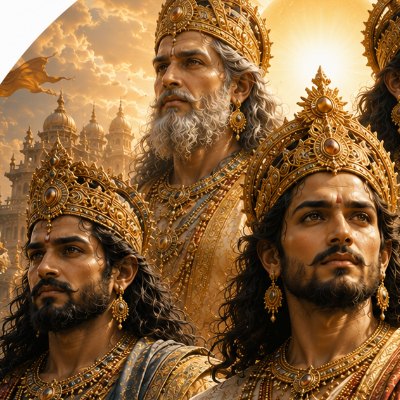
Dasharatha I, Ilavila, and Vishvasaha are three successive kings of the Ikshvaku Solar dynasty — the Suryavamsha — who reigned between Mulaka (also known as Narikavacha) and the celebrated saint-king Khatvanga (also called Dilipa II). Their succession is recorded in the genealogical king-lists of the Bhagavata Purana (Skandha 9) and the Vishnu Purana (Book IV), where they appear as consecutive nodes in the direct ancestral line leading from Mulaka to Khatvanga and thence to Raghu, Dasharatha II, and Rama. None of the three figures is the subject of independent narrative episodes in the primary sources; they are attested exclusively in genealogical verse passages enumerating the Solar dynasty kings. This group profile is compiled for the purposes of genealogical completeness rather than narrative documentation, and the profiles are proportionately brief in keeping with the limited evidence available for each figure.
✦ Dasharatha I
Dasharatha I is the son of Mulaka (Narikavacha) and the father of Aidavida, also called Ilivila or Ilavila, who succeeded him. He is the first of the two Ikshvaku kings named Dasharatha attested in the primary tradition, and must be carefully distinguished from Dasharatha II — the celebrated king of the Ramayana, father of Rama, Lakshmana, Bharata, and Shatrughna, who was the son of Aja and grandson of Raghu. Dasharatha I belongs to the generation before Khatvanga's father Vishvasaha; the celebrated Dasharatha II belongs to the generation after Khatvanga's son Dirghabahu and Dirghabahu's son Raghu. The Wisdomlib Purana glossary entry for Dasharatha, citing Bhagavata Purana 9.9.41 and Brahmanda Purana 3.63.184, gives his genealogical position as son of Mulaka and father of Aidavida; the Vishnu Purana (4.4.86–87) is cited in the same entry as a parallel authority for this placement. No personal narrative, epithet, or reign-characteristic is recorded for Dasharatha I in any surviving primary source passage.
✦ Ilavila (Aidavida)
Ilavila — rendered Aidavida in the Bhagavata Purana and Ilivila in the Vishnu Purana — is the son of Dasharatha I and the father of Vishvasaha. The Wisdomlib Purana glossary entry for Vishvasaha, citing Bhagavata Purana 9.9.41 and Vishnu Purana 4.4.75–76, identifies him as the son of Aidavida (Ilivila in the Vishnu Purana). The patronymic Aidavida or Ailavila — meaning son of Ilavila — is used in the Bhagavata Purana to identify Vishvasaha by reference to his father. The name Ilavila / Ilivila is distinct from the name Ilavida, the wife of the sage Vishrava and mother of Kubera in the Ramayana tradition — the two names and figures share no genealogical connection and must not be confused. No narrative episode, reign-characteristic, or epithet is recorded for this Ilavila in any surviving primary source passage.
The longer king-list preserved in the Wikipedia article on the List of Ikshvaku dynasty kings inserts several additional figures — Anaranya III, Nidhna, Animitra, and Duliduh — between Ilavila and the figure identified with Khatvanga. In the Bhagavata Purana's own compressed genealogical passage (9.9.41), the sequence runs directly from Dasharatha I through Aidavida to Vishvasaha to Khatvanga without these additional names. The discrepancy reflects the well-documented phenomenon of differing king-list lengths across Puranic recensions, where the Bhagavata Purana presents a compressed lineage and the Harivamsha and other sources expand it with intervening kings not enumerated in the Bhagavata.
✦ Vishvasaha
Vishvasaha is the son of Ilavila (Aidavida) and the father of the celebrated saint-king Khatvanga, also known as Dilipa II. He is attested by name in the Bhagavata Purana (9.9.41) and the Vishnu Purana (4.4.75–76), which are the primary sources for his genealogical position. The Wisdomlib Purana glossary confirms his identity directly from these two citations. His name Vishvasaha is a Sanskrit compound meaning one who endures all or one who bears the universe — from vishva (all, universal) and saha (bearing, enduring). No independent narrative episode, military campaign, or reign-characteristic is recorded for Vishvasaha in any surviving primary source. His significance in the tradition is entirely genealogical: he is the father of Khatvanga, one of the most celebrated kings of the Solar dynasty, renowned for having helped the gods defeat the Asuras in battle and for subsequently attaining liberation in the single muhurtha (forty-eight minutes) of life remaining to him after the gods informed him of his imminent death.
The Brahmanda Purana and the Vayu Purana record a second figure named Vishvasaha — son of Vyushitashva (or Yushitashva in the Vishnu Purana, or Dhyushitashva in the Vayu Purana) and father of Hiranyanabha Kausalya — who belongs to a different segment of the Solar dynasty genealogy within the same Puranic tradition. These are distinct figures who share only their name; their genealogical positions and the names of their fathers and sons are entirely different.
✦ The Succession in Context
These three kings occupy the Solar dynasty succession in the aftermath of the Parashurama episode. Mulaka, their immediate predecessor, had survived Parashurama's campaigns by sheltering among women. The period represented by Dasharatha I, Ilavila, and Vishvasaha is one of dynastic recovery and consolidation, following the decimation of the Kshatriya warrior class and the gradual rebuilding of royal lineages across India. The line from Vishvasaha through Khatvanga — Dirghabahu — Raghu II — Aja — Dasharatha II — Rama represents the final arc of the Solar dynasty's most celebrated sequence, culminating in the principal narrative of the Valmiki Ramayana.
✦ References
- Bhagavata Purana, Skandha 9, Chapter 9, verse 41: Primary source. The principal verse establishing the compressed succession Mulaka — Dasharatha I — Aidavida — Vishvasaha — Khatvanga within the Solar dynasty; cited in the Wisdomlib entries for all three figures. The most direct primary attestation for all three in a single genealogical sequence.
- Vishnu Purana, Book IV, Chapter 4, verses 75–76 and 86–87: Primary source. Parallel genealogical account confirming Vishvasaha as the son of Ilivila (Vishnu Purana's spelling for Ilavila) and father of Khatvanga (verse 75–76); and Dasharatha I as the son of Mulaka and father of Ilivila (verse 86–87).
- Brahmanda Purana, Book III, Chapter 63, verse 184; Vayu Purana 88.183–184: Primary sources. Parallel accounts confirming Dasharatha I's placement as son of Mulaka within the Solar dynasty succession.
- Wisdomlib — Dasharatha entry (Purana glossary): Modern secondary resource. Distinguishes the two Dasharatha figures in the tradition (1a: son of Mulaka and father of Aidavida; 1b: son of Aja and father of Rama) with primary source citations for each; the critical disambiguation reference.
- Wisdomlib — Vishvasaha entry (Purana glossary): Modern secondary resource. Confirms Vishvasaha as son of Aidavida (Ilivila in Vishnu Purana) and father of Khatvanga, with Bhagavata Purana 9.9.41 and Vishnu Purana 4.4.75–76 as primary citations; also documents the second distinct Vishvasaha of the Brahmanda and Vayu Puranas.
- Wikipedia — List of Ikshvaku dynasty kings in Hinduism: Modern secondary resource. Provides the expanded king-list from Mulaka to Khatvanga as preserved in the Harivamsha-influenced tradition, inserting Anaranya III, Nidhna, Animitra, and Duliduh between Ilavila and the Khatvanga-figure; documents the divergence from the Bhagavata Purana's compressed sequence.
- Medium (Ravi Unni) — King Khatvanga: Modern secondary resource. Confirms Vishvasaha as the father of Khatvanga and narrates the Khatvanga episode — the king's assistance to the gods, the grant of a boon, and his attainment of liberation in a single muhurtha — establishing the narrative significance of Vishvasaha's lineage position.