
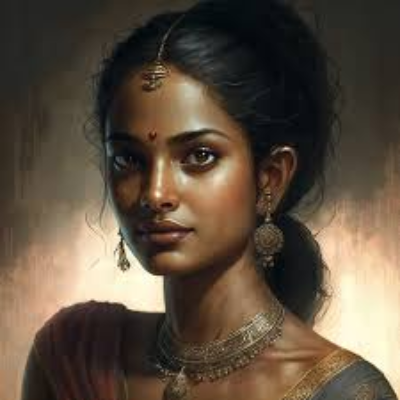
About
Vapushtama — Princess of Kashi, Queen of Janamejaya, Mother of Shatanika and Sankukarna
Vapushtama · Vapuṣṭamā · Vapusthama · Janamejaya-mahishi · Kashi-rajkumari · Suvarnavarman-putri · Sarvaga-pautrī · Bhima-prapautrī · Shatanika-mata · Sankukarna-mata
Vapushtama is the queen of Janamejaya — the great Kuru king of Hastinapura, great-grandson of Arjuna, who performed the Sarpa Satra (the snake sacrifice) to avenge his father Parikshit's death; the daughter of Suvarnavarman (also written Suvarnasena or Suvarnavarma), the king of Kashi; the granddaughter of Sarvaga — the son of Bhima and his wife Balandhara who ruled Kashi after the Kurukshetra War; and the great-granddaughter of Bhima, the second Pandava. She is the mother of two sons — Shatanika (who succeeded Janamejaya on the throne of Hastinapura and whose own son was Ashvamedhadatta) and Sankukarna (who is mentioned only in the Mahabharata's Adi Parva and does not appear in any of the major Puranas). Her marriage to Janamejaya united the two principal living branches of the Pandava family in the fourth generation after the Kurukshetra War — Bhima's Kashi line through her, and Arjuna's main Kuru line through Janamejaya — making her simultaneously a Pandava descendant and the wife of a Pandava descendant, both lines converging in her sons. She is described in the primary canonical sources as a beautiful and accomplished princess. The Vyasa Mahabharata (Adi Parva, Chapter 95, Verses 85–86) records her name, her father, her marriage, and her two sons in a single passage. The Devi Bhagavata Purana (Skandha 2) records her as the prominent queen of Janamejaya and the daughter of Suvarnavarman the king of Kashi. The HinduPad source describes her as chaste, pious, soft-natured, and deeply devoted to Vishnu — a queen who heard the stories of Krishna's childhood from the sage Narada and who, through her devotion, experienced a vision of Krishna as a child who played with her briefly before revealing his full divine form and blessing her. She entered her husband Janamejaya's funeral pyre after his death and attained liberation.
✦ The Name
The Sanskrit name Vapushtama — written Vapuṣṭamā — is a superlative compound of vapus (form, body, beauty, physical excellence) and the superlative suffix tama (most, greatest, the supreme). The name means the most beautiful one, she of the most excellent form, the supremely beautiful. It is a name of high aesthetic praise, given at birth or at naming to record that she was considered extraordinary in physical beauty and personal presence. The Wisdomlib entry on Vapushtama confirms this derivation and records her as the prominent queen of Janamejaya whose name appears in the Mahabharata (Adi Parva, Chapter 95, Stanza 86) as well as in the Harivamsa (11236 and 11245). The name's superlative character is consistent with the tradition of naming royal princesses with names that record their outstanding qualities — beauty in women of the royal lineage being a mark of divine grace and a fitting attribute for one who would become the first queen of Hastinapura in the generation immediately after the Sarpa Satra.
✦ Lineage
- Father: Suvarnavarman — king of Kashi; also written Suvarnasena and Suvarnavarma in different sources — all variant forms of the same Sanskrit name meaning golden-armoured or golden-arrayed; the Devi Bhagavata Purana (Skandha 2) names him Suvarnavarman; the Mahabharata stories tradition names him Suvarnavarman; the Glorious Hinduism source uses Suvarnasena; who gave his daughter in marriage to Janamejaya after examining the king's qualities according to dharma, when Janamejaya's ministers approached him on behalf of the young king
- Paternal grandfather: Sarvaga — king of Kashi after the Kurukshetra War; son of Bhima (the second Pandava) and Balandhara (the Kashi princess); who also administered Mithila and Kosala for a period after the war; the link through whom Vapushtama carries her Pandava descent
- Paternal great-grandfather: Bhima — the second Pandava; son of Pandu and Kunti, who invoked the wind god Vayu to father him; making Vapushtama Bhima's great-granddaughter
- Paternal great-grandmother: Balandhara — princess of Kashi; who married Bhima at a svayamvara or after his eastern military campaigns; who lived in Kashi rather than Indraprastha; making Vapushtama the great-granddaughter of the woman who first brought the Pandava-Kashi alliance into being
- Husband: Janamejaya — great-grandson of Arjuna (the third Pandava) through Abhimanyu and Parikshit; king of Hastinapura; who was crowned as a boy after his father Parikshit's death from the serpent Takshaka's bite; who performed the Sarpa Satra to destroy the serpent race; at whose sacrifice the entire Mahabharata was narrated for the first time by the sage Vaishampayana; who was persuaded by the young Brahmin Astika to end the sacrifice before all serpents were destroyed
- Father-in-law: Parikshit — the posthumous son of Abhimanyu and Uttara; the last Kuru king of the Kurukshetra War generation; who was cursed to die from a serpent's bite within seven days; who spent his final seven days hearing the Bhagavata Purana narrated by the sage Shuka on the banks of the Ganga and attained liberation
- Sons: Shatanika — who succeeded Janamejaya on the throne of Hastinapura; the Shatanika I of the Kuru-Vatsa succession; whose son Ashvamedhadatta continued the dynasty; and Sankukarna — mentioned in the Mahabharata's Adi Parva (Chapter 95, Verse 86) and in the Harivamsa but not in any major Purana; the Glorious Hinduism source notes that the Mahabharata is the primary authority for Sankukarna's existence and that the Puranas' silence on him does not negate his canonical status
- Connection — a Pandava married to a Pandava: Vapushtama descends from Bhima through Sarvaga and Suvarnavarman; Janamejaya descends from Arjuna through Abhimanyu and Parikshit; both are fourth-generation Pandava descendants; the two brothers Bhima and Arjuna whose combined devotion and martial power had been the heart of the Pandava victory at Kurukshetra, were reunited in the generation of their great-grandchildren through this marriage
✦ The Marriage — The Ministers' Arrangement
When Janamejaya was crowned king as a boy after Parikshit's death, his ministers recognised that the young king needed the stabilising support of a queen and a strong marital alliance. They approached Suvarnavarman, the king of Kashi, and requested his daughter Vapushtama for Janamejaya. Suvarnavarman examined the young king's qualities according to dharma — his lineage, his character, his potential for just governance — and found him worthy. He gave his daughter in marriage. The Vyasa Mahabharata's Adi Parva (the vyasaonline.com source records the episode directly) states that Janamejaya was happy marrying her and had not given himself to anyone before that — she was his first and principal wife. After the marriage the young king and queen travelled together through the kingdom enjoying each other's company in parks filled with flowering trees, the newly married couple delighting in each other before the weight of royal duty and the tragedy of his father's story settled on the king. The choice of a Kashi princess for Janamejaya was not accidental. Kashi was one of the most ancient and sacred kingdoms of the subcontinent — the city of Shiva, the city of liberation, the city where the dying attained moksha. Its royal house had been connected to the Pandava family through Balandhara's marriage to Bhima two generations earlier. By marrying Vapushtama, Janamejaya was not merely strengthening a political alliance with a powerful kingdom — he was reconnecting the main Kuru line with its own Bhima-branch through the Kashi royal house, consolidating the Pandava genealogical inheritance in his sons.
✦ The Sarpa Satra — Her Role
The HinduPad source records a tradition — not explicitly in the Vyasa Mahabharata's primary account of the sacrifice — in which Vapushtama joined the sage Astika in attempting to stop the Sarpa Satra. Astika's intervention is the canonical stopping of the sacrifice and his role is recorded in detail across the Mahabharata's Adi Parva. The tradition of Vapushtama also attempting to stop it adds her voice to the voices of restraint — the queen, moved by compassion for the serpent race being consumed in the sacrificial fire, joining the young Brahmin in asking her husband to end the destruction. Whether her intercession influenced Janamejaya's eventual acceptance of Astika's plea is not elaborated in the primary sources. The tradition of her participation places her in the episode's moral dimension — alongside the sage who saved the snakes — as one who understood that the sacrifice, however justified by a son's grief, had reached the limits of its proper scope.
✦ Personal Character — Devotion and Vision
Vapushtama is described across the devotional tradition as a woman of extraordinary piety and Vaishnava devotion. She heard the stories of the Bhagavata Purana — including the childhood pastimes of Krishna — from the sage Narada. Her devotion deepened as she heard them. One day, as she meditated on Krishna as a child, a divine child appeared before her and played with her for some time. When he revealed his full divine form and blessed her she understood that her devotion had brought the Lord himself to her presence. This episode — recorded in the HinduPad source in the context of the Devi Bhagavata tradition — places Vapushtama in the lineage of queens whose devotion was so concentrated that it drew direct divine manifestation. After Janamejaya's death she entered his funeral pyre and attained liberation.
✦ The Sons — Shatanika and Sankukarna
Vapushtama bore Janamejaya two sons. Shatanika — the elder — is confirmed in the Vishnu Purana (Book 4, Chapter 21), the Bhagavata Purana (Canto 9, Chapter 22), and the Garuda Purana (Chapters 140–141) as the successor of Janamejaya on the throne of Hastinapura. His son Ashvamedhadatta continued the dynasty and through Asimakrishna and then Nicaksha (who moved the capital to Kaushambi after Hastinapura was flooded) the Kuru-Vatsa succession continued for another twenty-six generations. Sankukarna — the younger son — is mentioned in the Mahabharata's Adi Parva (Chapter 95, Verse 86) and the Harivamsa but does not appear in the Vishnu Purana, Bhagavata Purana, or Garuda Purana succession lists. The Glorious Hinduism source notes that Shatanika is also called Chandrapida in that tradition and Sankukarna is also called Suryapida. His absence from the Puranas' succession lists suggests he did not inherit the throne and his further history is not recorded in the primary sources available.
✦ References
- Mahabharata (Adi Parva, Chapter 95, Verses 85–86) — the primary canonical source: Vapushtama named as the daughter of the king of Kashi and wife of Janamejaya; her two sons Shatanika and Sankukarna named; the marriage described as Janamejaya's first and principal union; the genealogical verse that establishes her identity and lineage in the primary epic text
- Harivamsa (Verses 11236 and 11245) — Vapushtama mentioned as Janamejaya's wife in the genealogical sections; confirming her canonical status beyond the Mahabharata's own text
- Devi Bhagavata Purana (Skandha 2) — Vapushtama named as the prominent queen of Janamejaya; her father named as Suvarnavarman the king of Kashi; the devotional tradition of her Bhagavata hearing and her vision of Krishna as a child
- Wisdomlib — Vapushtama (seven definitions) — the Sanskrit derivation of the name (vapus + tama = most beautiful form); her identification as daughter of Suvarnavarman the king of Kashi; the Mahabharata and Harivamsa verse citations; the most comprehensive modern reference entry
- Vyasaonline.com — Vaishampayana Narrates Mahabharata — the marriage episode in full: the ministers approaching Suvarnavarman; the king's examination of Janamejaya; the acceptance; the marriage; their happy travels together after the wedding; the context within the opening of the Sarpa Satra narrative
- Wikipedia — List of characters in the Mahabharata; Bharatpedia — List of characters in the Mahabharata — Vapushtama identified as daughter of Subarnavarma the king of Kashi, granddaughter of Sarvaga, great-granddaughter of Bhima; married to Janamejaya; two sons Shatanika and Sankukarna
- HinduPad — Vapusthama Wife of Janamejaya — her character as chaste and pious; her devotion to Vishnu; the Narada episode and the hearing of the Bhagavata; the vision of Krishna as a child; her entering the funeral pyre at Janamejaya's death
- Glorious Hinduism — Kasi Kingdom; Glorious Hinduism — The Ultimate Mahabharata Family Tree — the Kashi dynasty succession from Sarvaga through Suvarnasena to Vapushtama; the alternate names Chandrapida (Shatanika) and Suryapida (Sankukarna); the Mahabharata as primary authority for Sankukarna's existence despite his absence from the Puranas
- Sarpa Satra Wikipedia; Mahabharata Stories Blogspot — Janamejaya Plans the Serpent Sacrifice: the marriage context within the opening of the Sarpa Satra narrative; Vapushtama's early years with Janamejaya before the sacrifice began