
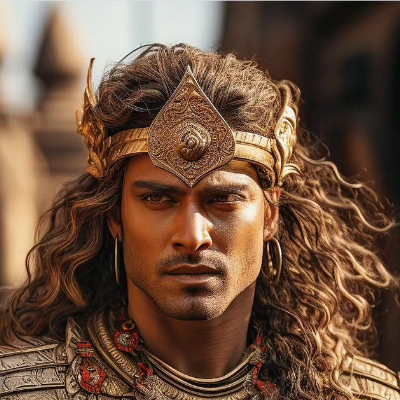
About
Shatanika — King of Hastinapura, Son of Janamejaya, Grandson of Parikshit
Shatanika · Shatānika · Janamejaya-putra · Parikshit-pautra · Kuru-raja · Vapushtama-pati
Shatanika is a king of Hastinapura in the Puru-Kuru dynasty; the son of Janamejaya — the great Kuru king who performed the Sarpa Satra (snake sacrifice) to avenge his father Parikshit's death from the serpent king Takshaka — and his wife Vapushtama, daughter of King Suvarnavarman of the Kashi kingdom; and the grandson of Parikshit, the last surviving Kuru king after the Kurukshetra War and the son of the slain hero Abhimanyu and Uttara. He is recorded in the Vishnu Purana, the Bhagavata Purana, the Matsya Purana, and the Harivamsa as a link in the direct royal succession from Parikshit through Janamejaya. His personal canonical record is brief — he is named as Janamejaya's successor and the father of Ashvamedhadatta, and little else is recorded of his personal life, character, or reign in the primary sources. A note on naming is essential: the name Shatanika is shared by at least three distinct figures in the Mahabharata tradition — this Kuru king; one of the five Upapandavas, the son of Nakula and Draupadi, killed in Ashvatthama's nocturnal raid on the Pandava camp after the Kurukshetra War; and a king of the Nishada people mentioned in the Mahabharata's Adi Parva. All three are distinct figures bearing the same name, and the present profile concerns the Kuru king who is the son of Janamejaya.
✦ The Name
The Sanskrit name Shatanika — written Shatānika — is a compound of shata (hundred) and anika (face, army, front, countenance); meaning he who has a hundred faces in battle, one who confronts a hundred armies, the warrior with a hundredfold presence. It is a name given to figures of exceptional martial or royal distinction throughout the Mahabharata — its occurrence for three different figures in the same epic reflects its use as a conventional honorific for great warriors and kings rather than as a unique personal identifier. The Upapandava Shatanika — son of Nakula and Draupadi — bore this name as a warrior-prince; the Kuru king Shatanika — son of Janamejaya — bore it as a royal epithet.
✦ Lineage
- Father: Janamejaya — king of Hastinapura; son of Parikshit; great-grandson of Arjuna; who performed the Sarpa Satra — the great snake sacrifice — to destroy the serpent race in revenge for his father Parikshit's death from the serpent Takshaka; who heard the entire Mahabharata narrated by the sage Vaishampayana during a pause in the sacrifice; who was eventually persuaded by the sage Astika to end the sacrifice before all serpents were destroyed
- Mother: Vapushtama — daughter of King Suvarnavarman of Kashi (Varanasi); given in marriage to Janamejaya; described in the Adi Parva as beautiful and virtuous
- Paternal grandfather: Parikshit — the last Kuru king after the Kurukshetra War; son of Abhimanyu (the son of Arjuna, killed in the Chakravyuha on the thirteenth day) and Uttara (daughter of King Virata); who was cursed by the sage Shringi to die from a snake bite within seven days; who spent his last seven days hearing the Bhagavata Purana narrated by the sage Shuka on the banks of the Ganga; who attained liberation at death; the last king of the Dvapara Yuga in the Puru-Kuru succession
- Paternal great-grandfather: Abhimanyu — son of Arjuna and Subhadra (Krishna's sister); the most celebrated young warrior of the Mahabharata; who entered the Chakravyuha formation on the thirteenth day of the war but could not exit it, having learned only how to enter while still in his mother's womb; killed by multiple Kaurava warriors simultaneously
- Wife: not named in primary sources
- Son: Ashvamedhadatta — named in the Vishnu Purana and Bhagavata Purana as Shatanika's successor; the name Ashvamedhadatta means given by the Ashvamedha sacrifice, suggesting that Shatanika performed an Ashvamedha and his son was born as the fruit of that sacrifice
- Dynasty position: the Vishnu Purana (Book 4, Chapter 21) and Bhagavata Purana (Canto 9, Chapter 22) both place Shatanika directly after Janamejaya in the Puru-Kuru succession, making him the twenty-eighth or twenty-ninth king in the direct line from Puru depending on which genealogical variant is followed
- The Upapandava Shatanika — a distinct figure: son of Nakula (the fourth of the five Pandava brothers) and Draupadi (the common wife of all five Pandavas); one of the five Upapandavas killed by Ashvatthama in the nocturnal raid on the Pandava camp on the night after the eighteenth day of the Kurukshetra War; not the same figure as the Kuru king profiled here
✦ Reign and Canonical Record
Shatanika's reign at Hastinapura is recorded only in the genealogical lists of the Vishnu Purana, Bhagavata Purana, Matsya Purana, and Harivamsa as a link in the Kuru dynasty's succession. No primary text records any specific episode, war, sacrifice, or achievement of his personal reign. His name in the succession list confirms the continuity of the Puru-Kuru dynasty from Parikshit through Janamejaya to himself and on through his son Ashvamedhadatta. The Vishnu Purana (Book 4, Chapter 21) includes him in the future-king list — some of the kings listed after Parikshit in this chapter are described as kings yet to come, suggesting that at the time of the Vishnu Purana's composition the tradition was recording both historical and near-future royal succession. The name of his son Ashvamedhadatta — given by the Ashvamedha — implies that his reign included at least one Ashvamedha sacrifice, a royal rite confirming universal sovereignty, but no narrative of this sacrifice is preserved in the available primary sources.
✦ References
- Vishnu Purana (Book 4, Chapter 21) — the principal genealogical source: Shatanika listed as the son of Janamejaya and father of Ashvamedhadatta in the Puru-Kuru dynasty succession; the most reliable canonical placement of Shatanika in the royal lineage
- Bhagavata Purana (Canto 9, Chapter 22) — Shatanika named as Janamejaya's son and Ashvamedhadatta's father in the Kuru dynasty genealogy; the second major Puranic confirmation of his succession position
- Matsya Purana and Harivamsa — parallel genealogical listings of the Puru-Kuru dynasty including Shatanika in the post-Parikshit succession
- Mahabharata (Adi Parva) — Vapushtama named as Janamejaya's wife and daughter of Suvarnavarman of Kashi; the marriage that produced Shatanika
- Wikipedia — Janamejaya; Wikipedia — Parikshit; AncientVoice — Shatanika son of Janamejaya; Wisdomlib — Shatanika in the Puranic Encyclopaedia: modern summaries drawing from the above primary sources