
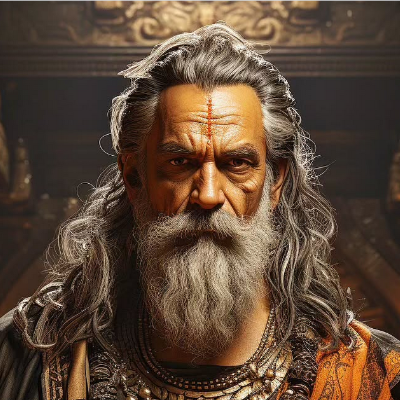
About
Virata — King of Matsya and Host of the Pandavas in Their Year of Concealment
Virata · Matsyaraja · King of Matsya · Father of Uttara · Father of Uttaraa
Virata was the king of the Matsya kingdom, one of the major realms of ancient Bharatavarsha, and the ruler at whose court the five Pandava brothers and their shared wife Draupadi spent their thirteenth and final year of exile in disguise. He was the husband of Sudeshna, a woman of Suta origin whose brother Kichaka served as commander-in-chief of the Matsya armies and wielded effective power over the kingdom during his lifetime. Virata is the central figure of the Virata Parva, the fourth book of the Mahabharata, which is named after him, though the narrative of that book is dominated more by the episodes surrounding Kichaka, Draupadi, and the Pandavas than by Virata's own actions. He is also mentioned in the Udyoga Parva, the Bhishma Parva, and other books of the Mahabharata in connection with his role in the events leading to and during the Kurukshetra war. Virata's daughter Uttaraa became the wife of Abhimanyu, the son of the Pandava Arjuna, making Virata the maternal grandfather of Parikshit, the last Kuru king whose reign is narrated in the Mahabharata.
✦ The Name
The name Virata is derived from the Sanskrit root vi combined with rata, carrying the sense of one who is greatly engaged or absorbed, or alternatively one who is illustrious or eminent. Some traditional commentators connect the name to the idea of pre-eminence or distinction within a realm. The name also functions as the primary identifier of his kingdom: the Matsya country, meaning the land of fish, is named for the people over whom he rules, while Virata as its king gives his name to the Virata Parva and to the city Viratanagara, which served as the capital of his kingdom and as the site of the Pandavas' concealment. The epithet Matsyaraja, meaning king of the Matsyas, is applied to him throughout the epic as a standard royal designation.
✦ Lineage
- Dynasty: The Matsya royal line; Virata's own parentage is not recorded with consistency across the primary sources, and the Mahabharata does not supply a detailed genealogy for him within the text of the Virata Parva itself
- Wife: Sudeshna — daughter of Kekaya, a Suta chieftain of the Kekaya country of northwestern Bharatavarsha, and of Malavi, a woman associated with the Malava country; sister of Kichaka, the commander-in-chief of Virata's armies; mother of Uttara and Uttaraa
- Son: Uttara — prince of Matsya; a young warrior who at the time of the Pandavas' incognito year was inexperienced in battle despite his boastfulness; he served as Arjuna's charioteer during the Kaurava cattle raid on Matsya, during which Arjuna, disguised as the dance teacher Brihannala, revealed himself and fought the Kaurava forces; Uttara later participated in the Kurukshetra war and was killed there
- Daughter: Uttaraa — princess of Matsya; became the wife of Abhimanyu, the son of the Pandava Arjuna and his wife Subhadra, who was the sister of Krishna, the Yadava prince revered as an avatar of the god Vishnu; Uttaraa's son Parikshit, born after Abhimanyu's death in the Kurukshetra war, became the last Kuru king recorded in the Mahabharata
- Son (variant account): Shankha — mentioned in some versions of the Mahabharata as another son of Virata who was killed in the Kurukshetra war; the textual tradition is not uniform on his details
✦ The Kingdom of Matsya
The Matsya kingdom was a well-established realm of ancient Bharatavarsha, generally identified in scholarly literature with territories in the region of modern Rajasthan, in the vicinity of the city now known as Jaipur. Viratanagara, the capital, is the principal setting of the Virata Parva. The kingdom was sufficiently powerful to be reckoned among the significant states of the Kuru period, though the Mahabharata makes clear that its military reputation during Virata's reign rested largely upon the personal power of Kichaka rather than upon Virata's own martial capacity. The text presents several neighbouring rulers, including the Trigarta king Susharma, as having been deterred from aggression against Matsya solely by fear of Kichaka. This characterisation establishes the context for the kingdom's sudden vulnerability after Kichaka's death and explains why Virata's realm became the target of simultaneous invasions shortly thereafter.
✦ The Pandavas at Virata's Court
The five Pandava brothers — Yudhishthira, Bhima, Arjuna, Nakula, and Sahadeva, the sons of King Pandu — had been defeated at dice by the Kaurava prince Duryodhana, the eldest son of the blind king Dhritarashtra, and were bound by the terms of that defeat to spend twelve years in forest exile followed by a thirteenth year living entirely unrecognised. Discovery during the thirteenth year would have compelled them to repeat the entire exile. They chose Virata's court as their place of concealment, each adopting a disguised identity suited to employment in or around the palace.
Yudhishthira presented himself as a brahmin dice-player and companion named Kanka. Bhima entered service as a cook named Vallala. Arjuna, who had spent a year in the heavens receiving instruction from the god Indra and had during that time been transformed in appearance, presented himself as a eunuch dance teacher named Brihannala and served in the women's quarters instructing Uttaraa in music and dance. Nakula served as a horse-keeper named Granthika. Sahadeva served as a cowherd named Arishtanemi. Draupadi, the shared wife of all five brothers, entered the service of Queen Sudeshna as a hairdresser under the name Sairandhri.
Virata accepted each of these disguised figures into his court without recognising any of them. The Mahabharata presents him as a king of reasonable disposition but limited perception, hospitable and not cruel, yet without the discernment to see through the disguises even when presented with servants of obviously exceptional ability. He took a liking to Yudhishthira as a dice companion and to Bhima as a wrestler and cook, and the text does not suggest that any suspicion arose on his part during the year of concealment until the Pandavas revealed themselves at its close.
✦ The Episode of Kichaka and Its Aftermath
The most damaging episode of Virata's reign in the Mahabharata concerns his failure to protect Draupadi from Kichaka's assault. When Kichaka pursued Draupadi into the royal assembly hall and kicked her to the ground before the gathered court, Virata was present. The text records that he did not intervene, accepting Kichaka's claim that Draupadi had intruded improperly and effectively endorsing the assault by his silence. This failure is not subjected to extended moral commentary by the Mahabharata in Virata's presence, but it contributes to the characterisation of Virata as a king who was in practice subordinate to Kichaka's will even in his own court.
After Kichaka's death and the killing of the Upakichakas by Bhima, Virata's kingdom became immediately vulnerable. The Trigarta king Susharma invaded from one direction, carrying off Matsya cattle, while the Kaurava forces under Duryodhana invaded from another. Virata himself rode out to face Susharma and was captured in battle. It was Yudhishthira who directed Bhima to rescue Virata, and Bhima did so, freeing the king and defeating the Trigartas. Virata thus owed his liberty directly to one of the disguised Pandavas in his own service, a fact he did not yet know.
✦ The Revelation of the Pandavas and the Marriage of Uttaraa
The Kaurava invasion of Matsya, led in part by Duryodhana and including the great Kuru warriors Bhishma, Drona, Karna, and Ashvatthama among its forces, was repelled by Arjuna, who fought from a chariot driven by the young prince Uttara. Arjuna, still nominally in his disguise as Brihannala, revealed himself during this engagement by taking up the Gandiva bow and fighting with his characteristic power. When Virata returned from his own engagement with the Trigartas and learned that the Kaurava army had been routed by a single fighter from his court, he was initially incredulous. The revelation of the Pandavas' true identities followed, and Virata's response, as the Mahabharata records it, was one of relief, honour, and rapid reorientation toward alliance.
Virata proposed to cement his new alliance with the Pandavas through the marriage of his daughter Uttaraa to Arjuna. Arjuna declined on the grounds that he had lived in close proximity to Uttaraa in the role of her dance teacher and regarded her in the manner of a daughter or pupil, making a marital union inappropriate. He proposed instead that Uttaraa marry his son Abhimanyu. Virata accepted this proposal with enthusiasm, and the marriage was celebrated at Viratanagara with considerable ceremony, attended by Krishna and other Yadava leaders as well as by representatives of kingdoms allied with the Pandavas.
✦ Virata in the Kurukshetra War
Virata sided firmly with the Pandavas in the Kurukshetra war and contributed the forces of the Matsya kingdom to the Pandava coalition. He is listed among the commanders of the Pandava army in the Udyoga Parva and the Bhishma Parva. His son Uttara was killed early in the war. Virata himself fought in the great battle and was killed during the conflict, though the precise circumstances of his death in battle are not narrated with the same detail as those of the principal warriors. The Mahabharata records his death as one of many kings who fell on the Pandava side during the eighteen-day war at Kurukshetra.
✦ Textual Variants and Inconsistencies
The genealogy of Virata is not elaborated consistently across the primary sources. The Mahabharata's Virata Parva focuses on his reign and the events of the Pandavas' year of concealment without supplying a detailed account of his own ancestry or the earlier history of the Matsya dynasty. Some Puranic sources mention the Matsya dynasty in broader dynastic lists, but the specific placement of Virata within those lists varies between texts and does not always align with the epic account. The number and names of his children also show some variation: the mention of a son named Shankha appears in some recensions but is absent or differently treated in others. These inconsistencies reflect the broader pattern of the Puranic dynastic lists, which were compiled at different times and from different regional traditions, and which do not always harmonise with the epic's own genealogical data.
✦ Connection to the Wider Genealogy
Virata's most significant genealogical connection in the Mahabharata tradition is through his daughter Uttaraa. Uttaraa's marriage to Abhimanyu — the son of Arjuna, who was himself the son of the god Indra and the Pandava queen Kunti — united the Matsya royal line with the Pandava-Kuru lineage at its most critical generational juncture. Abhimanyu was killed during the Kurukshetra war before his son was born. Uttaraa was pregnant at the time of Abhimanyu's death, and the child she carried — Parikshit — was targeted by the dying Ashvatthama, son of the teacher Drona, who discharged a Brahmastra weapon intended to destroy the Pandava line in the womb. Krishna intervened to protect the unborn child, and Parikshit was born safely, subsequently inheriting the Kuru throne as the sole surviving heir of the Pandava lineage. Virata is thus the maternal great-grandfather of the continuing Kuru line, and his kingdom of Matsya, through the marriage he agreed to at the close of the Pandavas' year of exile, became genealogically embedded in the central dynastic succession of the epic tradition.
✦ References
- Mahabharata, Virata Parva (Book 4), chapters 1–72: Primary source for all material relating to Virata; establishes his kingdom, his court, the Pandavas' year of concealment, the Kichaka episode, the Trigarta and Kaurava invasions, the revelation of the Pandavas, and the marriage of Uttaraa to Abhimanyu.
- Mahabharata, Udyoga Parva (Book 5): Records Virata's alliance with the Pandavas and his role in the preparations for the Kurukshetra war; includes his participation in the council of kings assembled to deliberate on war and peace.
- Mahabharata, Bhishma Parva (Book 6): Lists Virata among the commanders of the Pandava army at the outset of the Kurukshetra war.
- Mahabharata, Drona Parva (Book 7) and Karna Parva (Book 8): Record the deaths of Uttara and other Matsya warriors in the course of the war; contain references to Virata's participation and his eventual death in battle.
- Vishnu Purana and Bhagavata Purana: Include the Matsya dynasty in broader dynastic genealogies of the lunar line; the placement of Virata within these lists varies and does not always harmonise precisely with the Mahabharata's own account.
- Vettam Mani, Puranic Encyclopaedia (1975): Entry on Virata synthesises the Mahabharata material and references Puranic dynastic lists; identifies his family, kingdom, and role in the epic narrative without contributing independent primary source detail beyond what the texts themselves supply.
- Alf Hiltebeitel, The Cult of Draupadi, Vol. 1 (1988): Analyses the Virata Parva including Virata's role as host and as a figure whose court provides the setting for the Kichaka episode and the Pandavas' year of disguise; contributes scholarly perspective on the structural and theological significance of the Virata narrative.