
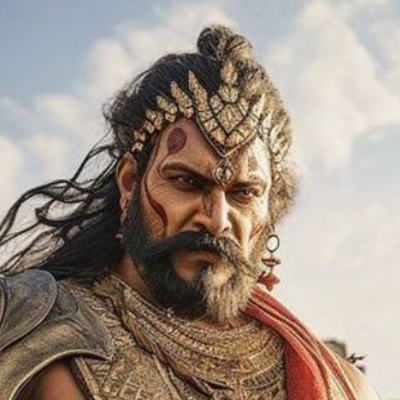
About
Kichaka — Commander-in-Chief of Matsya and Slain Antagonist of the Virata Parva
Kichaka · Sutaputra · Son of Kekaya · Brother of Sudeshna
Kichaka was the senapati, or commander-in-chief, of the armies of King Virata, ruler of the Matsya kingdom, and one of the most powerful military figures described in the Virata Parva of the Mahabharata. He was the son of Kekaya, a Suta chieftain associated with the Kekaya country of northwestern Bharatavarsha, and of Malavi, a woman associated with the Malava country. His sister Sudeshna was the chief queen of King Virata, a connection that gave Kichaka enormous influence over the Matsya court. The Upakichakas, his numerous brothers, served under him in the kingdom. Kichaka is principally remembered in the Mahabharata for his fatal infatuation with Draupadi — the wife of the five Pandava brothers — during the year the Pandavas spent in disguise at Virata's court, and for his subsequent killing at the hands of Bhima, the second of the five Pandava brothers. He appears exclusively in the Virata Parva and in later retellings and regional adaptations derived from it.
✦ The Name
The name Kichaka is derived from the Sanskrit word for a hollow reed or bamboo stalk. Some traditional commentators have understood this name as a descriptive or symbolic designation rather than a purely given name, though the Mahabharata itself does not offer an explicit etymology within the text. The name Sutaputra, meaning son of a Suta, is a patronymic applied to him and to his brothers collectively, identifying their community affiliation. His brothers are called the Upakichakas, a compound meaning those who are subordinate to or associated with Kichaka, marking their collective identity as a group defined in relation to their eldest and most prominent brother.
✦ Lineage
- Father: Kekaya — a Suta chieftain associated with the Kekaya country of northwestern Bharatavarsha; the Suta community was a hereditary class traditionally associated with chariot-driving, bardic recitation, and royal service at the courts of ancient India
- Mother: Malavi — a woman associated with the Malava country of central Bharatavarsha; named in the Virata Parva as Kichaka's mother alongside his father Kekaya
- Sister: Sudeshna — the chief queen of King Virata, ruler of the Matsya kingdom; it was through Sudeshna's position at court that Kichaka held his dominant role in the Matsya military establishment, and it was Sudeshna who, at Kichaka's urging, sent Draupadi to his quarters, thereby precipitating the chain of events that led to his death
- Brothers: The Upakichakas — a large number of brothers who served alongside Kichaka in the Matsya kingdom; they were killed by Bhima after they attempted to cremate Draupadi alive with Kichaka's corpse
✦ Role at the Matsya Court
The Mahabharata portrays Kichaka as the effective power behind King Virata's throne. His military reputation was so formidable that neighbouring kingdoms and rulers who might otherwise have challenged Virata refrained from doing so out of fear of Kichaka alone. The text makes clear that Kichaka's strength was the primary guarantor of the Matsya kingdom's security and prestige. His position as brother to Queen Sudeshna gave him a privileged standing at court that extended beyond his formal military role, and the Mahabharata describes the Matsya kingdom as functioning largely under his shadow during this period. This concentration of power in Kichaka's person is narratively significant because it means that his death, when it comes, leaves the Matsya kingdom suddenly vulnerable — a vulnerability that the text subsequently connects to the Trigarta king Susharma's invasion and to the role the Pandavas play in defending Virata's kingdom.
✦ The Pursuit of Draupadi
During the thirteenth and final year of exile imposed upon the five Pandava brothers — Yudhishthira, Bhima, Arjuna, Nakula, and Sahadeva, the sons of King Pandu — the Pandavas were required to live entirely incognito, on pain of being compelled to repeat their twelve years of forest exile if discovered. They chose the court of King Virata as their place of concealment. Draupadi, the shared wife of all five brothers and daughter of King Drupada of Panchala, entered the Matsya court in the guise of a serving woman named Sairandhri, presenting herself as a skilled hairdresser formerly employed by the goddess Draupadi — a fiction she maintained to explain her refined bearing and appearance.
Kichaka encountered Draupadi in the queen's quarters and was immediately and overwhelmingly drawn to her. He pressed his suit repeatedly and persistently, approaching her directly, appealing to her through his sister Sudeshna, and offering her wealth and status. Draupadi refused him consistently, warning him that she was protected by powerful gandharva husbands — the cover story she maintained to protect the Pandavas' identities — and that any harm done to her would bring destruction upon him. Kichaka disregarded these warnings entirely.
At Kichaka's request, Sudeshna sent Draupadi to his quarters on a pretext, ostensibly to fetch wine. Kichaka seized the opportunity and assaulted Draupadi physically in the presence of the royal court. Draupadi fled to the assembly hall where King Virata and the court were gathered, with Kichaka in pursuit. He kicked her to the ground before the assembled court. Yudhishthira, who was present in his disguise as a brahmin dice-player named Kanka, restrained Bhima from retaliating immediately to preserve their concealment. Draupadi was thus left without public redress.
✦ The Death of Kichaka
Draupadi approached Bhima in secret by night, pressing him urgently to avenge the assault. Bhima, the son of the wind-god Vayu and the most physically powerful of the five brothers, agreed. A plan was devised in which Draupadi sent word to Kichaka that she had relented and would meet him alone at the dance hall at night. Kichaka, believing himself on the verge of success, came to the appointed place eagerly and in secret.
Bhima had gone ahead and waited in the darkened hall, lying in the place where Kichaka expected to find Draupadi. When Kichaka arrived and reached out to touch what he believed was the woman he had pursued, he found instead Bhima. A fierce and brutal combat followed between the two. The Mahabharata describes the fight in terms that emphasise the extraordinary physical strength of both combatants, but Bhima's power proved overwhelming. He killed Kichaka with his bare hands, crushing and contorting the body so thoroughly that Kichaka's limbs were driven into his torso, reducing the corpse to an unrecognisable mass of flesh. The manner of death was deliberately designed to make Bhima's identity impossible to determine — the killing appeared to be the work of a non-human or supernatural being, consistent with Draupadi's fiction about her gandharva protectors.
When the Upakichakas discovered Kichaka's body in the morning, they attributed his death to Draupadi's gandharva husbands and resolved to punish her by cremating her alive with the corpse. They seized Draupadi and dragged her toward the cremation ground. Draupadi cried out loudly, and Bhima, who had been following at a distance disguised as a forest-dweller, killed the Upakichakas as well. With this act, the entire male line descended from Kekaya and Malavi was destroyed.
✦ Consequences of Kichaka's Death
The death of Kichaka had immediate and far-reaching consequences within the Virata Parva's narrative. News of the killing spread rapidly beyond the Matsya kingdom. The Trigarta king Susharma, who had long feared Kichaka as an obstacle to his ambitions against Virata, seized upon the moment of Matsya's military weakness and launched an invasion to carry off Virata's cattle. Around the same time, the Kaurava princes — led by Duryodhana, the eldest son of the blind king Dhritarashtra, and their regent Bhishma, the grand-uncle of both the Pandavas and the Kauravas — also invaded Matsya from another direction with a massive force, partly in search of cattle and partly in the hope of discovering the Pandavas, whose year of incognito exile was drawing to its close. The Pandavas responded to both threats, revealing themselves in the process, and the narrative moves swiftly from the Kichaka episode into the larger confrontations that precede the Kurukshetra war.
✦ Characterisation in the Text
The Mahabharata's portrayal of Kichaka is consistently negative in moral terms. He is presented as a man whose physical power and social position have made him accustomed to taking what he wants without restraint. His disregard for Draupadi's repeated refusals, his use of his sister to facilitate access to her, his public assault upon her before the court, and his contemptuous dismissal of her warnings are all rendered as expressions of a character corrupted by unchecked power. At the same time, the text does not entirely flatten him — his military reputation is presented as genuine, and his physical courage in meeting an unknown opponent in a darkened room, however misguided his purpose, is implicit in the narrative. The Mahabharata uses his death as a demonstration both of the inviolability of Draupadi's honour and of the terrible consequences awaiting those who disregard the protection of powerful, concealed forces.
✦ Connection to the Wider Genealogy
Kichaka stands as the most prominent member of the Suta lineage of Kekaya and Malavi recorded in the Mahabharata. His sister Sudeshna's marriage to King Virata of the Matsya kingdom — Virata being a ruler of the lunar dynasty and the father of Uttara and Uttaraa, the latter of whom became the wife of Abhimanyu, son of Arjuna, thereby connecting the Matsya royal family to the Pandava line — places Kichaka at one remove from some of the most significant genealogical connections of the late Kuru period. The destruction of Kichaka and all the Upakichakas by Bhima brought the Kekaya-Malavi Suta line recorded in the epic to a complete end within the narrative.
✦ References
- Mahabharata, Virata Parva (Book 4), chapters 13–23: Primary and principal source for all material relating to Kichaka; establishes his parentage, his role at the Matsya court, his pursuit of Draupadi, the assault before the court, his killing by Bhima in the dance hall, and the subsequent killing of the Upakichakas.
- Mahabharata, Virata Parva (Book 4), chapters 24–72: Narrates the consequences of Kichaka's death, including the Trigarta and Kaurava invasions of Matsya and the revelation of the Pandavas' identities at the close of their year of concealment.
- Mahabharata, Adi Parva (Book 1): Supplies background on the Suta community and its social and professional role in the world of the epic; does not mention Kichaka directly.
- Vettam Mani, Puranic Encyclopaedia (1975): Entry on Kichaka synthesises the Virata Parva material and identifies his parentage through Kekaya and Malavi; does not add primary source material beyond the epic.
- Alf Hiltebeitel, The Cult of Draupadi, Vol. 1 (1988): Discusses the Kichaka episode in the context of Draupadi's narrative role and her function as the central figure of honour whose violation and vindication structures the Virata Parva; contributes analytical perspective on the episode's significance within the larger Mahabharata.