
About
Uttara Kumara — Prince of Matsya and Charioteer of Arjuna at the Battle of Viratanagara
Uttara · Uttara Kumara · Prince of Matsya · Son of Virata · Bhuminjaya
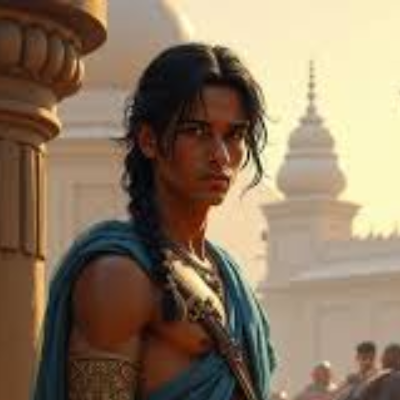
Uttara Kumara was the prince of the Matsya kingdom, the son of King Virata, ruler of Matsya, and his chief queen Sudeshna, who was the daughter of Kekaya, a Suta chieftain of the Kekaya country of northwestern Bharatavarsha, and of Malavi, a woman associated with the Malava country of central Bharatavarsha. He was the brother of Uttaraa, the princess of Matsya who became the wife of Abhimanyu and the mother of Parikshit, the last Kuru king recorded in the Mahabharata. Uttara Kumara appears in the Virata Parva of the Mahabharata as the young prince who served as charioteer to Arjuna — the third of the five Pandava brothers, disguised at that time as the eunuch dance teacher Brihannala — during the Kaurava cattle raid on the Matsya kingdom. He is also known by the epithet Bhuminjaya. He subsequently participated in the Kurukshetra war on the side of the Pandavas and was killed early in the conflict. His death is recorded in the Mahabharata and lamented by his father Virata.
✦ The Name
The name Uttara is shared between the prince and his sister Uttaraa, distinguished in Sanskrit by grammatical gender — the masculine Uttara for the prince and the feminine Uttaraa for the princess. As a common Sanskrit word, Uttara means northern, upper, subsequent, or superior. The designation Kumara, meaning prince or young man, is appended to distinguish him from his sister and from other figures named Uttara in the tradition, and the compound Uttara Kumara functions as his standard identification throughout the Virata Parva. The epithet Bhuminjaya, meaning conqueror of the earth or born of the earth, appears in some portions of the Mahabharata as an alternate name or honorific for this prince, though it is used less consistently than Uttara Kumara.
✦ Lineage
- Father: Virata — king of the Matsya kingdom, a ruler of the lunar dynasty; hosted the five Pandava brothers and Draupadi during their thirteenth year of incognito exile; fought on the side of the Pandavas in the Kurukshetra war and was killed during the conflict
- Mother: Sudeshna — daughter of Kekaya the Suta chieftain and of Malavi; chief queen of Virata; sister of Kichaka, the commander-in-chief of the Matsya armies who was killed by Bhima during the Pandavas' year of concealment
- Sister: Uttaraa — princess of Matsya; became the wife of Abhimanyu, son of the Pandava Arjuna and Subhadra; mother of Parikshit, who inherited the Kuru throne after the Kurukshetra war as the last surviving heir of the Pandava line
- Maternal uncle: Kichaka — commander-in-chief of Virata's armies; the most powerful military figure in the Matsya court during his lifetime; killed by Bhima, the second of the five Pandava brothers, during the year the Pandavas spent in disguise at Virata's court
- Maternal uncles: The Upakichakas — the brothers of Kichaka and Sudeshna who served in the Matsya military establishment; killed by Bhima at the cremation ground after they attempted to burn Draupadi alive with Kichaka's corpse
✦ Character as Presented in the Virata Parva
The Mahabharata's portrayal of Uttara Kumara in the Virata Parva is notably candid about his limitations as a warrior at the time of the events described. The text presents him as a young man of considerable vanity regarding his martial prowess, given to boasting before the women of the court about his own fighting ability and the deeds he would perform in battle. When the Kaurava forces invaded Matsya to carry off the kingdom's cattle — the invasion that directly followed the Trigarta raid in which Virata himself had been captured and then rescued by Bhima — Uttara Kumara was the only prince available to lead the Matsya response, as Virata and his other forces were occupied with the Trigarta engagement.
Uttara Kumara presented himself before the women of the court, including Draupadi, with declarations of his willingness to fight the Kauravas if only a suitable charioteer could be found for him. Draupadi, who was living at court under her assumed identity as the serving woman Sairandhri, suggested that the eunuch dance teacher Brihannala — Arjuna in disguise — had once been the charioteer of a great warrior and might serve. Uttara Kumara accepted this proposal, and the two set out toward the Kaurava forces.
✦ The Kaurava Cattle Raid and the Revelation of Arjuna
When Uttara Kumara and Arjuna in his disguise as Brihannala approached the Kaurava forces and the young prince actually saw the vast assembled army — including the greatest warriors of the age, among them Bhishma, the grand-uncle of both the Pandavas and the Kauravas and one of the most formidable fighters in the tradition; Drona, the preeminent teacher of martial arts of the Kuru period; Karna, the great hero and secret elder brother of the Pandavas; and Ashvatthama, the son of Drona — his resolve collapsed entirely. The Mahabharata describes him as overcome with fear, his bow slipping from his hands, his body trembling, and his stated desire to flee the field. He appealed to Brihannala to turn the chariot around and abandon the engagement.
Arjuna refused to retreat and held Uttara Kumara in the chariot by force when the prince attempted to jump down and run. He then directed him to drive to a particular shami tree on the edge of the battlefield, where the Pandavas had concealed their weapons at the outset of their year of disguise. At the tree, Arjuna revealed his true identity to the terrified prince, named each of his concealed weapons, and took up the Gandiva bow, his own divine weapon, along with his other arms. The revelation of Arjuna's identity transformed Uttara Kumara's terror into wonder and relief. Arjuna then reversed the roles: the prince became the charioteer and Arjuna the fighter, and the Kaurava army — despite containing the greatest warriors of the age — was routed by Arjuna alone.
The Mahabharata's account of Uttara Kumara's fear and flight at the sight of the Kaurava army, and his subsequent function as witness to Arjuna's revelation and fighting, serves a clear narrative purpose: his initial cowardice and his transformation into an awed observer frames the episode as a demonstration of Arjuna's incomparable power rather than as a conventional battle narrative. The episode also serves to establish the end of the Pandavas' incognito year, since Arjuna's identity was effectively revealed in the engagement even if the formal declaration came afterward.
✦ After the Revelation of the Pandavas
When Virata returned from his engagement with the Trigartas and learned that the Kaurava army had been defeated by a single warrior from his court, he initially attributed the victory to his son Uttara Kumara. Yudhishthira, still maintaining his disguise as the brahmin companion Kanka, corrected Virata, indicating that the true victor had been Brihannala. Virata's disbelief at this claim gave way when the full revelation of the Pandavas' identities was made. The episode of Uttara Kumara's charioteer role is thus embedded within the larger narrative of the Pandavas' unmasking and the reorientation of the Matsya kingdom toward Pandava alliance.
Following the revelation of the Pandavas and the celebration of the marriage of his sister Uttaraa to Abhimanyu, Uttara Kumara's individual narrative in the Virata Parva comes to a close. He participated in the Kurukshetra war as a commander of the Matsya forces fighting on the Pandava side, having been drawn into the Pandava alliance through the events of the incognito year and the marriage alliance.
✦ Death in the Kurukshetra War
Uttara Kumara was killed during the Kurukshetra war. The Mahabharata records that he fell on the first day of the great battle, slain by Shalya, the king of Madra, who was fighting on the Kaurava side. Shalya was a formidable warrior and the maternal uncle of Nakula and Sahadeva, the twin Pandava brothers — his fighting on the Kaurava side being the result of Duryodhana's having tricked him into offering his services to the Kauravas before he could commit them to the Pandavas. The death of Uttara Kumara on the first day of battle, at the hands of so senior a warrior as Shalya, is consistent with the Mahabharata's broader pattern of presenting the early deaths of younger or less experienced fighters as marking the ferocity and scale of the conflict from its very outset.
Virata's grief at the death of his son is recorded in the Mahabharata. The king himself survived Uttara Kumara but was also killed during the war, leaving the Matsya kingdom without its principal male heirs of that generation. The survival of the Matsya line into the next generation came through Uttaraa rather than through Uttara Kumara, as Uttaraa's son Parikshit continued the combined Matsya-Kuru-Pandava lineage.
✦ Textual Variants and Inconsistencies
The account of Uttara Kumara's charioteer episode is broadly consistent across the main recensions of the Mahabharata, though some variation exists in the degree of detail given to his fear and flight, and in the precise manner of Arjuna's self-revelation at the shami tree. The identification of Shalya as the warrior who killed Uttara Kumara on the first day of battle is given in the Bhishma Parva, though some regional and vernacular retellings of the Mahabharata vary in the attribution of this killing. The epithet Bhuminjaya applied to Uttara Kumara appears in portions of the Mahabharata but is not used consistently throughout, and some commentators have treated it as a separate name while others regard it as an honorific applied to the same figure.
✦ Connection to the Wider Genealogy
Uttara Kumara's genealogical significance in the Mahabharata tradition is secondary to that of his sister Uttaraa, through whom the Matsya royal line entered the Kuru dynastic succession. As the son of Virata and Sudeshna, Uttara Kumara was the grandson of Kekaya the Suta chieftain and of Malavi, and the nephew of Kichaka and the Upakichakas. His death without recorded issue on the first day of the Kurukshetra war means that the male line of the Matsya royal family through Virata and Sudeshna was effectively extinguished in that generation — Virata himself dying in the same war — leaving the continuation of all genealogical significance through Uttaraa and her son Parikshit. Uttara Kumara's role in the tradition is therefore primarily narrative rather than genealogical: his charioteer episode in the Virata Parva is one of the best-remembered scenes of that book, but it is his sister and nephew who carry the lineage forward.
✦ References
- Mahabharata, Virata Parva (Book 4), chapters 32–60: Primary source for the charioteer episode; narrates Uttara Kumara's boasting before the women of the court, his agreement to fight the Kaurava cattle raiders, his flight from the battlefield, Arjuna's restraint of him, the revelation of the Pandavas' weapons and identities at the shami tree, and the defeat of the Kaurava forces by Arjuna.
- Mahabharata, Virata Parva (Book 4), chapters 62–72: Records the marriage of Uttaraa to Abhimanyu and the presence of Uttara Kumara within the Matsya royal household at that occasion.
- Mahabharata, Bhishma Parva (Book 6): Records Uttara Kumara's participation in the Kurukshetra war as a commander of the Matsya forces and his death at the hands of Shalya, king of Madra, on the first day of battle.
- Mahabharata, Stri Parva (Book 11): References Virata's grief at the deaths of his son and other Matsya warriors among the lamentations of those who lost family members in the war.
- Vettam Mani, Puranic Encyclopaedia (1975): Entry on Uttara synthesises the Virata Parva and Bhishma Parva material; identifies his parentage, his charioteer role, and his death in battle without contributing independent primary source detail beyond what the texts supply.
- Alf Hiltebeitel, The Cult of Draupadi, Vol. 1 (1988): Discusses the charioteer episode of the Virata Parva including Uttara Kumara's role as the frightened prince whose transformation into Arjuna's charioteer frames the revelation of Arjuna's identity; contributes analytical perspective on the episode's structural function within the Virata narrative.